Estwing Welding Chipping Hammer Review: Built to Last
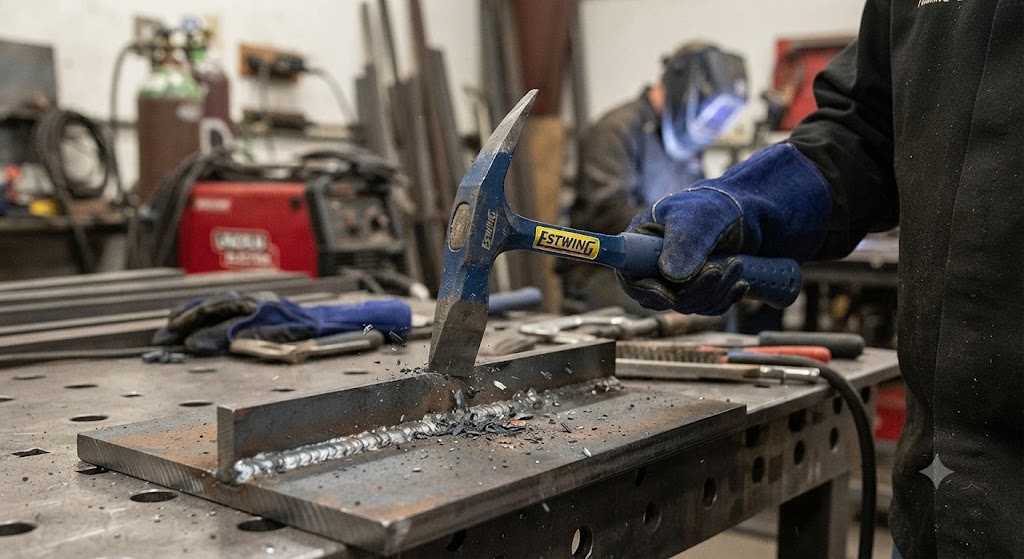
Pick up an Estwing hammer and you feel the difference before you swing it. There is no seam where the head meets the handle, no wedge holding things together, just one continuous piece of polished steel. That single detail, forged from one bar of steel, is why Estwing has a near-cult following among tradespeople, and why its welding chipping hammer gets recommended when someone asks for a slag tool that will outlast everything else in the drawer.
The Estwing welding chipping hammer (E3-WC) is a premium slag removal tool forged in one piece from American steel, with a chisel and pointed end and a molded shock-reduction grip that cuts impact vibration. Here is what makes it different, how it performs, and whether it is worth the step up.
What sets Estwing apart
Most hammers join a separate head to a separate handle, which creates a weak point that can loosen or fail over years of hard use. Estwing’s signature is one-piece forged construction: the head and handle are forged from a single piece of American steel, so there is no joint to loosen, ever. On a chipping hammer, which takes thousands of sharp impacts, that matters. Estwing has built tools this way in Rockford, Illinois for a century, and the reputation is earned. When welders say a hammer is the last one they will buy, this construction is why.
Direct answer: is it worth it?
Yes, the Estwing E3-WC is worth it if you chip slag regularly and want a tool that lasts. What you get:
- One-piece forged American steel, so the head cannot loosen or fly off.
- A shock-reduction grip that cuts impact vibration substantially, easing hand fatigue.
- A chisel end and a pointed end for broad flaking and tight corners.
- A tool that holds up to years of daily abuse.
The trade-off is that it is a step up from a basic spring-handle hammer. For occasional slag removal, a basic hammer is enough. For daily use, professional work, or anyone who values buy-it-once durability, the Estwing earns its keep.
The one-piece forged construction
The headline feature deserves a closer look. Because the E3-WC is forged from a single bar of steel and fully polished, there is no welded-on head, no wooden handle to crack, and no wedge to work loose. This is the same construction that made Estwing’s rock picks and framing hammers legendary. For a chipping hammer, the payoff is a tool that survives repeated hard chipping without the head loosening, which is the most common failure point on lesser hammers. It is the difference between a hammer you replace every couple of years and one you hand down.
The shock-reduction grip
One-piece steel construction has one downside: steel transmits vibration, and repeated chipping can sting the hand. Estwing solves this with its bonded and molded shock-reduction grip, a dimpled vinyl grip that absorbs a large share of the impact vibration. Estwing states it reduces impact vibration by around 70 percent, and in practice the hammer is noticeably more comfortable to chip with than a bare steel handle would be. For a tool used in long repetitive sessions, that comfort protects your hand and lets you work longer.
The replaceable-tip version
Estwing also makes a version worth knowing about: the E3-WCT, a welding chipping hammer with replaceable tips. Instead of retiring the whole hammer when the tips wear, you swap in fresh tips made of high-strength 4140 steel (it comes with spares, and more are available). It keeps the same one-piece forged handle and shock-reduction grip. For a heavy user who wears down tips, the replaceable-tip design extends the tool’s life even further, though the standard E3-WC is plenty for most welders. Choose the E3-WCT if you chip enough to actually wear tips down.
Who should buy it (and who should not)
Match the tool to your use:
- Buy the Estwing if you chip slag regularly, weld professionally, or simply want a buy-it-once tool that will not loosen and eases hand fatigue.
- A basic hammer is enough if you weld only occasionally and do not need the extra durability for how little you chip.
The Estwing is not the choice for someone who chips slag twice a year. It is the choice for someone who wants the best and will use it.
Which to buy
Here are the standard and replaceable-tip versions.
- Estwing E3-WC welding chipping hammer (one-piece forged) is the classic premium slag hammer, forged from a single piece of American steel with a chisel and point and a shock-reduction grip for durability and comfort. Its limitation is that it is a step up from a basic spring-handle hammer.
- Estwing E3-WCT welding chipping hammer with replaceable tips keeps the one-piece forged handle and shock-reduction grip but adds swappable 4140 steel tips, so you refresh the tips instead of retiring the tool. The trade-off is that it is aimed at heavy users, so lighter users may not wear tips enough to need it.
How to choose: for most welders who want a durable, comfortable slag hammer, the standard E3-WC is the pick. For heavy users who actually wear tips down, the E3-WCT extends the tool’s life with replaceable tips.
Who should skip the Estwing: purely occasional welders, who will get by fine with a basic spring-handle hammer and do not need the buy-it-once durability.
The bottom line
The Estwing E3-WC welding chipping hammer is built to last, forged from one piece of American steel so the head can never loosen, with a shock-reduction grip that cuts impact vibration for comfortable chipping. It is a premium tool, so occasional welders can get by with a basic hammer, but for regular slag removal and professional use it is a genuine buy-it-once choice. And if you chip enough to wear tips down, the replaceable-tip E3-WCT extends its life further. This is the hammer you buy when you are done replacing hammers.
FAQ
Is Estwing a good chipping hammer brand? Yes. Estwing is known for one-piece forged American steel construction and shock-reduction grips, and its welding chipping hammer (E3-WC) is a durable, comfortable premium slag tool trusted by professionals for years of daily use.
What makes Estwing’s construction different? Estwing forges the head and handle from a single piece of steel, so there is no welded-on head, wooden handle, or wedge to loosen or fail. This one-piece construction is why the tools are so durable and why the head cannot work loose.
Is the one-piece design more durable? Yes. Because there is no joint between head and handle, there is no weak point to loosen under repeated chipping, which is the most common failure on lesser hammers. That is what makes the Estwing a buy-it-once tool for regular use.
Does the Estwing chipping hammer reduce vibration? Yes. Its bonded, molded shock-reduction grip absorbs a large share of impact vibration (Estwing states around 70 percent), which reduces hand fatigue during long, repetitive slag removal compared with a bare steel handle.
What is the difference between the E3-WC and E3-WCT? The E3-WC is the standard one-piece forged hammer. The E3-WCT adds replaceable tips made of 4140 steel, so heavy users can swap worn tips instead of retiring the whole hammer. Both share the forged handle and shock-reduction grip.
Is the Estwing worth choosing over a basic hammer? For regular or professional slag removal, yes, thanks to its durability and comfort. For occasional welding, a basic spring-handle hammer is enough, since you will not fully use the buy-it-once longevity the Estwing offers.
References
- Estwing welding chipping hammer (E3-WC) and replaceable-tip (E3-WCT) product documentation, including one-piece forged construction and shock-reduction grip claims (manufacturer), estwing.com.
- Estwing company history and manufacturing in Rockford, Illinois (manufacturer), estwing.com.
- Lincoln Electric and Miller Electric guidance on slag removal in stick and flux-cored welding (manufacturers), lincolnelectric.com, millerwelds.com.