Fire Extinguisher Guide for Welding Shops
Welding is, at its core, controlled fire, and controlled has a way of becoming uncontrolled fast. Sparks fly farther than you think, slag lands in places you forgot were flammable, and a smoldering rag or a puddle of degreaser can turn a normal day into an emergency in seconds. Every welding space, from a two-car garage to a production shop, needs a fire extinguisher within arm’s reach and the right kind for the fires you might actually start. This guide covers which extinguisher to get, where to mount it, and one shipping quirk worth knowing.
Welding shops need an ABC dry chemical fire extinguisher for the ordinary, flammable-liquid, and electrical fires common around welding. A Class D extinguisher is only needed if you cut or grind reactive metals. Here is how to choose and place them.
Why welding shops need the right extinguisher
Fire risk around welding is real and specific:
- Sparks and slag travel, landing on wood, cardboard, rags, and dust well away from the arc.
- Flammable liquids like solvents, fuels, and degreasers are common in shops and ignite easily.
- Live electrical equipment means an energized fire is possible.
- Response time is everything, since a small fire caught in seconds is very different from one caught in minutes.
The right extinguisher, mounted where you can grab it fast, is the difference between a scare and a disaster.
Direct answer: which extinguisher
For almost every welding shop, the answer is straightforward:
- An ABC dry chemical extinguisher covers Class A (ordinary combustibles like wood and paper), Class B (flammable liquids), and Class C (live electrical) fires, the three you are most likely to face.
- Size it adequately, with a 5 pound unit a common minimum for a home shop and larger or multiple units for bigger spaces.
- A Class D extinguisher is only needed if you work reactive metals like magnesium, titanium, or lithium.
- Choose a reputable UL-listed brand such as Amerex, Kidde, or First Alert.
One good ABC extinguisher (or several for a larger shop) handles the vast majority of welding fire risk.
Why ABC is the standard
The ABC dry chemical extinguisher is the workhorse because it handles the three fire classes a welding shop actually encounters. Class A covers the ordinary stuff that sparks ignite, wood, paper, cardboard, rags. Class B covers the flammable liquids that live in most shops, solvents, fuels, and cleaners. Class C means the extinguisher is safe to use on fires involving energized electrical equipment, which matters when your machine, grinder, or wiring is part of the problem. One ABC unit therefore covers you across the realistic scenarios without needing separate extinguishers for each. The dry chemical smothers the fire and interrupts the chemical reaction, and while it leaves a residue to clean up, that is a small trade for broad protection. For a general welding space, ABC is simply the right default.
When you need Class D
Here is a point of real confusion worth clearing up: most welders do not need a Class D extinguisher, and putting the wrong agent on a metal fire can make things worse. Class D extinguishers are for combustible-metal fires, magnesium, titanium, zirconium, sodium, lithium, and similar reactive metals, which burn intensely and react violently with water and many standard agents. If you routinely cut, grind, or weld those metals, or work with their powders and fine chips, then yes, keep a dedicated Class D unit on hand. But if your work is ordinary steel, stainless, and aluminum in solid form, an ABC extinguisher is what you need, and a Class D would sit unused. Know your materials: the presence of reactive metals, not welding in general, is what calls for Class D.
Placement and a shipping quirk
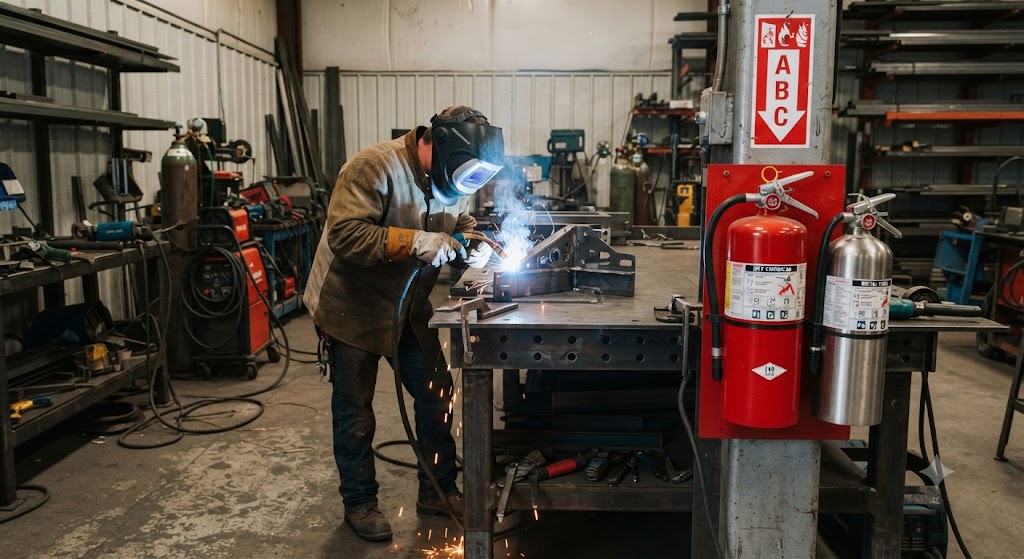
Owning an extinguisher only helps if you can reach it, so placement matters. Mount it in plain sight, near an exit or the path you would take leaving the area, not right at the weld station where a fire might block your access to it. It should be reachable in a few steps from where you work, high enough to stay clear of clutter but easy to lift off its bracket. In a larger shop, place several so one is always close. One practical quirk to know: extinguishers have been known to discharge inside the box during shipping, so many safety-minded buyers prefer to pick one up locally or, if ordering, inspect it immediately on arrival to confirm it is fully charged and undamaged. Whatever you buy, check the pressure gauge regularly and know how to use it before you ever need to.
Which extinguishers to buy
Here are three reputable ABC options.
- Amerex B402 5 lb ABC dry chemical extinguisher is a professional-grade rechargeable unit with all-metal valve construction and a wall bracket, a strong choice for a shop that wants a serviceable, durable extinguisher. Its limitation is that it is heavier-duty than a bare-minimum home unit.
- Kidde full home ABC fire extinguisher is a UL-listed rechargeable ABC extinguisher from a widely trusted brand, a practical pick for a home garage or small shop. The trade-off is a smaller capacity than a full 5 pound commercial unit.
- Amerex B500 5 lb ABC dry chemical extinguisher is another rechargeable 5 pound ABC unit with a durable stored-pressure design and metal valve, a dependable all-around shop extinguisher. Its limitation, like any shipped extinguisher, is to inspect it on arrival for shipping discharge.
How to choose: for a serviceable professional unit, the Amerex B402. For a trusted home-shop extinguisher, the Kidde. For a durable all-around 5 pound unit, the Amerex B500. If you work reactive metals, add a dedicated Class D extinguisher from a fire-safety supplier.
Who should skip a Class D unit: the vast majority of welders working ordinary steel, stainless, and aluminum, who only need ABC coverage.
The bottom line
Welding is controlled fire, and every welding space needs the means to stop the uncontrolled kind fast. An ABC dry chemical extinguisher covers the ordinary, flammable-liquid, and electrical fires you are actually likely to face, making it the right default for nearly every shop; a Class D unit is only for those who work reactive metals like magnesium or titanium. Mount your extinguisher in plain sight near an exit, reachable in a few steps, and inspect any shipped unit on arrival since they can discharge in transit. The Amerex and Kidde units above are reputable, UL-listed choices. Keep it charged, know how to use it, and hope you never have to.
FAQ
What kind of fire extinguisher does a welding shop need? An ABC dry chemical extinguisher, which covers Class A (ordinary combustibles), Class B (flammable liquids), and Class C (live electrical) fires, the three most likely around welding. A 5 pound unit is a common minimum for a home shop, with larger or multiple units for bigger spaces. Choose a UL-listed brand.
Do I need a Class D fire extinguisher for welding? Only if you cut, grind, or weld reactive metals like magnesium, titanium, zirconium, lithium, or sodium, or work with their powders and chips. Those metals burn intensely and react badly with standard agents. For ordinary steel, stainless, and aluminum, an ABC extinguisher is what you need.
Where should I mount a fire extinguisher in a shop? In plain sight, near an exit or your path out of the area, reachable in a few steps and not right at the weld station where a fire could block access to it. Keep it high enough to stay clear of clutter but easy to lift off its bracket. In a larger shop, place several.
What size fire extinguisher is best for a garage welding shop? A 5 pound ABC unit is a common minimum for a home or garage shop, giving enough agent to handle a small fire. Larger shops or higher-risk areas benefit from bigger or multiple units. Match the number and size to the space so one is always within a few steps.
Which fire extinguisher brands are reliable? Amerex, Kidde, and First Alert are widely trusted, UL-listed brands with strong availability. Look for a UL listing, an ABC rating for welding shops, and a pressure gauge you can check. Rechargeable metal-valve units are more serviceable than disposable ones.
Why do fire extinguishers sometimes arrive discharged? Extinguishers can discharge inside the box during shipping if jostled, which is a known issue. Many buyers prefer to pick one up locally, or if ordering, inspect it immediately on arrival to confirm it is fully charged and undamaged, checking the pressure gauge before mounting it.
References
- Amerex fire extinguisher specifications and Class D fire guidance, including ABC dry chemical ratings and combustible-metal hazards (manufacturer), amerex-fire.com.
- NFPA guidance on portable fire extinguisher selection, placement, and travel distance (industry standards), nfpa.org.
- OSHA guidance on portable fire extinguishers in the workplace (regulator), osha.gov.