Flux Core Welding Machine: Setup Choices for Indoor and Outdoor Work
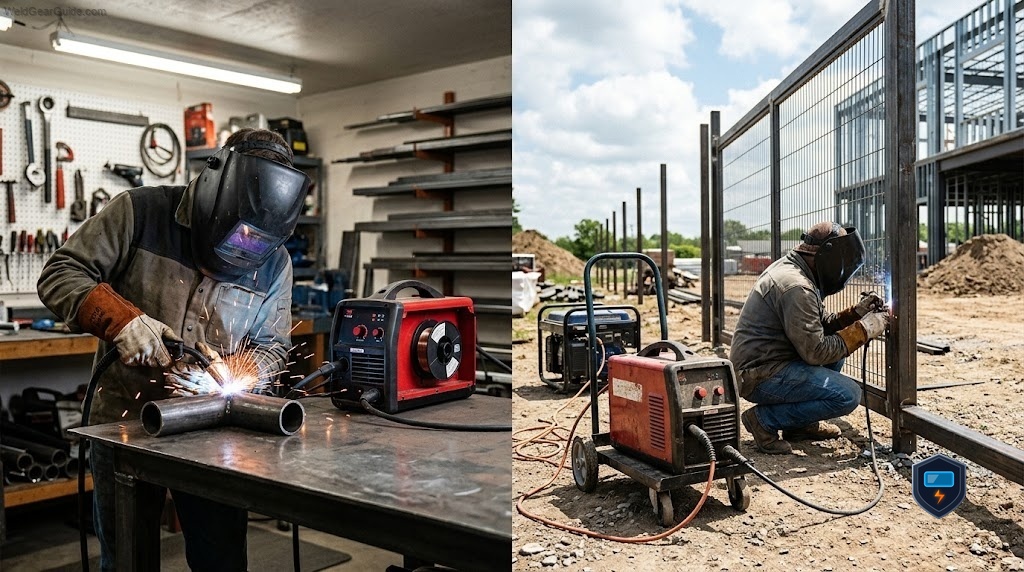
A machine that welds beautifully on a bench in a garage can be almost useless on a fence line in February. Cold hands, an extension cord running to a house outlet, a joint you have to reach across, and wind that would scatter shielding gas. The gap between shop conditions and field conditions is where flux core machines earn their keep, and where the wrong purchase becomes obvious.
What a flux core welding machine is
A flux core welding machine is a wire feed power source configured to run tubular flux cored wire, most often self-shielded wire that needs no gas cylinder. Mechanically it is the same equipment used for MIG welding: a power source, a wire drive, a gun and a work lead. The difference is polarity and the wire itself.
The direct answer for buying: choose a 120 volt machine only if your work stays under about 3/16 inch, and choose a dual-voltage machine if there is any chance you will weld 1/4 inch or thicker. Duty cycle at your working amperage matters more than the headline amperage number, and synergic control is genuinely useful for beginners rather than marketing.
The 120 volt ceiling, stated plainly
Every buyer meets this eventually. A standard household circuit limits how much power a machine can draw, and that caps output regardless of what the box promises. In practice, a 120 volt flux core machine handles:
- 18 gauge to 1/8 inch comfortably in a single pass
- 3/16 inch with a bevelled joint and multiple passes
- 1/4 inch only with careful joint preparation, several passes and patience, with penetration you should verify rather than assume
Dual-voltage machines roughly double usable output on 240 volt power, which moves 1/4 inch into routine territory. If you already have or can add a 240 volt outlet, buy for it.
Duty cycle, and why the headline number misleads
Duty cycle is stated as a percentage at a given output over a ten minute period. A machine rated 30 percent at 140 amps welds for three minutes then rests seven. On short repair beads you will never approach that limit. Running a long fillet along a trailer frame, you will meet it repeatedly.
What to look for: the duty cycle at the amperage you will actually use, not at maximum. Manufacturers who publish a full duty cycle curve are giving you more useful information than those who publish one flattering number.
Synergic control, plainly explained
On a conventional machine you set voltage and wire feed speed independently, and getting them balanced is the main skill of setup. Synergic control links them: you tell the machine the wire diameter and material thickness, and it sets a matched pair for you, usually with a trim adjustment for fine tuning.
For a beginner this removes an entire class of mistake. For an experienced welder it is a fast starting point rather than a replacement for judgment. It is not magic, and a synergic machine set to the wrong wire diameter will confidently produce bad settings.
Machines worth considering
Lincoln Electric Handy Core
The Lincoln Electric Handy Core is the simplest useful machine in this category. It plugs into a household outlet, runs gasless wire only, and welds mild steel to about 1/8 inch.
Its flaws are structural rather than incidental: tapped voltage settings give you a handful of fixed positions rather than fine control, the duty cycle is short, and the thickness ceiling is low. It is a genuinely reliable light repair machine and a poor choice for anyone with fabrication ambitions.
YESWELDER FLUX-135
The YESWELDER FLUX-135 adds synergic control plus stick and lift TIG modes on 120 volt power. Three processes on a household outlet is a lot of capability for a small shop.
The honest downsides: the supplied gun and consumables are basic and get replaced, the manual is thin, and support behind the brand is limited compared with the legacy manufacturers. If you want a machine your local welding supplier can service, this is not the one.
YESWELDER 165A dual voltage
The YESWELDER 165A dual voltage multiprocess welder is the better buy for most people, simply because 240 volt capability changes what you can weld. It handles flux core, gas MIG, stick and lift TIG.
Same caveats apply on accessories and support. It also asks more of the user: more modes means more ways to be in the wrong one, and beginners occasionally spend an hour welding badly because the machine is set for the wrong process.
Millermatic 142
The Millermatic 142 represents what a well-built 120 volt machine feels like. Automatic parameter setting, a drive system that feeds consistently, and a gun that does not fight you.
Its limits are scope and cost. It welds up to about 3/16 inch, and it costs several times what a budget machine does. Anyone who needs 1/4 inch capability or works mainly outdoors on heavy steel is buying refinement in the wrong direction and should look at a larger dual-voltage machine.
How they compare
| Handy Core | FLUX-135 | YESWELDER 165A | Millermatic 142 | |
|---|---|---|---|---|
| Voltage | 120 V | 120 V | 120 and 240 V | 120 V |
| Processes | Flux core | Flux core, stick, TIG | Flux core, MIG, stick, TIG | MIG, flux core |
| Setup style | Tapped | Synergic | Synergic | Automatic |
| Practical ceiling | 1/8 in | 3/16 in | 1/4 in on 240 V | 3/16 in |
| Main weakness | Very limited range | Basic accessories | Complexity, support | Cost and thickness ceiling |
Indoor setup versus outdoor setup
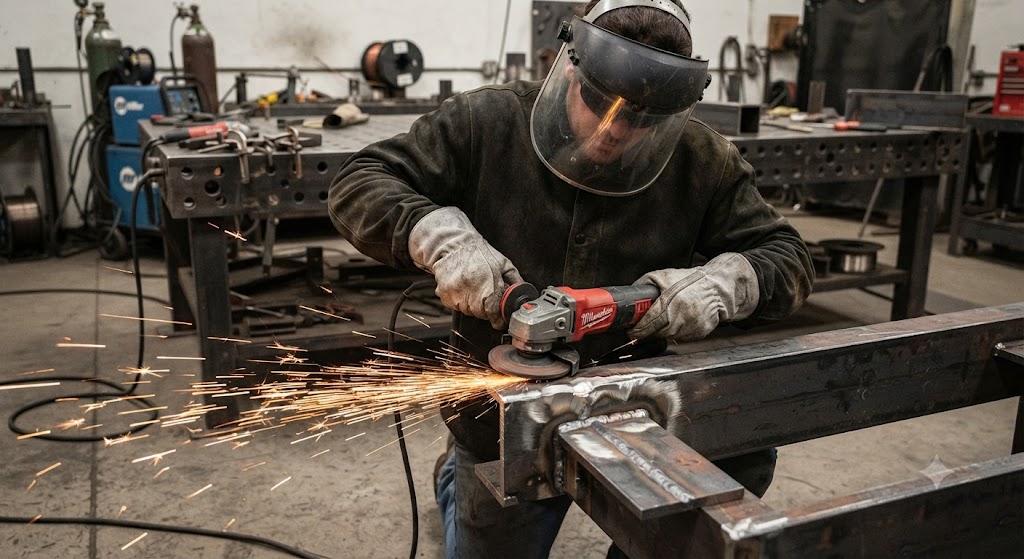
Outdoors, flux core is at its best. No gas to blow away, tolerance for damp and rusty steel, and simplicity. What you need to plan for is power: a heavy gauge extension cord as short as possible, because voltage drop on a thin cord will make any machine feel weak. Bring a grinder, because outdoor steel is never clean.
Indoors, the equation flips. Self-shielded flux core produces heavy fume, and a closed garage fills fast. Position extraction near the arc, not across the room. If most of your work will be indoors on clean, thin material, a machine that also runs gas MIG will serve you better, and that is a strong argument for a multiprocess unit.
Consumables to buy with the machine
Whatever machine you choose, budget for spares from day one: contact tips in your wire size, a spare liner, knurled drive rolls if not included, and anti-spatter spray. Machines rarely fail; consumables wear constantly, and a worn tip produces symptoms people mistake for machine faults.
On wire, Lincoln NR-211-MP in 0.030 inch suits smaller machines and gives the tidiest self-shielded bead, with a plate thickness recommendation around 5/16 inch that limits heavy work. Hobart E71T-11 in 0.035 inch is the better match for 240 volt machines on heavier stock, and too hot for sheet.
Who should skip flux core machines entirely
Autobody workers, anyone welding thin decorative work, and anyone in a small enclosed indoor space without extraction. All three are better served by a gas MIG setup, and in the first two cases the difference in results is dramatic rather than marginal.
Final verdict
Buy for the thickest metal you seriously plan to weld and the outlet you will actually use. A dual-voltage machine with synergic control covers almost every home shop and farm need, and the extra cost over a 120 volt-only machine is smaller than the cost of replacing an undersized welder in a year.
One closing thought that saves people money: the machine is rarely the limiting factor in weld quality below 1/4 inch. Wire condition, polarity, stickout and cleaning matter more. Spend enough to get 240 volt capability and a solid drive system, then put the rest of the budget into good wire, a decent helmet, and fume extraction.
Frequently asked questions
What size flux core welding machine do I need? For material up to 3/16 inch, a 120 volt machine is adequate. For 1/4 inch and above, buy a dual-voltage machine and run it on 240 volts.
What does synergic control do? It sets voltage and wire feed speed together based on wire diameter and material thickness, removing the trial and error of balancing them manually.
Can a flux core machine also run MIG? Many can, if they have a gas solenoid and allow a polarity change. Flux core runs electrode negative and solid MIG wire runs electrode positive.
How important is duty cycle? Very, if you weld long beads. Check the rating at the amperage you will use rather than at the machine’s maximum output.
Can I use a flux core machine indoors? Yes, with effective ventilation or local fume extraction. Self-shielded flux core produces substantial smoke and should not be run in an enclosed space without air movement.
Do I need a special extension cord? Use the heaviest gauge and shortest length practical. Voltage drop across a long thin cord noticeably reduces welding performance.
Is a more expensive machine worth it? For drive system quality, gun comfort, consistent feeding and long-term support, yes. For raw amperage per dollar, budget brands offer more on paper.
What consumables should I keep on hand? Contact tips in your wire size, a spare liner, correct drive rolls, and anti-spatter spray. These wear out and cause most of the problems blamed on machines.