Flux Core Welding Tips That Fix the Problems People Actually Have
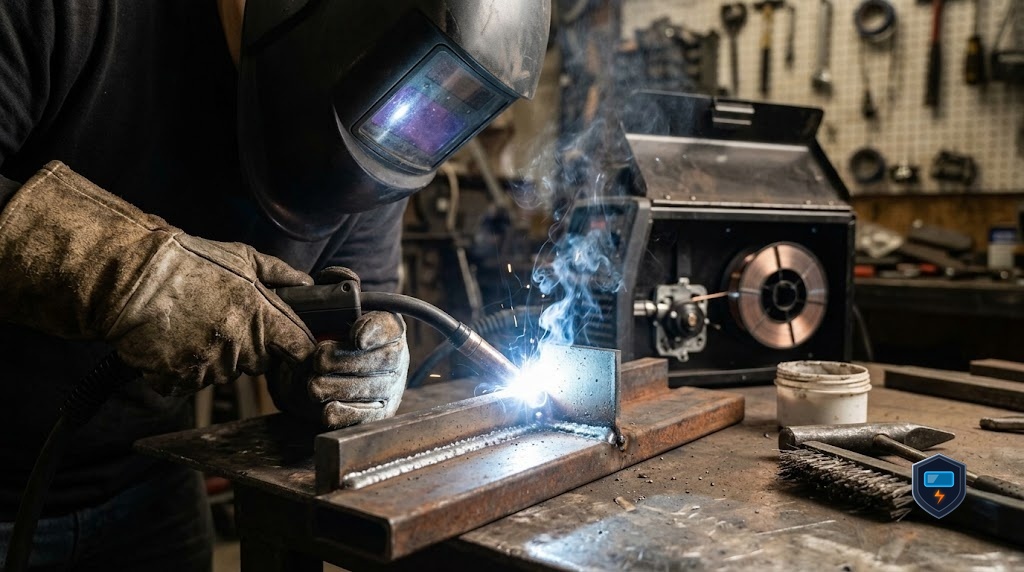
The welder who taught me flux core had one instruction he repeated more than any other, usually while watching me do the opposite: “Back the gun off.” I kept creeping the tip toward the plate because it felt like control. Every time I did, the arc went erratic and the bead filled with tiny holes.
Stickout. It is the least dramatic thing on this list and it fixes more bad welds than anything else.
The short version
If you only take five things from this page: hold about 1/2 inch of stickout, drag the gun rather than pushing it, confirm you are on DC electrode negative for self-shielded wire, balance wire speed against voltage until the arc crackles steadily, and chip and brush every pass without exception. Those five habits account for the majority of the difference between welders who like this process and welders who fight it.
Tip 1: Stickout is longer than you think
MIG habits do not transfer. Self-shielded flux core wants 1/2 inch to 3/4 inch from the contact tip to the work, because the wire needs that distance to preheat through electrical resistance and for the flux to do its job.
Too short and the wire burns back and fuses to the tip. Too long and shielding breaks down and porosity appears. Practise holding it consistently on scrap, because your hand naturally drifts closer as you concentrate on the puddle.
Tip 2: Drag, never push
Angle the gun 15 to 20 degrees away from the direction of travel, so the slag trails behind the puddle.
When you push, the slag runs ahead into the joint and gets buried under the advancing weld metal. That is a slag inclusion, and it cannot be repaired without grinding the section out. This is the single most consequential technique difference between MIG and flux core, and it is the one people carry over wrongly.
Tip 3: Set the machine by ear
The chart inside the door is a starting point. Your ear is the instrument.
| What you hear | What it means | What to change |
|---|---|---|
| Steady, even crackle | Correct balance | Nothing |
| Loud irregular popping | Wire speed too low | Increase wire speed |
| Soft sputtering, wire stubbing | Wire speed too high | Reduce wire speed |
| Hissing with a tall narrow bead | Voltage too low | Increase voltage |
| Wide flat bead with undercut | Voltage too high | Reduce voltage |
Change one variable at a time and run a test bead after each change. Changing both at once means you learn nothing.
Tip 4: Keep the wire dry
Flux core wire absorbs moisture, and damp wire produces porosity that no technique corrects. A spool left on an open machine in a humid garage for a year is a common and invisible cause of bad welds.
Practical habits:
- Buy spool sizes you will actually consume. A 1 pound spool of NR-211-MP suits someone welding occasionally, even though the per-pound cost is higher than a large spool.
- Store opened spools in a sealed container with desiccant, not on the machine.
- Discard wire that shows surface rust or discolouration.
Small twin packs such as the Hobart 2 pound twin spool set exist for exactly this reason. You pay more per pound and throw away less.
Tip 5: Fix the feeder before blaming your hand
Erratic arcs usually start at the drive rolls, not the gun.
- Use knurled drive rolls sized for your wire. Smooth rolls crush tubular wire.
- Set tension just past the point where the wire stops slipping.
- Blow flux dust out of the liner periodically with dry compressed air.
- Replace contact tips when the bore goes oval. They are consumables.
- Cut the ball off the wire end after every stop before restarting.
Tip 6: Prepare the joint more than you want to
Flux core tolerates rust and scale better than MIG, and people take that too far. Heavy paint, galvanising, oil and thick mill scale still cause porosity and produce fume you should not breathe.
On thicker material, bevel the joint rather than expecting the arc to reach the root. A small machine on a square-edged 1/4 inch butt joint will produce a bead that looks fine and has fused to almost nothing underneath.
Tip 7: Manage heat on thin material
Burn-through is the most common frustration on sheet.
- Use the smallest wire diameter your machine accepts, usually 0.030 inch.
- Stitch rather than run continuously: short beads with pauses to let the metal cool.
- Back the joint with a copper or aluminium block to absorb heat where you can.
- Skip around the workpiece rather than welding one continuous line, which also controls warping.
If you are consistently blowing through, the honest answer may be that flux core is the wrong process for that thickness and gas MIG would serve better.
Tip 8: Chip every pass, without exception
This is where finished quality is decided. Chipping hammer, then a wire wheel on an angle grinder. Every pass, including tacks before you weld over them.
The temptation to skip cleaning grows as a job gets long, and that is exactly when inclusions get built into a joint you have already invested hours in.
Tip 9: Match wire to the job
Lincoln NR-211-MP is the tidiest general-purpose self-shielded wire and forgiving of poor fit-up, with a plate recommendation around 5/16 inch in the small diameters that limits heavy work.
Hobart E71T-11 in 0.035 inch suits 3/16 inch and heavier on 240 volt machines, and it is too aggressive for sheet.
Forney 42302 E71T-GS in 0.035 inch works for single-pass repairs and should not be used on multipass structural joints, because that classification is not intended for it.
Blue Demon E71T-11 in 0.030 inch is fine value on a small spool, with heavier spatter than the premium wires and more nozzle cleaning as a result.
Tip 10: Take the fume seriously
Self-shielded flux core produces more visible smoke than nearly any other common process. In a closed garage it builds within minutes.
Set up extraction near the arc rather than a fan across the room, which just moves the plume around. Keep your head out of the rising smoke, which sounds obvious and is easy to forget when you are concentrating on a joint. On galvanised or painted steel, treat proper extraction as mandatory.
Tip 11: Cut a bead in half
The best diagnostic in flux core welding costs nothing. Run a test bead on scrap, cut it in half with a cut-off wheel, and look at the cross section.
You will see immediately whether the weld penetrated, whether it fused at the root, and whether slag got trapped. Ten seconds of looking at that cross section teaches more than an hour of studying the top of the bead, which can look perfect over a joint that barely fused.
Tip 12: Protect your hands properly
Flux core throws spatter and radiates heat, and thin gloves get uncomfortable during long beads. The Tillman 1350 leather welding glove is a longstanding shop choice with good flexibility for gun control. It is unlined, so heat comes through faster during extended arc time, and people welding heavy continuous work often prefer a lined glove instead.
Final verdict
Flux core welding is unusually responsive to habits rather than talent. Stickout, drag angle, verified polarity, balanced settings, dry wire, and religious slag removal. Six things, all learnable in an afternoon, all of them worth more than a machine upgrade.
The habit worth building first is the test bead. Two minutes on scrap of the same thickness in the same position, before touching the actual work, prevents more ruined projects than any other single practice in this process.
Frequently asked questions
What is the most common flux core welding mistake? Pushing the gun instead of dragging it, which traps slag in the weld. Close behind is holding too little stickout.
How do I stop porosity in flux core welds? Check polarity is DC electrode negative, hold 1/2 inch of stickout, use dry wire, and clean paint, oil and heavy scale off the joint.
Why does my wire keep burning back to the tip? Stickout too short or wire feed speed too low for the voltage. Pull back slightly and increase wire speed.
Can I weld thin sheet with flux core? With 0.030 inch wire, low settings and stitched beads, yes, but burn-through is common below 16 gauge. Gas MIG is easier on thin material.
How do I know my settings are right? Listen for a steady, even crackle. Then cut a test bead in half and look at the penetration in cross section.
Do I need to clean slag between passes? Always. Trapped slag becomes a permanent inclusion that must be ground out to repair.
How should I store flux core wire? In a sealed container with desiccant, not left on the machine. Buy spool sizes you will use within a reasonable period.
Is spatter normal with flux core? Some is unavoidable. Excessive spatter usually means wrong polarity, mismatched settings, or a dirty nozzle and worn contact tip.