Forney Easy Weld 140 FC-i MIG Welder Review
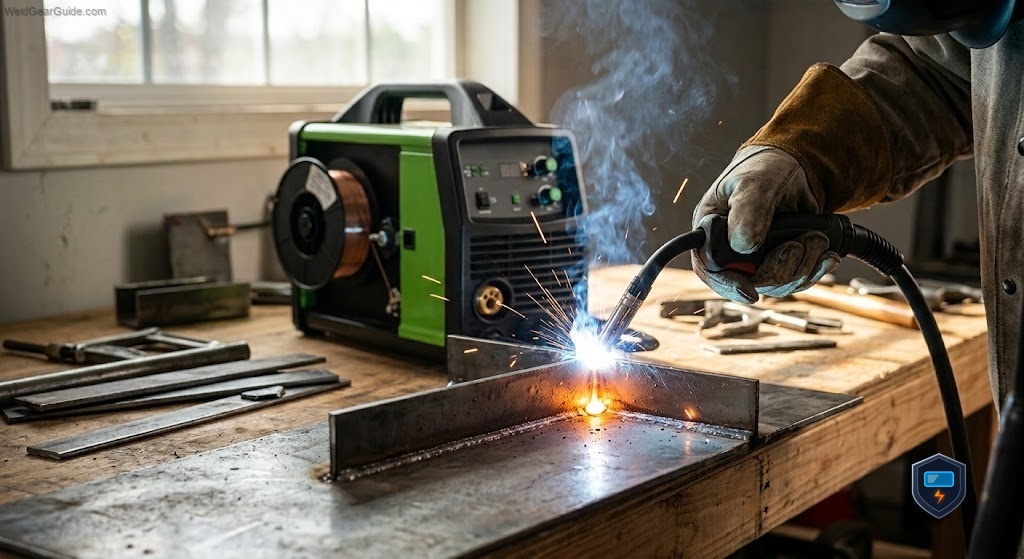
Every welding forum has a thread where a beginner asks what to buy first, and within three replies someone recommends the Forney Easy Weld 140 FC-i. That consistency is not an accident. It is a machine designed around a single, honest idea: strip away everything that confuses a first-time welder and let them put down a bead.
Whether that idea suits you depends on whether simplicity is what you need or a limit you will hit fast. Both are legitimate positions.
What the Forney Easy Weld 140 FC-i is
The Forney Easy Weld 140 FC-i is a compact, self-shielded flux-cored inverter welder that runs on a standard 120-volt outlet. It has a maximum output of 140 amps, a 30 percent duty cycle at 90 amps, infinite voltage and wire-feed-speed control, and it is rated to weld mild steel up to a quarter inch. It weighs about 19 pounds and, per Forney’s spec sheet, needs a 120V, 20-amp circuit.
One thing to be clear about up front: it is flux-cored only. There is no gas solenoid and no MIG-with-gas capability. It runs self-shielded flux-cored wire, and that is the whole design.
Why it gets recommended so often
It is genuinely simple. Two knobs, infinite adjustment, no gas bottle, no regulator, no gas setup to learn. You plug it in, load .030 flux-cored wire, and weld. For a first machine, removing the gas system removes a whole category of things that go wrong.
Infinite control instead of taps. Unlike cheaper machines with fixed voltage settings, the 140 FC-i lets you dial voltage and wire speed continuously, which means you can actually tune the arc to the metal rather than picking the least-wrong preset. On a beginner machine that is a meaningful step up.
Flux-cored works outdoors. Because it is self-shielded, there is no shielding gas to blow away, so it welds outside and on slightly dirty or rusty metal better than gas MIG does. For farm, ranch and outdoor repair, that is exactly right.
The 140-amp headroom. Compared to a 125-amp machine, the extra amperage and quarter-inch rating give a little more room on the thicker end, which matters when you are learning where the limits are.
It is light and portable. At 19 pounds it goes to the job.
Where it hits its ceiling
Flux-cored only means no clean sheet-metal MIG. Self-shielded flux-cored wire runs hotter and dirtier than gas MIG, with more spatter and slag to chip. On thin sheet it is harder to control, and it will never give the clean, low-spatter bead that gas MIG produces. Anyone whose main work is thin sheet or cosmetic welds will outgrow this quickly.
30 percent duty cycle at 90 amps. About three minutes of welding in ten at that output. Fine for learning and short jobs, limiting for anything sustained.
A quarter inch is the real limit. It welds to a quarter inch, and like any small flux machine, thick material means beveling and multiple passes, with the same penetration cautions as any 120V unit. Do not expect structural thick welding from it.
No gas upgrade path. Because there is no gas capability at all, you cannot later add a bottle and run clean MIG. When you outgrow flux-cored, you replace the machine rather than upgrade it. That is worth knowing before you buy, because a gas-capable machine leaves that door open.
Who should buy it, and who should skip it
Buy the Forney Easy Weld 140 FC-i if you are a beginner who wants the simplest possible entry, you weld outdoors or on dirty metal, you work mostly with steel up to a quarter inch, and you are fine running flux-cored wire with its spatter and slag. For that buyer it is close to ideal and the price makes it easy to recommend.
Skip it if you know you will want clean sheet-metal welds, if you want the option to add gas later, or if you already suspect you will be welding thicker steel regularly. In those cases a gas-capable machine is the smarter first purchase even at a higher price. The Lincoln Weld-PAK 90i FC is a comparable flux-cored starter with Lincoln’s support, while a step up to a gas-capable dual-voltage machine like the POWER MIG 215 MPi buys clean MIG, more amperage and stick and TIG besides, for buyers ready to spend more up front to avoid replacing the machine later.
Whatever you run, wear proper gloves. The Lincoln Traditional MIG and Stick gloves handle the heat and spatter of flux-cored work well.
The verdict
The Forney Easy Weld 140 FC-i deserves the recommendations it gets. It does exactly what it sets out to do: give a beginner the simplest possible path to a real weld, with infinite control, outdoor capability and enough amperage to learn on, in a light, affordable package.
Three things to be honest about. It is flux-cored only, so it produces more spatter and slag than gas MIG and will never give the cleanest thin-sheet welds. Its 30 percent duty cycle at 90 amps and quarter-inch limit define the work it suits, which is learning and light-to-medium steel, not sustained or structural welding. And there is no gas upgrade path, so when you outgrow flux-cored you buy a new machine, which is why some buyers are better served spending more up front on a gas-capable unit.
For the right beginner, it remains one of the easiest first welders to recommend, precisely because it does not try to be more than it is.
Frequently asked questions
Is the Forney Easy Weld 140 FC-i a MIG welder? It is a flux-cored welder. It uses the same wire-feed principle as MIG but runs self-shielded flux-cored wire with no shielding gas, and it has no gas capability at all.
Can the Forney 140 FC-i use gas? No. It has no gas solenoid and cannot run gas-shielded MIG. It is flux-cored only, which is part of why it is so simple to set up.
How thick can the Forney 140 FC-i weld? Up to a quarter inch of mild steel per its rating. Thicker material requires beveling and multiple passes and is only appropriate for non-structural work.
What power does it need? A standard 120-volt outlet on a 20-amp circuit, which makes it usable in most homes and garages without special wiring.
Is the Forney 140 FC-i good for beginners? Yes, it is one of the most recommended first welders because of its simplicity, infinite voltage and wire-speed control, and no gas setup to learn. It is well suited to learning on steel.
What wire does it use? Self-shielded flux-cored wire, commonly .030 inch for general work. No shielding gas is required, which is why it welds well outdoors.
What is the downside of flux-cored only? More spatter and slag than gas MIG, harder control on thin sheet, and no clean cosmetic welds. There is also no path to add gas later, so outgrowing flux-cored means replacing the machine.
How does it compare to the Lincoln Weld-PAK 90i FC? Both are 120V flux-cored starter machines. The Forney offers 140 amps and infinite control; the Lincoln brings its support network and documentation. Both are flux-cored focused entry machines rather than gas MIG units.
References
- Forney Industries, 140 FC-i Welder specification sheet
- Forney Industries, Easy Weld 140 FC-i product page
- Lincoln Electric, Weld-PAK 90i FC Flux-Cored Welder specifications
- Lincoln Electric, POWER MIG 215 MPi Multi-Process Welder specifications