Forney Easy Weld 140 Multi Process Welder Review
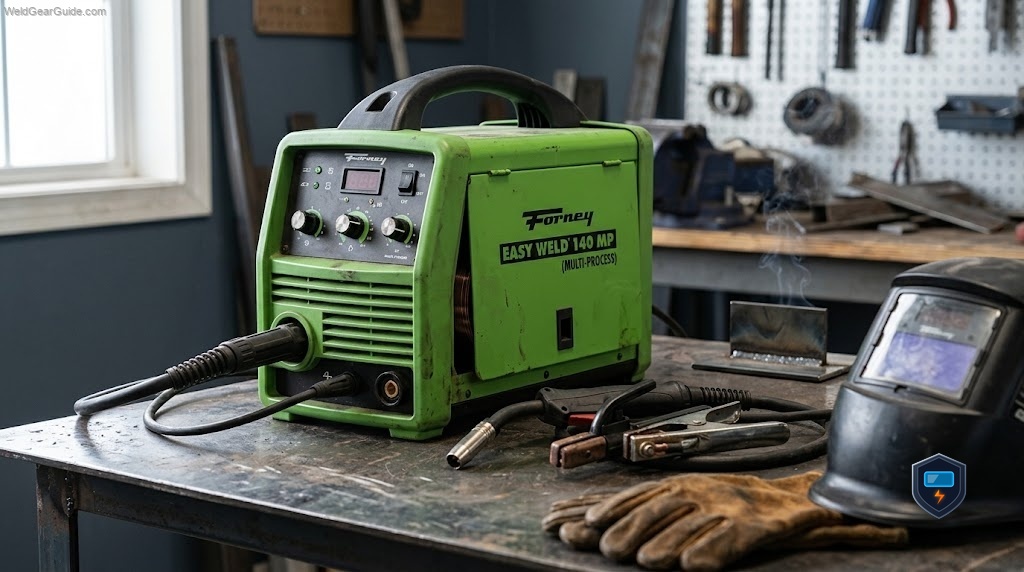
Every garage welding project starts at the same place: a standard wall outlet and no appetite for calling an electrician. That single constraint eliminates most of the machines people daydream about, and it is why the Forney Easy Weld 140 multi process welder keeps coming up. It runs on 120 volt power, weighs less than 25 pounds, and claims MIG, stick and DC TIG from one box.
The interesting question is not whether it does all three. It does. The question is what each of those three is actually good for once you look past the number on the front.
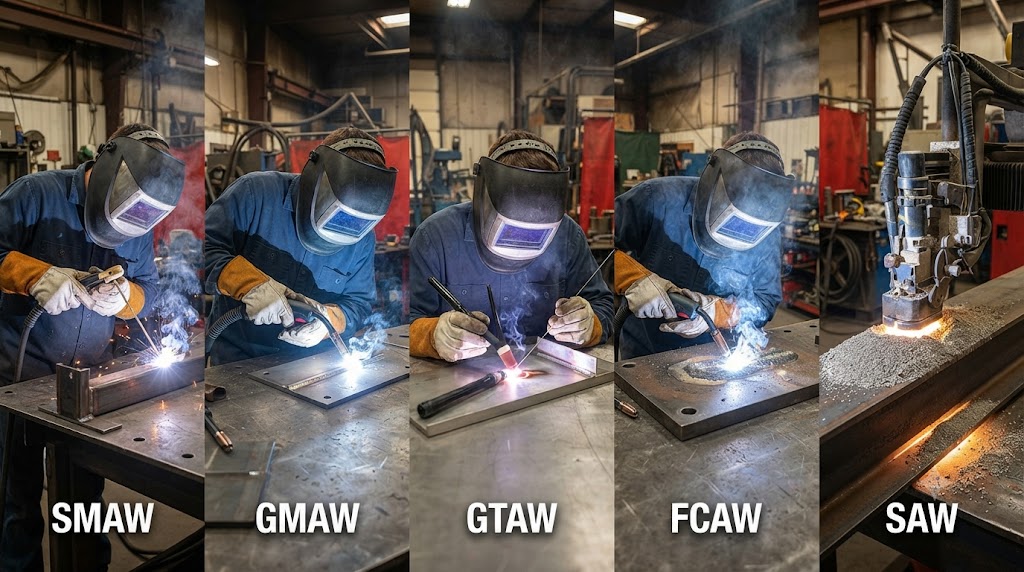
This is a 120 volt inverter machine, model 271 in Forney’s Easy Weld line, covering GMAW with solid or flux cored wire, SMAW stick, and lift start DC TIG. Forney gives it a full output current range of 10 to 140 amps, a plate capacity up to 1/4 inch, and stick capability up to a 1/8 inch electrode.
Straight answer before the details: this machine is a legitimate first welder for a home shop working on 1/8 inch and thinner steel, light fabrication, brackets, carts, trailer patches and automotive repair. It is not a machine for aluminum, for production runs, or for anyone who needs to weld anything close to its 1/4 inch ceiling repeatedly.
The Three Duty Cycle Numbers That Define the Machine
Forney publishes duty cycle by process, and that trio tells you more than any review paragraph can.
Stick is rated 30 percent at 80 amps. MIG is rated 30 percent at 90 amps. TIG is rated 30 percent at 110 amps. Output voltage runs 12 to 23 volts and the output current range at rated conditions is 43 to 110 amps, inside that broader 10 to 140 amp envelope.
Read those numbers together and the machine’s real personality shows up. The headline is 140 amps. The sustainable working range is roughly 80 to 110 amps depending on process, three minutes of arc for every ten. On 1/8 inch steel with a 3/32 inch rod, that is a comfortable place to live. On 1/4 inch, you are running the machine at the edge of its rating and stopping to let it cool, which is a slow and unsatisfying way to build anything.
The 30 percent figure is also honest by the standards of this class. Plenty of 120 volt machines quote duty cycle at an amperage nobody welds at. Forney quoting three separate figures, each at a realistic current, is the kind of spec sheet you can plan around.
What Each Process Is Actually Worth Here
MIG is the strongest of the three and it is what most owners use. Wire feed speed runs 79 to 197 inches per minute and the machine takes .030 and .035 inch solid or flux cored wire on spools up to 10 pounds, fed by an all metal drive. It comes with a 10 foot MIG gun. Run flux cored and you need no gas at all, which suits outdoor and breezy garage work.
The honest problem with MIG here is the top of the wire feed range. At 197 inches per minute, you run out of wire speed before you run out of ambition. Higher deposition on thicker material simply is not available, and that ceiling is a bigger practical limit than the amperage rating.
Stick is the process people underuse on this machine and it is genuinely capable within its band. Up to a 1/8 inch electrode, on rusty or painted repair steel where MIG wire would give you porosity, at 80 amps for three minutes out of ten. It ships with an 8 foot electrode holder and an 8 foot ground clamp. That is short. You will be moving the machine rather than moving yourself, which for a 25 pound unit is tolerable but noticeable.
DC TIG is the process to be most careful about. Forney gives it lift arc start, which is a real advantage over scratch start because you touch, lift and the arc establishes without dragging tungsten across your workpiece. But the TIG torch is not included, and there is no foot pedal capability. No pedal means no amperage control while you weld, so your heat management is torch angle, travel speed and rod feed only. On thin stainless or small steel repairs that is workable. On anything demanding, it is a real handicap.
Who should skip this machine’s TIG capability entirely: anyone buying it primarily to TIG. Buy a dedicated machine with pedal control instead, because the lift start here is a useful bonus, not a foundation.
The Aluminum Question, Answered Plainly
It cannot weld aluminum. There is no spool gun connection on this machine, and DC lift TIG will not do aluminum the way AC TIG does.
This is the single most common disappointment among buyers, because “multi process welder” reads like “any metal” and it does not mean that. Steel, stainless and similar ferrous work are the honest boundaries here. If aluminum is on your project list even occasionally, you need to move up the line, and it is far less painful to do that before you buy than after.
Where It Sits in Forney’s Own Lineup
The Easy Weld line and the larger Forney welder families answer three different problems, and the step between them is bigger than the model numbers suggest.
Below the 140 MP sits the Forney Easy Weld 140 FC-i, a flux cored only machine on the same 120 volt supply. Any forney easy weld 140 fc i review comes down to the same trade: you give up stick and TIG entirely and get a simpler, lighter machine that does gasless wire and nothing else. If wire is genuinely all you will use, that simplicity is a feature rather than a compromise, and there is one less thing to set wrong.
One real step up is the 190 MP, and it is a step, not a nudge. Dual 120 and 240 volt input, output rated 120 amps on 120 volt power and 200 amps on 240, MIG amperage ranges of 30 to 120 amps and 30 to 200 amps respectively, stick from 10 to 190 amps on 240 volt power, electrodes up to 5/32 inch, plate up to 3/8 inch. Most importantly for the aluminum problem, it carries a 7-pin connection for a spool gun. What matters in a forney 190 mp review is not the amperage jump, it is that spool gun port and the second input voltage.
Above that is the 220 MP: 120 and 240 volt input, 220 amps of output, welding capacity up to 1/2 inch, MIG, flux cored, stick and DC TIG, aluminum with a spool gun, a digital display, an all metal drive system and a three year warranty on the power source. A forney 220 mp review is a review of a light industrial machine that happens to share a brand with the 140. At 51 pounds it is still portable, but it is asking for a 240 volt circuit to show what it can do.
The pattern is clear once you line them up. Your 120 volt outlet is the thing capping your capability, not Forney’s engineering. Every meaningful gain in this lineup comes with 240 volt input attached to it.
For completeness, the cross brand comparison people usually make is against a Lincoln multi process welder such as the Weld-Pak 180i MP DV, which runs dual voltage, delivers up to 180 amps, and covers MIG, flux cored, stick, DC TIG and aluminum with a spool gun. That is a different tier of machine and a different power requirement, which is exactly the point: the 140 MP is not competing there and does not pretend to.
Living With It
A few practical notes that do not appear on the box.
The machine ships with a 20 amp to 15 amp adapter, which tells you something useful: it wants a 20 amp circuit and will work on a 15 amp one with reduced headroom. If your garage outlets share a circuit with the freezer, you will find out during a long weld.
At 24.81 pounds and roughly 14 by 19 by 12 inches, it genuinely travels. Reviewers who use these regularly point to the same practical strengths: a printed setup chart inside the machine, corner protection on the case, and infinite rather than stepped adjustment on both voltage and wire speed. Infinite adjustment matters more than people expect on a small machine, because dialing between two tapped settings is where thin material gets ruined.
The included consumables are a starting point, not a kit. Plan on a proper ground clamp upgrade if you are working on anything with paint or scale, since a poor ground makes any small machine look worse than it is.
Where This Machine Belongs
The Forney Easy Weld 140 MP earns its place on one specific bench: the home shop that has 120 volt power, works on light steel, and wants to try stick and TIG without buying three machines. In that role it is honest equipment. The processes are real, the duty cycle numbers are published per process rather than hidden, the drive system is metal, and the arc is stable inside its band.
It is the wrong machine for aluminum, for anyone who needs pedal controlled TIG, for repeat work at 1/4 inch, and for anyone who already has 240 volt power available and is choosing this to save space.
Three things to hold onto. First, judge any multi process welder by its per process duty cycle, because a single headline amperage number tells you almost nothing about a machine with three different outputs. Second, the wire feed speed ceiling is as limiting as the amperage ceiling on a small MIG machine, and almost nobody checks it. Third, if aluminum is anywhere on your five year project list, buy the machine with the spool gun port now.
The smartest thing about this welder is that it lets you find out which process you actually like before you commit to one. That is a legitimately useful thing for a first machine to do, and most first machines cannot.
Frequently Asked Questions
Can the Forney Easy Weld 140 MP weld aluminum?
No. There is no spool gun connection and the TIG side is DC lift start only, which will not weld aluminum properly. For aluminum you need to move up to a Forney machine with a spool gun port, such as the 190 MP or 220 MP.
What is the duty cycle of the Forney 140 MP?
Forney rates it at 30 percent on stick at 80 amps, 30 percent on MIG at 90 amps and 30 percent on TIG at 110 amps. Thirty percent means three minutes of arc time in each ten minute period, with the rest spent cooling.
How thick of metal will it weld?
Forney lists a plate thickness range up to 1/4 inch and stick capability up to a 1/8 inch electrode. Realistically, 1/8 inch and thinner is where the machine is comfortable; 1/4 inch is possible with beveling and multiple passes but pushes hard against the duty cycle.
Does it come with a TIG torch?
No. The TIG torch is a separate purchase, and there is no foot pedal capability on this machine, so you control heat with technique rather than with a pedal. The package includes a 10 foot MIG gun, an 8 foot electrode holder and an 8 foot ground clamp.
What size circuit does the Forney 140 MP need?
It runs on 120 volt household power and ships with a 20 amp to 15 amp adapter. A dedicated 20 amp circuit is the sensible setup; sharing a 15 amp circuit with other loads is where nuisance breaker trips come from.
What wire does it take?
It uses .030 inch and .035 inch solid or flux cored wire, with a wire feed speed range of 79 to 197 inches per minute. Flux cored wire requires no shielding gas, which makes it the practical choice for outdoor and drafty conditions.
Is the Forney 140 MP better than the 140 FC-i?
They answer different questions. The FC-i does gasless flux cored wire only and is simpler; the MP adds stick and DC TIG on the same 120 volt supply. If you know you only want wire, the simpler machine is not a downgrade.
Is this a good welder for a complete beginner?
Yes, with realistic expectations. Infinite adjustment, a printed setup chart inside the case and a stable arc make it forgiving to learn on. Just accept that it teaches you light fabrication on steel, not heavy plate work and not aluminum.