Forney Easy Weld: Power, Process Range and Shop Fit
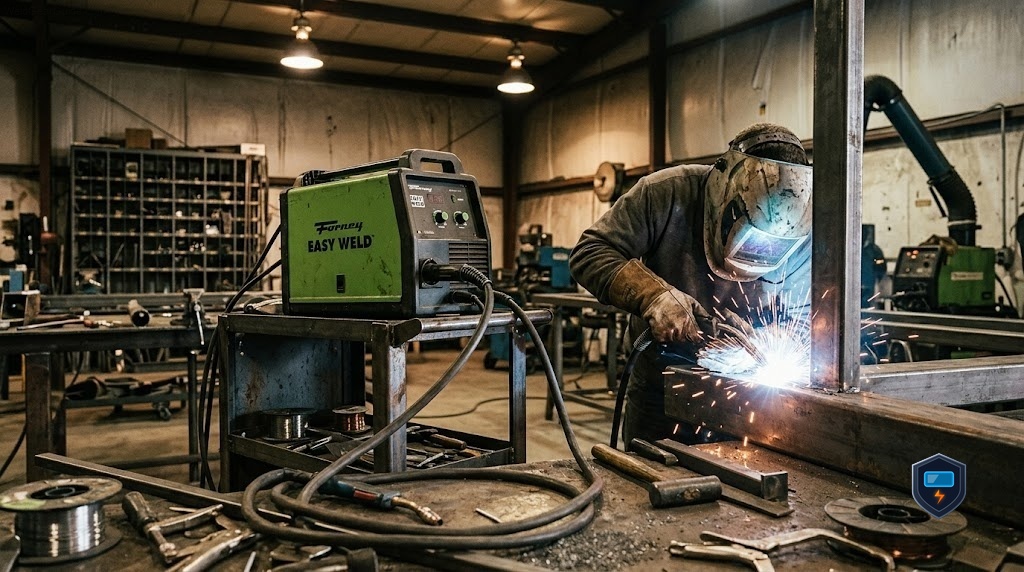
The gate hinge snapped on a Sunday afternoon, and the nearest farm supply store had two welders on the shelf: a Lincoln and a Forney. I picked up the Forney Easy Weld 140 FC-i because it was the one with a carry strap, and I was tired of dragging my old machine across the shop floor. Two hours later, the hinge was fixed, and I was rethinking everything I thought I knew about Forney welding.
Forney Industries has been making welding equipment since the 1940s, but the Easy Weld line is their modern entry-level series: compact inverter machines designed for DIY, farm repair, metal fabrication, and hobbyist use. The line includes the 140 FC-i (flux-cored only), the 140 MP (MIG, stick, and DC TIG), and the 190 MP (dual-voltage MIG, stick, flux-cored, and DC TIG with synergic controls). If you are looking at Forney, the question is not whether these are good machines. They are. The question is which one matches the work you actually do.
Forney Easy Weld 140 FC-i: The Flux-Cored Workhorse
The Forney Easy Weld 140 FC-i (model 261) is the simplest machine in the line. It does one thing: flux-cored welding. No gas, no MIG, no stick, no TIG. You plug it into a 120V outlet, load a spool of self-shielded flux-cored wire, and weld.
At 19 pounds, it is light enough to carry to the work. The output is 140 amps, with a 30% duty cycle at 90 amps. That means you can weld for 3 minutes out of every 10 at 90 amps, which is better than the Lincoln 140 Weld Pak’s 20% rating at the same amperage. In practice, the 140 FC-i handles 24-gauge sheet metal up to 1/4 inch steel without struggling, as long as you are not trying to run long continuous beads.
The Forney Easy Weld 140 FC-i is available on Amazon and comes with an 8-foot MIG gun, 8-foot ground clamp, and a 20A-to-15A adapter. The gun is integrated (not a Euro-connect), which means you cannot easily swap it for a longer or higher-amperage torch. The wire drive handles .030 and .035 wire, though Forney recommends .030 because .035 can reduce the duty cycle.
The flaw here is the single-process limitation. If you ever want to run MIG with shielding gas, you cannot. If you want to try stick welding, you cannot. The 140 FC-i is a one-trick machine, and it does that trick well, but you should know that going in.
Who should skip the 140 FC-i: anyone who thinks they might want MIG with gas, stick, or TIG capability down the road. For a pure flux-cored machine, it is excellent. For anything else, look at the 140 MP.
Forney Easy Weld 140 MP: Three Processes, One Outlet
The Forney Easy Weld 140 MP (model 271) is the machine I wish I had bought first. It does MIG, DC TIG, and stick welding on 120V power, all from one machine. The output range is 10 to 140 amps, with duty cycles of 30% at 90 amps for MIG, 30% at 80 amps for stick, and 30% at 110 amps for TIG, according to Forney’s specifications.
At 24.81 pounds, it is heavier than the FC-i but still portable. The 140 MP includes a 10-foot MIG gun, 8-foot electrode holder, 8-foot ground clamp, and a 20A-to-15A adapter. The TIG torch is not included, which is the main catch. You need to buy a TIG torch separately if you want to use that process.
The 140 MP uses a lift-start for DC TIG, which is better than scratch-start but still not high-frequency start. It works for steel and stainless, but not for aluminum (which requires AC TIG). There is no foot pedal operation on this machine, so you set amperage on the panel and weld with fixed output.
The wire feed speed range is 79 to 197 IPM, which is narrower than the Lincoln 140 (50 to 500 IPM) or the Titanium Unlimited 200 (80 to 400 IPM). In practice, this means less fine control at the extremes. For most garage work, it is adequate.
The 140 MP is available through Home Depot, Lowe’s, and the Forney website. I could not confirm a current Amazon US listing, so check those retailers directly.
Who should skip the 140 MP: anyone who needs AC TIG for aluminum, anyone who needs foot pedal control for precision TIG work, and anyone who needs more than 140 amps on 120V power.
Forney 190 MP: When You Need More Power
The Forney 190 MP (model 323) is the step-up machine in the Easy Weld line. It is a dual-voltage (120V/240V) four-in-one machine: MIG, stick, flux-cored, and DC TIG. The dual-voltage input means you can plug it into a standard outlet for light work or a 240V circuit for heavier material.
What sets the 190 MP apart is the synergic control system. You set the material thickness and wire size, and the machine automatically adjusts wire speed to match the voltage. Forney calls this “True Set” technology, and it works similarly to Miller’s Auto-Set. If you are new to welding and have no idea what wire speed to use for 1/8 inch steel with .035 wire, the synergic control gets you close on the first try.
The 190 MP also features what Forney calls “despooler technology,” which automatically sets optimal spool tension. In practice, this reduces the bird’s-nesting problem that plagues beginners who overtension the wire drive. It is a small feature that makes a real difference in daily use.
The 190 MP includes digital readouts for voltage and wire speed, slope-up time and burn-back time adjustments, and a full metal case. It accepts 2-pound and 10-pound wire spools.
The flaw here is the investment. The 190 MP is a significant step up from the 140 MP, not just in amperage but in what you pay for it. If you are only doing occasional garage projects, the 140 MP covers most of the same ground. The 190 MP makes sense if you have 240V power, want the synergic controls, and need the extra amperage for thicker material.
Who should skip the 190 MP: anyone on 120V-only power who will never use 240V, and anyone who does not need the synergic control features. The 140 MP is the better value for pure 120V work.
Forney vs. the Competition
How does the Forney Easy Weld line compare to other 120V welders? The main competitors are the Lincoln 140 Weld Pak (MIG and flux-cored only, transformer-based, 50 lbs) and the Titanium Unlimited 200 from Harbor Freight (multi-process, dual-voltage, inverter).
The Forney machines are all inverter-based, which means they are lighter and more feature-rich than the transformer-based Lincoln 140. The trade-off is that transformer machines like the Lincoln tend to have a smoother, more forgiving arc, especially on flux-cored wire. The Forney inverters are good, but the arc is not quite as buttery as the Lincoln’s.
Compared to the Titanium Unlimited 200, the Forney 140 MP has a narrower wire speed range and lower maximum amperage on 120V. The Titanium has the advantage of dual voltage and a higher amperage ceiling. The Forney 190 MP is the closer match to the Titanium, with similar dual-voltage capability and synergic controls.
The Forney machines have a 3-year warranty, which is better than Harbor Freight’s standard warranty. The build quality is solid, with full metal cases and metal wire drives. If you are used to Miller weld quality, Forney is a step down in refinement but a step up in value for the features you get.
What Forney Gets Right That Others Miss
The carry strap. It sounds trivial, but every Forney Easy Weld machine comes with a built-in carry strap, and if you have ever tried to carry a 50-pound welder across a muddy barnyard, you understand why this matters. The Forney machines are designed to go to the work, not the other way around.
The Tweco-style consumables on the newer models (140 MP-i) are another smart move. Tweco is an industry standard, which means you can find replacement contact tips and nozzles at almost any welding supply store. You are not locked into proprietary consumables.
The generator-capable rating on the newer Easy Weld models (4,000W continuous, no low-idle, 5% THD max) is a real feature for anyone who welds away from grid power. Not many machines in this class are rated for generator use.
Where Forney Falls Short
The wire speed range on the 140 MP (79 to 197 IPM) is the narrowest in its class. The Lincoln 140 runs 50 to 500 IPM, and the Titanium Unlimited 200 runs 80 to 400 IPM. This matters less than it sounds for most garage work, but if you weld very thin sheet metal or run high-deposition flux-cored wire, you may hit the limits.
The TIG experience on the 140 MP is basic. No foot pedal, no high-frequency start, and the TIG torch is not included. If TIG is your primary interest, a dedicated TIG machine will serve you better than any multi-process welder in this class.
The 140 FC-i’s integrated gun means you cannot upgrade to a longer or higher-amperage torch. If the gun fails, you are looking at a more involved repair than simply unplugging a Euro-connect torch.
Which Forney Belongs in Your Truck
If you want a simple, no-gas flux-cored welder for repairs and projects, the 140 FC-i is the right pick. It is light, it works, and it does not pretend to be anything else.
If you want one machine that can MIG, stick, and dabble in TIG on 120V power, the 140 MP is the sweet spot in the Easy Weld line. The three-process capability and the reasonable weight make it the most versatile machine in the lineup.
If you have 240V power and want synergic controls plus more amperage, the 190 MP is the step up. It is a more serious machine for a more serious shop, and the dual-voltage input means it grows with your electrical setup.
All three Forney machines are honest tools. They do not pretend to be production welders, and they do not charge like one. Pick the one that matches your outlets, your material thickness, and the processes you actually want to run.
Frequently Asked Questions
Is the Forney Easy Weld a good beginner welder?
Yes. The 140 FC-i is one of the simplest welders to start with because it does flux-cored welding only, with no gas setup required. The 140 MP is a good beginner machine for someone who wants to explore multiple processes.
Can the Forney Easy Weld 140 MP weld aluminum?
The 140 MP can weld aluminum with MIG if you add a spool gun, but it does not do AC TIG, which is required for aluminum TIG welding. For aluminum, MIG with a spool gun is the practical option.
What is the difference between the Forney 140 FC-i and the 140 MP?
The 140 FC-i is flux-cored only, with no gas capability. The 140 MP adds MIG with gas, stick welding, and DC TIG. The 140 MP is heavier and more versatile, while the 140 FC-i is simpler and lighter.
Does Forney make a 220V welder?
The Forney 190 MP is a dual-voltage machine that runs on 120V or 240V power. Forney also makes larger industrial machines, but the 190 MP is the dual-voltage option in the Easy Weld line.
Can you use a foot pedal with the Forney Easy Weld 140 MP?
No. The 140 MP does not support foot pedal operation. You set the amperage on the machine panel and weld with fixed output for TIG.
How does Forney compare to Miller?
Miller is a professional-grade brand with higher build quality and a deeper feature set. Forney is aimed at the DIY and hobbyist market. For light shop work, Forney is a solid value. For production or daily professional use, Miller is the better long-term investment.