GMAW Welding Definition: A Clear Explanation
If you are studying welding, reading a welding code, or working toward certification, you will encounter the term GMAW rather than the everyday name MIG, and you need a precise definition. GMAW is one of the most widely used welding processes in the world, and understanding exactly what the term means, how the process works, and how its variations differ is foundational knowledge. This is not just trivia: knowing the correct definition helps you read technical documents, communicate with professionals, and understand what your machine is actually doing.
This guide gives a clear definition of GMAW welding, explains the process, and covers its main types.
The definition
Let us state the definition precisely, then unpack it.
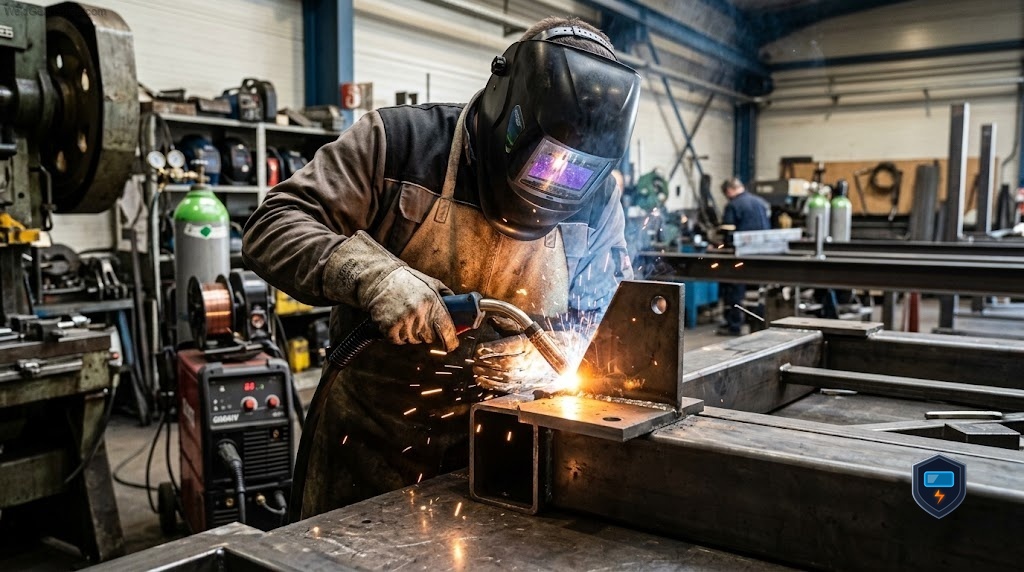
GMAW stands for Gas Metal Arc Welding. It is an arc welding process that joins metals by forming an electric arc between a continuously fed consumable wire electrode and the workpiece, while a shielding gas supplied through the welding gun protects the molten weld pool from atmospheric contamination. In plain terms, a machine feeds a wire that melts into the joint while gas shields the weld from the air. Crucially, GMAW is the formal technical name for the process most people call MIG welding; the two terms refer to the exact same thing. GMAW is the term used in industry standards, welding codes, and certification.
How the process works
With the definition set, here is the mechanism it describes.
In GMAW, the welding machine continuously feeds a solid wire electrode from a spool, through the gun, at a controlled speed. When the operator pulls the trigger, the wire feeds and electricity creates an arc between the wire tip and the metal. That arc generates intense heat, melting both the wire and the base metal so they fuse together as the wire is consumed into the joint. Simultaneously, shielding gas flows from the gun nozzle to blanket the molten pool, keeping oxygen and nitrogen in the air from contaminating the weld and making it porous or weak. The operator controls the arc voltage and wire-feed speed, which together determine the weld’s characteristics.
The types of metal transfer
A complete definition includes the modes by which GMAW transfers metal across the arc, since this appears in technical study.
GMAW works through several metal transfer modes. In short-circuit transfer, the wire repeatedly touches the weld pool and short-circuits, giving low heat suited to thin metal and all positions. In globular transfer, larger droplets cross the arc, an intermediate mode. In spray transfer, a fine spray of molten droplets crosses at higher voltage, giving deep penetration on thicker metal. And pulsed spray pulses the current to combine deep penetration with lower average heat and control. The mode depends on the voltage, current, wire, and shielding gas used. For most everyday MIG welding, short-circuit and spray are the common modes.
GMAW versus related terms
Rounding out the definition means distinguishing GMAW from the terms it is often confused with.
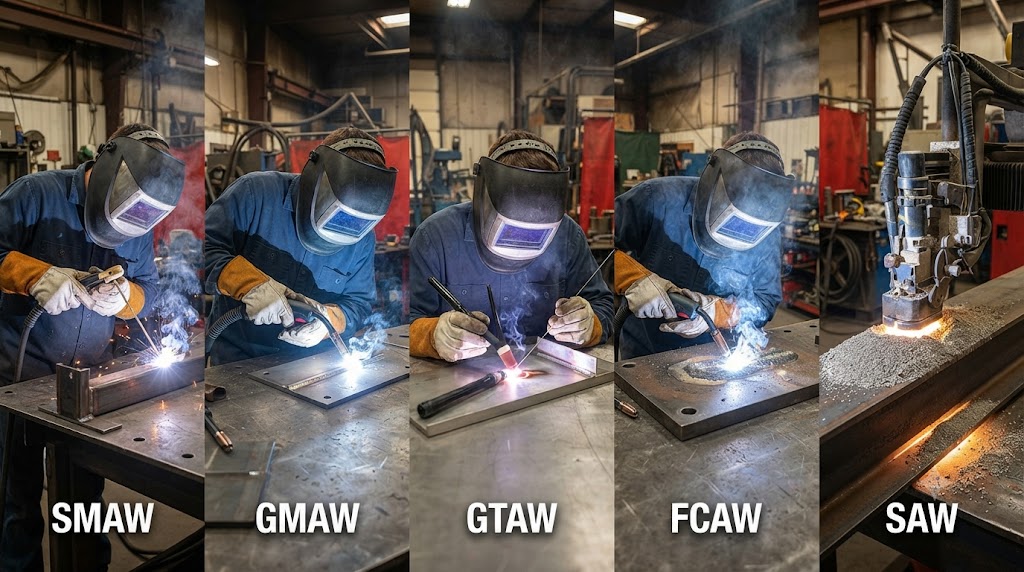
GMAW and MIG are the same process, so treat them as interchangeable; MIG is just the popular name. GMAW is different from FCAW (Flux-Cored Arc Welding), which uses a hollow flux-filled wire and may need no external gas, even though the same machine often does both. GMAW is also distinct from GTAW (Gas Tungsten Arc Welding), the technical name for TIG welding, which uses a non-consumable tungsten electrode and a separately added filler rather than a continuously fed wire. Keeping these straight, GMAW/MIG, FCAW/flux-core, and GTAW/TIG, is essential for reading technical material correctly.
What to take away
GMAW, Gas Metal Arc Welding, is the formal name for MIG welding, an arc process that fuses metal using a continuously fed wire electrode shielded by gas.
Three things to remember. The definition is precise: GMAW joins metal by forming an arc between a continuously fed consumable wire and the workpiece, with shielding gas protecting the weld, and it is identical to MIG welding. The process works by feeding wire that the arc melts into the joint while gas shields the molten pool, controlled by voltage and wire-feed speed. And GMAW has several metal transfer modes, and it is distinct from FCAW (flux-core) and GTAW (TIG), which are separate processes with their own technical names.
Frequently asked questions
What is the definition of GMAW welding? GMAW, Gas Metal Arc Welding, is an arc welding process that joins metal by forming an arc between a continuously fed consumable wire electrode and the workpiece, with shielding gas protecting the weld pool.
Is GMAW the same as MIG welding? Yes. GMAW is the formal technical name and MIG (Metal Inert Gas) is the popular everyday name for the exact same process. The terms are interchangeable.
What does GMAW stand for? Gas Metal Arc Welding. It is the term used in welding codes, industry standards, and certification for the process commonly called MIG welding.
How does GMAW work? A machine continuously feeds a wire electrode through a gun. An arc between the wire and metal melts both, fusing them, while shielding gas blankets the molten pool to protect it from the air.
What are the metal transfer modes in GMAW? Short-circuit (low heat, thin metal, all positions), globular (intermediate), spray (deep penetration on thicker metal), and pulsed spray (deep penetration with lower average heat and control).
What is the difference between GMAW and FCAW? GMAW uses solid wire with an external shielding gas. FCAW, Flux-Cored Arc Welding, uses a hollow flux-filled wire that may need no gas. Many machines can perform both processes.
What is the difference between GMAW and GTAW? GMAW (MIG) uses a continuously fed consumable wire. GTAW (TIG) uses a non-consumable tungsten electrode with filler added separately, giving more precise but slower welds.
References
- American Welding Society, AWS
- Lincoln Electric, MIG Welders
- Occupational Safety and Health Administration, Welding, Cutting, and Brazing
- National Institute for Occupational Safety and Health, Welding Safety