GTAW/TIG Welding: A Practical Introduction
Read two welding articles and you will see two names for what looks like the same thing. One calls it TIG. The other calls it GTAW. A beginner reasonably wonders whether these are different processes, different machines, different skills to learn. They are not. They are the same process wearing two names, and clearing that up is the first step to actually getting good at it.
Let me settle the naming, then give you the practical path from confused beginner to clean, controlled welds.
Same process, two names
GTAW stands for gas tungsten arc welding. It is the official American Welding Society designation, the one you see in codes, textbooks and certifications.
TIG stands for tungsten inert gas. It is the older, more descriptive shop name that stuck around because it rolls off the tongue and describes what is happening.
They are identical. A GTAW welder and a TIG welder are the same person; a GTAW machine and a TIG machine are the same machine. If you learn TIG, you have learned GTAW. Use whichever name the room uses.
What the process is doing
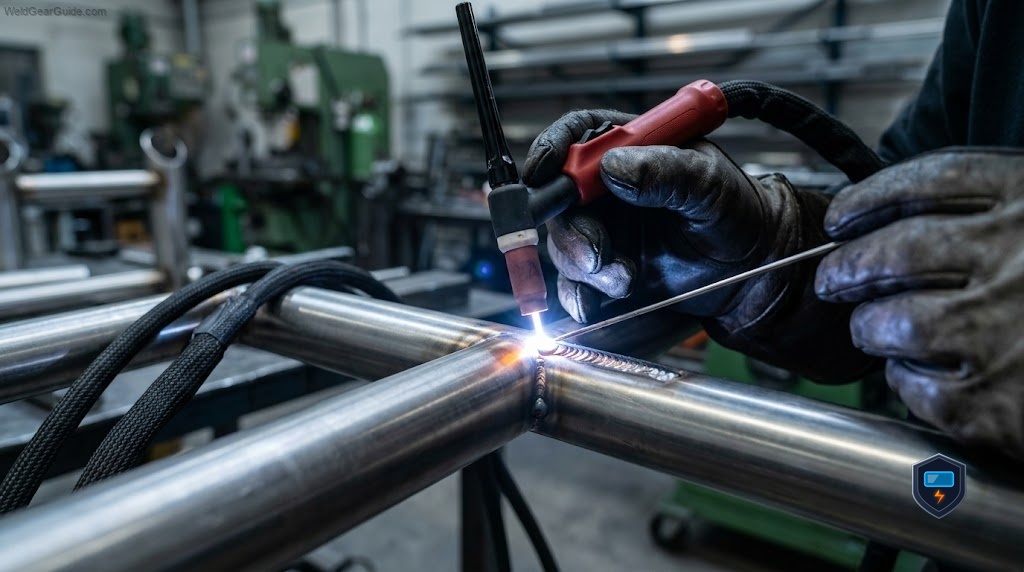
Whichever name you use, the mechanics are the same. A non-consumable tungsten electrode creates an electric arc that melts the base metal. An inert shielding gas, almost always argon, protects the tungsten and the molten puddle from the air. Filler metal is added by hand when the joint needs it, and amperage is usually controlled with a foot pedal.
The defining trait is separation: the arc, the filler and the heat are all controlled independently. That separation is why GTAW/TIG produces the cleanest, most precise welds of the common processes, and why it takes the most practice.
Why it is worth learning
Control. You manage heat, filler and arc separately, giving you command over the weld that no other common process matches.
Clean results. No spatter, no slag, and the neatest beads in welding. When the weld will be seen or must be exact, this is the process.
Versatility across metals. Steel, stainless, aluminum, chrome-moly, titanium, copper. On AC it handles aluminum cleanly, which is a signature strength.
Thin material. Fine heat control lets you weld thin sheet without blowing through.
The practical path to cleaner welds
Cleaner GTAW/TIG welds come from a repeatable routine, not from talent. Here is the path.
Start with the right consumables. A 2% lanthanated tungsten (blue) is the all-purpose choice for AC and DC on all metals. Keep a stock, because you will contaminate several while learning. A 2% lanthanated tungsten 10-pack is a sensible starting point, paired with filler rod matched to your metal: ER70S-2 for mild steel, ER308L for stainless, or ER5356 for aluminum.
Grind the tungsten correctly. For DC steel work, a point ground lengthwise gives a focused, stable arc. Grind direction matters more than beginners expect.
Set polarity for the metal. DC electrode negative for steel and stainless, AC for aluminum. Wrong polarity is the classic reason an arc misbehaves.
Dial in argon flow. 100 percent argon at roughly 15 to 20 cubic feet per hour for most work. Too little oxidizes the weld, too much causes turbulence.
Build the core rhythm. Form a puddle, dip filler into its leading edge, travel slowly, repeat. Keep the arc short and steady.
Practice in order. Beads without filler first, then filler on flat plate, then joints, then aluminum on AC. Competence before cosmetics.
A simple starting checklist
- Clean the metal thoroughly.
- Grind a lanthanated tungsten and set the correct polarity.
- Set argon flow and check for leaks.
- Set amperage for the thickness and control it with the pedal.
- Short arc, form the puddle, feed filler into its edge, travel slow.
The verdict
GTAW and TIG are one process with two names: GTAW the formal code term, TIG the descriptive shop term. Learn one and you have learned both. What you are learning is a process that separates arc, filler and heat, which is the source of its precision and its difficulty alike.
Three things to carry forward. Do not let the two names confuse you, because a GTAW machine and a TIG machine are the same tool. The cleanest welds come from a repeatable routine, correct tungsten and grind, right polarity, proper argon flow and a steady short arc, rather than from raw talent. And progress comes from practicing in order, puddle control first, then filler, then joints, then aluminum, so resist chasing pretty beads before the fundamentals are automatic.
Name settled, path laid out. The rest is time on the torch, and that time pays off in welds that look as controlled as they are.
Frequently asked questions
Is GTAW the same as TIG welding? Yes. GTAW (gas tungsten arc welding) is the formal name and TIG (tungsten inert gas) is the older descriptive name. They refer to the same process, machine and skill.
Why does TIG welding have two names? TIG is the traditional shop term describing the tungsten electrode and inert gas. GTAW is the official American Welding Society designation used in codes and certifications. Both stuck, so you hear both.
What makes GTAW/TIG welds so clean? The process separates the arc, filler and heat into independently controlled elements, produces no spatter or slag, and uses an inert gas shield. That control yields the neatest, most precise welds of the common processes.
What tungsten should I start with? 2% lanthanated (blue) is the best all-purpose electrode, working on both AC and DC and all metals with good arc starts and stability, which helps while learning.
What gas does GTAW use? Almost always 100 percent argon, at roughly 15 to 20 cubic feet per hour for most work. Argon-helium blends are used for thick aluminum or copper to add heat.
Is GTAW hard to learn? Yes, relatively, because it requires coordinating the torch, filler rod and foot pedal simultaneously. A repeatable setup routine and practice in stages make it learnable.
What filler rod do I use for GTAW? Match it to the base metal: ER70S-2 for mild steel, ER308L for 304-series stainless, ER4043 or ER5356 for aluminum. The wrong filler weakens the weld.
Can GTAW weld aluminum? Yes, on AC output. AC TIG cleans aluminum’s oxide layer and gives excellent control on thin material, which is one of the process’s signature strengths.
References
- Miller Electric, How a TIG Welder Works and When to TIG Weld
- Wikipedia, Gas tungsten arc welding
- Miller Electric, All About Tungsten in TIG Welding: Types, Selection and Use