Handler 210 MVP MIG Welder: Is It Right for You?
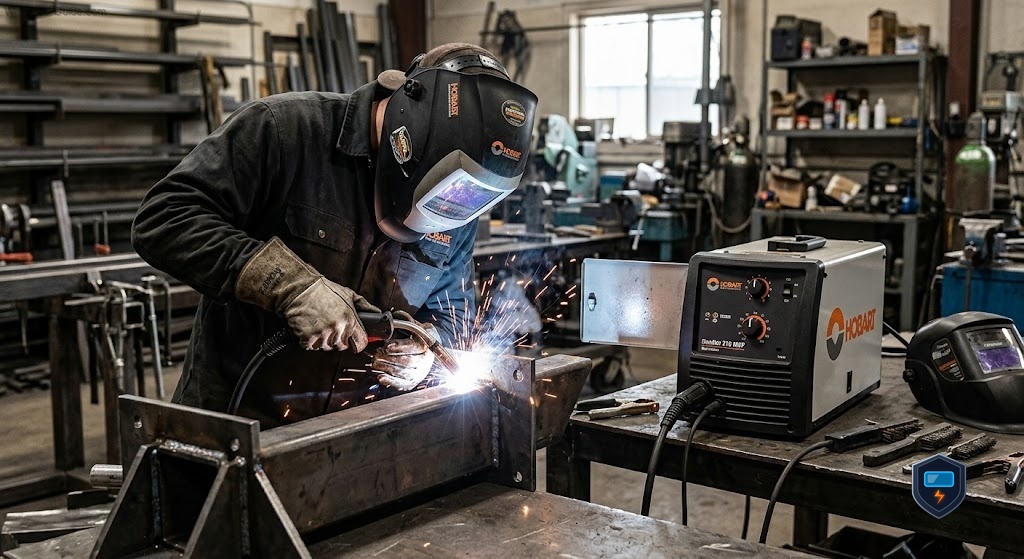
The Hobart Handler 210 MVP earns a spot on almost every shortlist of do-everything home MIG welders, and the decision of whether to buy it usually comes down to how its flexibility and value stack up against the alternatives. It is a strong machine, no question, but strong is not the same as right for you. Whether it is the best choice depends on your power situation, the metal you weld, your budget, and how it compares to the Miller and Lincoln machines it competes with. This is a buyer’s decision, not just a spec sheet.
This guide takes a buyer-focused look at the Handler 210 MVP, weighing what it offers against who should actually buy it.
The core value proposition
Start with what the Handler 210 MVP is really selling, because that is what you are weighing.
The Handler 210 MVP offers dual-voltage flexibility plus rugged Hobart build at a competitive price. Its Multi-Voltage Plug (the MVP) lets it run on both 120 and 240 volts by swapping a plug adapter with no tools, so it welds light material on a household outlet and thicker steel, up to about three-eighths of an inch, on a 240-volt circuit. Add spool-gun readiness for aluminum, flux-core capability, and Hobart’s durable construction, and the pitch is clear: do-everything home capability with the toughness of a brand under the same parent as Miller, often for less than the premium competitors. That value-plus-flexibility combination is its whole appeal.
The case for buying it
There are solid reasons the Handler 210 MVP might be exactly right for you.
Buy it if you want one flexible machine that adapts to whatever power you have, welds a wide range of steel, and handles aluminum with a spool gun. Buy it if you value rugged durability, since Hobart machines are built to take a beating and last. Buy it if you want that capability at a competitive price, potentially saving money versus the premium Miller and Lincoln machines while getting comparable real-world capability. And buy it if you are a serious hobbyist, home fabricator, or farm and ranch user whose work spans thin sheet to medium-thick steel. For that buyer, the Handler 210 MVP hits a genuine sweet spot of flexibility, toughness, and value.
The case for looking elsewhere
Honesty means noting when a different machine serves you better.
Look elsewhere if you only weld thin steel occasionally on a household outlet, since a cheaper 120-volt machine like the Hobart Handler 140 or Miller 142 would do the job for less. Look elsewhere if you need industrial thick-plate capacity or a high production duty cycle, which calls for a larger shop machine like a 250-class unit. Consider the premium competitors, the Miller and Lincoln 211-class machines, if you want the last measure of arc refinement or the strongest resale value, and are willing to pay for it. And if you want stick and TIG too, look at a multi-process machine instead. The Handler 210 MVP is excellent, but it is not the answer for every use.
Making the decision
Here is how to settle it based on your own situation.
Ask yourself four questions. What power do I have? If you want to use both household and 240-volt outlets, the MVP’s dual-voltage design is a real plus. How thick is my metal? If it spans thin sheet to about three-eighths-inch steel, the 210 MVP fits; if heavier, step up. What is my budget versus the premium brands? If value matters and you are comfortable with Hobart, it saves money; if resale and refinement matter most, weigh Miller or Lincoln. Do I need aluminum or just steel? If aluminum, confirm the spool-gun setup. Answer those honestly and the decision becomes clear.
What to take away
The Hobart Handler 210 MVP is an excellent do-everything home MIG welder whose dual-voltage flexibility, rugged build, and competitive price make it right for many buyers, but not all.
Three things to remember. Its core value is dual-voltage flexibility plus Hobart toughness at a competitive price, welding thin sheet to about three-eighths-inch steel and aluminum with a spool gun. It is the right buy for serious hobbyists, home fabricators, and farm users who want one flexible, durable machine and value price over premium-brand polish. And it is the wrong buy for occasional thin-steel welders (choose a cheaper 120-volt machine), heavy industrial work (choose a larger machine), or those wanting stick and TIG (choose multi-process).
Frequently asked questions
What does MVP stand for on the Handler 210 MVP? Multi-Voltage Plug. It lets the machine run on both 120-volt and 240-volt power by swapping a plug adapter with no tools, giving flexibility between household and higher-voltage outlets.
How thick can the Handler 210 MVP weld? Up to around three-eighths of an inch of steel on 240-volt power in a single pass, and thicker with multiple passes. On 120-volt power it steps down for thinner material.
Is the Handler 210 MVP worth it over the Miller 211? It often costs less for comparable real-world capability, making it strong on value. The Miller may edge it on arc refinement and resale value. The right choice depends on your priorities.
Should I buy the Handler 210 MVP or a cheaper 120-volt machine? If you weld only thin steel occasionally on a household outlet, a cheaper 120-volt machine suffices. The 210 MVP makes sense if you want dual-voltage power and a wider thickness range.
Can the Handler 210 MVP weld aluminum? Yes, it is spool-gun ready. With a compatible spool gun, aluminum wire, and 100 percent argon gas, it welds aluminum in addition to steel and stainless.
Who should buy the Handler 210 MVP? Serious hobbyists, home fabricators, and farm or ranch users who want one flexible, rugged machine spanning thin sheet to medium-thick steel, and who value competitive pricing.
Does the Handler 210 MVP do stick or TIG? No. It is a MIG machine running solid wire with gas and flux-core. For stick and TIG in addition to MIG, look at a multi-process machine instead.
References
- American Welding Society, AWS
- Occupational Safety and Health Administration, Welding, Cutting, and Brazing
- National Institute for Occupational Safety and Health, Welding Safety
- Miller Electric, MIG Welders