Harbor Freight Flux Core Welder: Getting Cleaner Beads From a Budget Machine
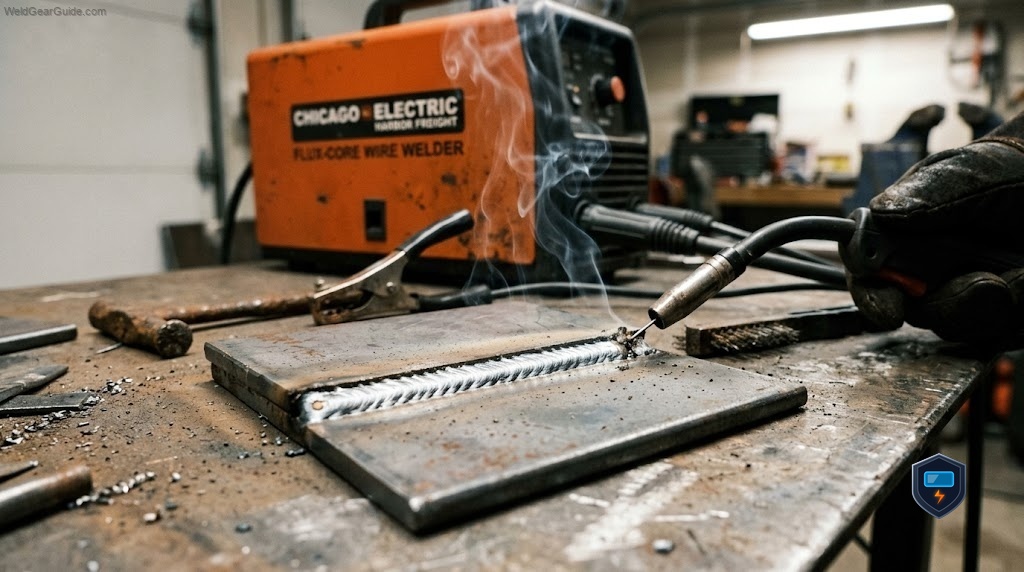
The most useful upgrade for an inexpensive flux core welder usually costs a fraction of the machine. It is a spool of decent wire. I have watched a budget machine go from throwing sparks in every direction to laying an even, tidy bead in the time it took to swap out the sample spool that came in the box.
The machine was never the problem. The wire that shipped with it was.
What you get with a budget flux core welder
A Harbor Freight flux core welder is a self-shielded wire feed machine sold under store brands, typically 120 volt with tapped voltage settings, or dual voltage in the larger models. It runs gasless flux cored wire, needs no cylinder, and arrives configured for flux core operation.
The direct answer on capability: on 120 volt power these machines weld mild steel from about 18 gauge up to 1/8 inch reliably, and up to 3/16 inch on a bevelled joint with multiple passes. Dual-voltage models on 240 volt power reach 1/4 inch. What they compromise is duty cycle, gun quality, drive system precision and long-term support, not fundamental weld soundness.
Three things to fix before your first real project
1. Verify the polarity
Self-shielded wire requires DC electrode negative. Machines usually ship wired for it, but not always, and a machine that also offers MIG will not be.
Open the wire feed compartment and check the leads against the diagram. Symptoms of getting this wrong are exactly what people describe when they call these machines junk: heavy spatter, an unstable arc, and beads that pile up without fusing at the edges.
2. Replace the sample wire
The short spool included in the box is there to prove the machine runs, not to weld with. It is usually a basic E71T-GS wire that spatters heavily and feeds inconsistently.
A proper E71T-11 wire transforms the experience. Lincoln NR-211-MP in 0.030 inch is the tidiest option, forgiving of poor fit-up and easy on slag removal, with a plate recommendation around 5/16 inch that caps heavy work. Hobart E71T-11 in 0.030 inch feeds beautifully and suits learners, though it spatters when run hot on thin stock.
For genuinely occasional use, a twin pack of 2 pound spools avoids a large spool slowly absorbing garage humidity. You pay more per pound for that.
3. Check the drive roll and liner
Budget machines sometimes ship with a smooth drive roll or one sized for a different wire. A knurled roll matched to your wire diameter, set to moderate tension, prevents the crushed wire and birdnesting that people blame on the feeder.
Settings on a tapped machine
Most budget machines give you a few voltage positions and a wire speed dial. That is enough, once you understand what each does.
- Pick the voltage tap by material thickness using the chart on the machine.
- Set wire speed mid-range.
- Run a test bead on scrap of the same thickness.
- Adjust wire speed in small steps until the arc makes a steady, even crackle.
| Symptom | Change |
|---|---|
| Loud irregular popping | More wire speed |
| Mushy arc, wire stubbing into puddle | Less wire speed |
| Tall narrow bead, poor edge fusion | Higher voltage tap |
| Flat wide bead with undercut | Lower voltage tap |
The frustration on tapped machines is landing between two taps with neither quite right. When that happens, adjust wire speed to compensate and accept that you are working within the machine’s resolution.
Technique that suits a modest machine
Stickout of 1/2 inch. Budget machines have less stable arcs to begin with, so consistent stickout matters more, not less.
Drag the gun at 15 to 20 degrees. Pushing traps slag. This is universal and non-negotiable.
Prepare joints properly. A gap that a 200 amp machine could bridge becomes a burn-through at 90 amps. Grind for fit rather than filling gaps with wire.
Bevel anything over 3/16 inch. Do not expect the arc to reach the root of a square-edged thick joint.
Pace yourself. Duty cycle is where these machines are weakest. Weld, then let the fan run.
What a budget machine cannot do
Be honest with yourself before starting a project.
- Structural work on heavy steel. Penetration and duty cycle both fall short.
- Automotive frames and suspension components. Not the place to test a value machine.
- Sheet metal panels. Flux core generally, and budget flux core especially, is the wrong process below 16 gauge.
- Long production runs. Thermal cutouts will define your pace.
Anyone whose work list includes those items should look at a dual-voltage machine with a published duty cycle curve rather than trying to make a light machine cover it.
Comparing the alternatives
| Budget store machine | Lincoln Handy Core | YESWELDER FLUX-135 | YESWELDER 165A | |
|---|---|---|---|---|
| Voltage | 120 V typical | 120 V | 120 V | 120 and 240 V |
| Adjustment | Tapped | Tapped | Synergic | Synergic |
| Processes | Flux core | Flux core | Flux core, stick, TIG | Flux core, MIG, stick, TIG |
| Support | Store return policy | Extensive network | Limited | Limited |
| Ceiling | About 1/8 to 3/16 in | About 1/8 in | About 3/16 in | About 1/4 in on 240 V |
The Lincoln Handy Core is comparable in capability with better parts availability, and equally limited in range. The YESWELDER FLUX-135 adds synergic control and two more processes for similar money, with basic accessories and thin support. The YESWELDER 165A dual voltage is the sensible step up for anyone welding over 3/16 inch, carrying the same caveats.
If you weld often enough that downtime costs you, the Millermatic 142 shows what a properly engineered drive system and gun feel like. It costs several times more and is still capped around 3/16 inch, so it is refinement rather than capacity.
Protective gear is not where to save
The arc from a budget machine damages eyes exactly as thoroughly as an expensive one. A working auto-darkening helmet such as the Forney Easy Weld auto-darkening welding helmet is a reasonable entry point, with the caveat that lower-cost helmets have smaller viewing areas and fewer adjustment options than premium models, and heavy users usually upgrade.
Fume matters more with gasless welding than most people realise. These machines end up in closed garages, which is the worst place for a process that produces this much smoke. Get air moving and keep your head out of the plume.
Final verdict
A budget flux core welder is a real tool with a narrow band of competence. Verify polarity, throw away the sample wire, fit a knurled drive roll, keep 1/2 inch of stickout, drag the gun, and stay inside 1/8 inch on household power. Do that and the welds hold perfectly well for repair work.
The upgrade signal is not weld quality. It is rhythm. When you spend more time waiting for the machine to cool than welding, or bevelling joints that a bigger machine would handle square, the cheap welder has started charging you in time instead of money.
Frequently asked questions
Are budget flux core welders any good? For light repair, hobby work and learning, yes. They produce sound welds on mild steel up to about 1/8 inch on household power. They fall short on duty cycle, accessories and support.
What wire should I use instead of the spool that came with it? An E71T-11 wire in 0.030 inch. It feeds better, spatters less, and produces a tidier bead than the sample wire supplied with most machines.
What polarity does a gasless welder use? DC electrode negative. Check inside the wire feed compartment before your first bead, especially on machines that also run MIG.
How thick can I weld on 120 volt power? Up to about 1/8 inch in a single pass, and 3/16 inch with a bevelled joint and multiple passes.
Why is my budget welder spattering so much? Usually wrong polarity, poor quality wire, wire speed out of balance with voltage, or a nozzle clogged with spatter.
Can I add gas to a gasless machine? No. Flux core only machines lack the gas solenoid and connection required for MIG.
How long can I weld before it overheats? Expect short bursts at higher settings. Duty cycles in this class are modest, so plan on pausing regularly.
Is it worth upgrading the gun? On machines where the gun is permanently attached, no. Where a standard gun can be fitted, an upgrade improves comfort and feeding noticeably.