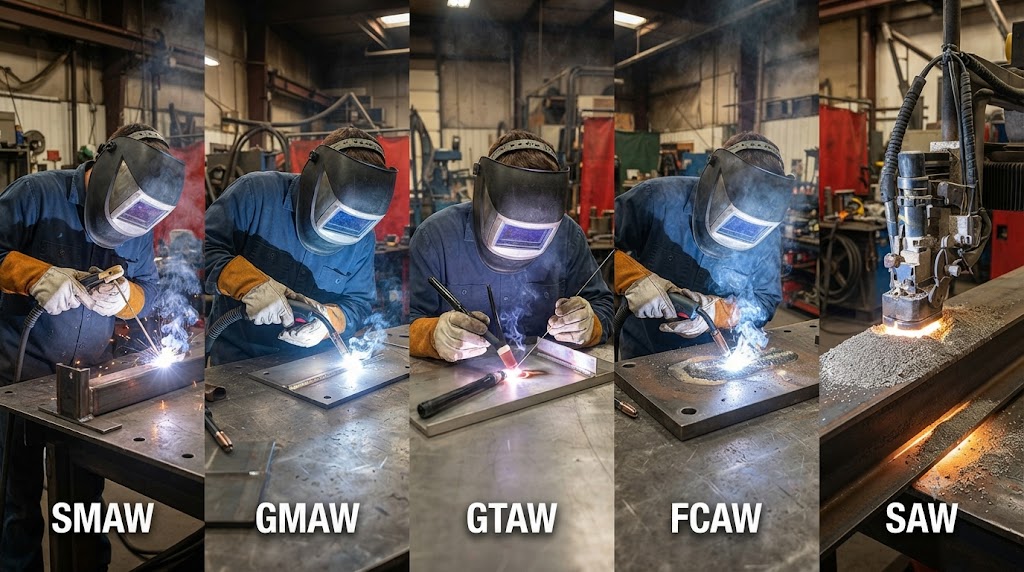
How Does TIG Welding Work? Full Explainer
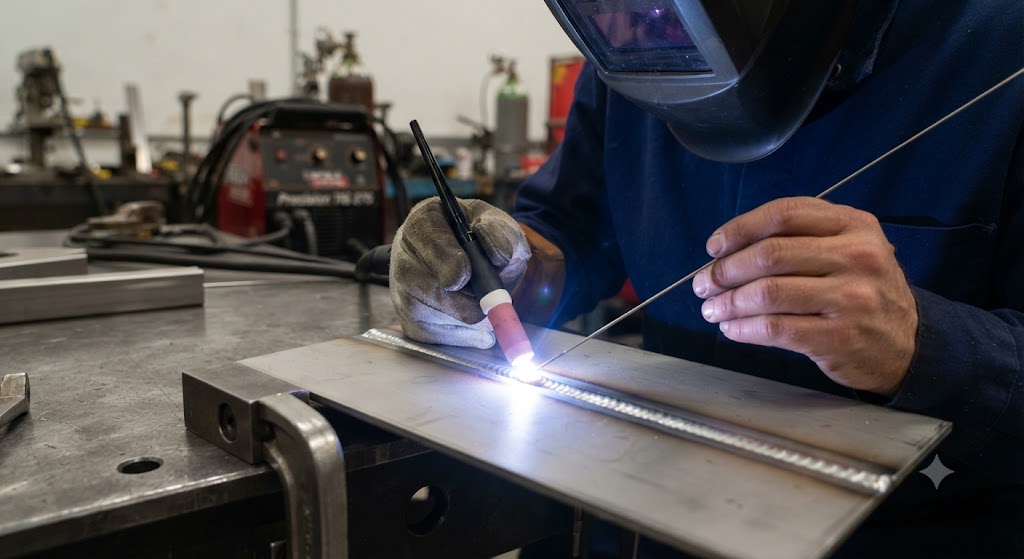
TIG welding looks almost delicate next to the crackle of stick or the buzz of MIG: a steady arc, a glowing pool, and a rod dipped in by hand. That control is exactly the point. TIG produces some of the cleanest, most precise welds there are, which is why it rules aerospace, thin stainless, and aluminum art. But it also asks the most of the welder, partly because so much is happening at the tip of a tungsten electrode. This explainer covers how a TIG welder works, from the non-melting electrode to the foot pedal.
TIG welding, formally gas tungsten arc welding (GTAW), works by using a non-consumable tungsten electrode to create an arc that melts the base metal, while an inert gas (usually argon) shields the weld and filler is added separately by hand. Here is the full explainer.
The main parts
A TIG setup has a distinct set of components:
- A tungsten electrode that carries the current but does not melt.
- A torch that holds the tungsten and directs shielding gas.
- An inert shielding gas, typically argon.
- A separate filler rod, fed into the pool by hand.
- An amperage control, often a foot pedal.
- A power source capable of DC and, for aluminum, AC.
These let the welder control heat and filler independently, which is the source of TIG’s precision.
Direct answer: how a TIG welder works
Here is the sequence:
- The tungsten electrode delivers current to form the arc.
- An arc jumps from the tungsten to the base metal, often started without touching.
- The arc’s heat melts the base metal into a small, controlled pool.
- Argon flows from the torch, shielding the tungsten and pool.
- Filler rod is dipped into the pool by hand, if filler is needed.
- The foot pedal adjusts amperage in real time as you weld.
Because the electrode does not melt and filler is separate, the welder controls each variable on its own.
The non-consumable tungsten electrode
The heart of TIG is the tungsten electrode, and the key word is non-consumable. Tungsten has an extremely high melting point, so it can carry the welding current and sustain the arc without melting away like a MIG wire or stick electrode does. Its only job is to deliver the current that forms the arc, and the arc’s heat, not the electrode itself, melts the base metal. This is what lets TIG separate heat from filler: the tungsten makes the heat, and you add filler metal separately. Keeping the tungsten clean and properly shaped matters, because if the tungsten touches the pool or filler it gets contaminated, which spoils the arc until you re-grind it. That is also why a no-touch arc start is so useful.
The shielding gas and filler
Like MIG, TIG needs an inert shielding gas to protect the molten metal from the air, and TIG almost always uses argon (sometimes helium or a mix). The gas flows from a nozzle around the tungsten, cooling and protecting the electrode and blanketing the weld pool so oxygen and nitrogen cannot reach it and cause defects. What is different from MIG is the filler. Because the tungsten does not melt, it adds no metal, so if the joint needs filler, the welder feeds a separate filler rod into the pool by hand, much like traditional gas flame welding. This hand-fed approach is slower, but it gives complete control over exactly how much metal goes where, which is why TIG welds look so clean and precise.
The foot pedal and high frequency start
Two controls give TIG its finesse. The first is the foot pedal, which adjusts the welding amperage in real time. Pressing the pedal raises the heat and easing off lowers it, so a welder can dial the heat up as the metal warms and back down to avoid burning through, all while welding. This live control is a big reason TIG handles thin and heat-sensitive material so well. The second is high frequency start. To avoid contaminating the tungsten by scratching it on the metal, TIG machines can use a high-frequency, high-voltage pulse that ionizes the gap and lets the arc jump without the tungsten ever touching the work. That gives a clean, precise arc start and keeps the electrode sharp. For aluminum, the machine also runs on AC, which helps break up the oxide layer, while steel and stainless typically use DC electrode negative.
The bottom line
TIG welding works by separating heat and filler. A non-consumable tungsten electrode carries the current and creates an arc whose heat melts the base metal, argon gas shields the tungsten and the pool, and the welder adds filler by hand only where needed. A foot pedal controls amperage on the fly, and a high-frequency start lets the arc begin without touching (and contaminating) the tungsten, with AC used for aluminum. All of this hands the welder precise, independent control over every variable, which is why TIG produces such clean welds and why it is the choice for thin material, stainless, aluminum, and demanding work, even though it takes more skill and time than MIG or stick.
FAQ
How does a TIG welder create an arc without melting the electrode? The electrode is tungsten, which has an extremely high melting point, so it carries the current and sustains the arc without melting the way a MIG wire or stick electrode does. The arc’s heat, not the electrode itself, melts the base metal, so the tungsten stays intact and only delivers current.
Why does TIG welding need a foot pedal? The foot pedal controls welding amperage in real time. Pressing it raises the heat and easing off lowers it, so the welder can increase heat as the metal warms and reduce it to avoid burning through, all while welding. This live heat control is a big reason TIG handles thin and heat-sensitive metals so well.
What is high frequency start used for? High frequency start lets the arc jump from the tungsten to the work without the electrode touching the metal. A high-frequency, high-voltage pulse ionizes the gap so the arc can begin cleanly. This prevents contaminating the tungsten, which happens if it scratches the work, and keeps the arc start precise and the electrode sharp.
Does TIG welding use filler like MIG? Yes, but differently. Because the tungsten electrode does not melt, it adds no metal, so the welder feeds a separate filler rod into the pool by hand when the joint needs filler, similar to gas flame welding. This hand control over filler is slower than MIG’s continuous wire but gives very precise, clean results.
What gas does TIG welding use? TIG almost always uses argon, an inert gas, sometimes helium or an argon-helium mix. The gas flows around the tungsten to cool and protect it and blankets the weld pool so oxygen and nitrogen from the air cannot reach the molten metal and cause defects. Inert gas is essential to clean TIG welds.
Why is TIG used for aluminum and stainless? TIG gives precise heat and filler control, which suits thin and heat-sensitive metals like stainless, and it runs on AC for aluminum, which helps break up aluminum’s tough oxide layer. The clean, controllable arc and separate filler produce the high-quality, good-looking welds these metals demand.
References
- Miller Electric guide to how a TIG welder works (manufacturer), millerwelds.com.
- Fronius and Linde references on gas tungsten arc welding fundamentals (manufacturer and industry), fronius.com.
- The Welding Institute (TWI) definition of TIG/GTAW fusion welding (industry reference), twi-global.com.