Is Hobart Owned by Miller? The Ownership Story, Explained
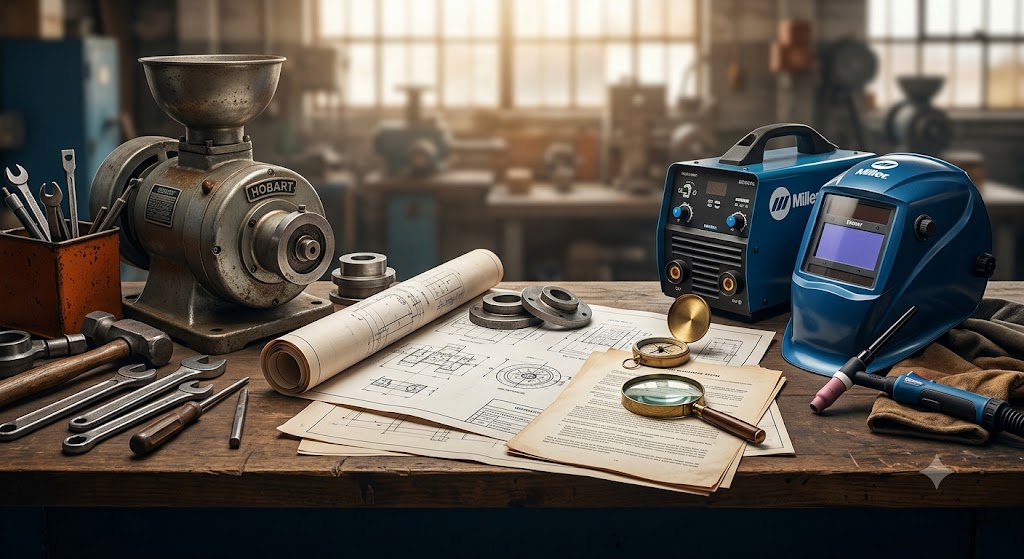
Walk into any welding supply shop and you will hear it repeated as fact: “Hobart is just a cheaper Miller.” A guy on a forum swears the machines are identical inside. Someone else insists they roll off the same line. It is one of those shop-floor legends that is half right, which is exactly what makes it so sticky and so worth sorting out before you spend real money assuming the two brands are interchangeable.
Here is the clean answer: Hobart is not owned by Miller. Both brands are owned by the same parent company, Illinois Tool Works (ITW). Miller does not own Hobart, and Hobart does not own Miller. They are corporate siblings under one roof, which is a different relationship than most people assume, and it changes what you should and should not conclude about the products.
Who actually owns what
Hobart Brothers was family-owned and operated from its early days until 1996, when it was acquired by Illinois Tool Works. ITW is a large multinational manufacturer of industrial products, and it is also the parent company of Miller Electric, along with other welding names like Bernard, Tregaskiss, and Jetline. So when someone says “Hobart and Miller are the same company,” what is true is that they share a parent. What is false is the idea that one is a division of the other.
That distinction is not pedantic. Sibling brands under a holding company can share some engineering and still be run as separate businesses with separate product lines, separate positioning, and separate factories for many products.
The FTC twist most people never heard
There is a piece of this history that quietly shaped both brands, and it is documented by the Federal Trade Commission. When ITW moved to acquire Hobart in the mid-1990s, the FTC raised antitrust concerns, because ITW’s Miller group and Hobart were among the leading makers of industrial welding power sources and engine drives in the United States. Letting one company own both raised competition questions at the industrial level.
To settle it, ITW entered a consent agreement requiring it to divest Hobart’s industrial power source and industrial engine drive business, and it agreed not to market industrial power sources under the Hobart name for a period of years. That is a big part of why Hobart’s identity today leans toward the consumer, farm, and hobbyist market while Miller sits in the professional and industrial space. The split you notice on the shelf was partly engineered by a regulator, not just by marketing.
So are the machines the same inside?
This is where the myth earns its half-truth. Because both brands share a parent and some technology, certain Hobart and Miller machines are genuinely similar in design and share components, and welders have long noticed the family resemblance, especially in entry and mid-tier MIG units. That resemblance is real.
But “similar and related” is not “identical and interchangeable.” You should not assume a given Hobart part drops into a Miller machine, or that a Hobart unit has every feature of a Miller model that looks like its cousin. Feature sets, duty cycles, controls, and support can differ. Treat shared DNA as a reason the two brands feel familiar, not as a guarantee of parts compatibility. If you need a specific consumable or replacement part, match it to your exact model rather than trusting the family legend.
What this means when you are buying
The practical takeaway for anyone choosing between them:
- If you are a hobbyist, farmer, or home fabricator, Hobart is positioned squarely for you, and its machines often deliver that ITW build quality at a friendlier point in the lineup. That is the market ITW steered Hobart toward after the FTC settlement.
- If you are running a shop or need heavy industrial capability and the widest professional support network, Miller is the sibling built for that world.
- Do not buy a Hobart purely because you think it is a rebadged Miller for less. Buy it because the specific model fits your work. The shared parentage is a nice reassurance about pedigree, not a spec sheet.
The one honest caution: because the brands are so often conflated, some sellers and forum posts overstate the sameness to justify a price gap. Judge the individual machine’s duty cycle, feature set, and warranty, not the badge lineage.
The short version
Hobart and Miller are both owned by Illinois Tool Works. Miller does not own Hobart. They share a parent, some technology, and a family feel, but an FTC-driven divestiture pushed Hobart toward the consumer and hobby market and kept Miller in the industrial space. They are cousins, not clones.
FAQ
Is Hobart owned by the same company as Miller? Yes. Both Hobart and Miller are owned by Illinois Tool Works (ITW). Neither brand owns the other; they are sibling companies under the same parent.
Are Hobart and Miller parts interchangeable because of this? Not reliably. The brands share some technology and design, but parts and consumables should be matched to your exact model rather than assumed to swap between brands.
Does shared ownership mean shared factories? Some technology and components are shared, but the brands run as separate product lines. An FTC settlement even required ITW to divest Hobart’s industrial power source business, reinforcing the separation at the industrial level.
Does this affect which brand is the better value? It means you should buy on the specific model’s merits. Hobart is positioned for hobby and light-professional use, Miller for professional and industrial work. Value depends on your job, not on the badge.
When did ITW acquire Hobart? ITW acquired Hobart Brothers in 1996, ending its long run as a family-owned company.
Why does Hobart focus on hobby and farm markets? Largely because of the 1990s FTC consent agreement, which required ITW to divest Hobart’s industrial power source and engine drive business and to stop marketing industrial power sources under the Hobart name for a set period.
References
- Federal Trade Commission, “Illinois Tool Works Agrees To Settle FTC Antitrust Concerns Stemming from Proposed Acquisition of Hobart Brothers Co.” (1996), ftc.gov.
- Hobart Brothers, “History of Hobart” and “A Century of Innovation” (manufacturer corporate history, noting 1996 ITW acquisition), hobartbrothers.com.
- MillerWelds, “About Us / The ITW Welding Family” (manufacturer documentation of ITW brand family), millerwelds.com.