Miller LPR-100 Replacement Filters: SA00818 vs SA00819 Explained
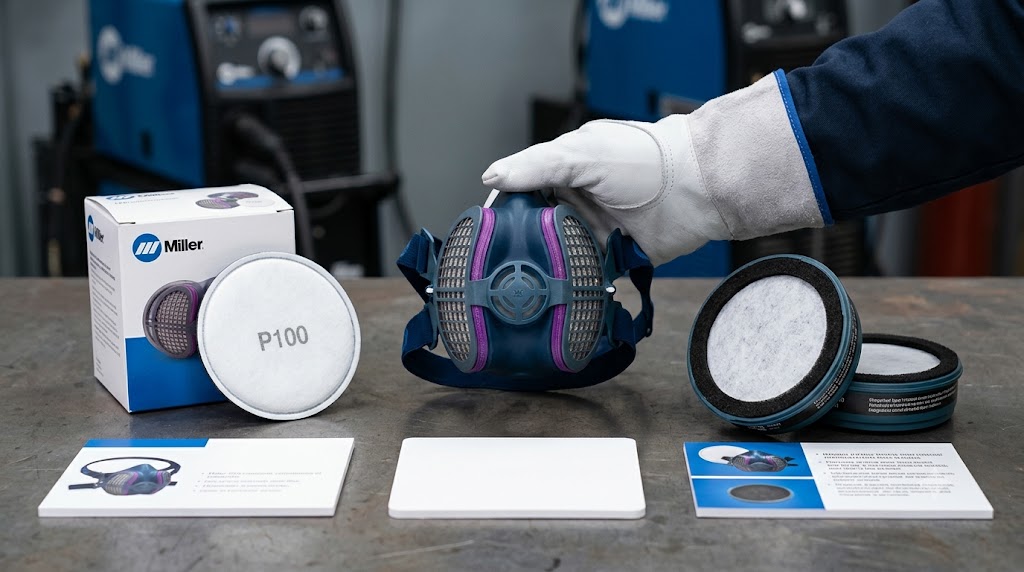
You went to strike an arc, took one breath through your LPR-100, and noticed the airflow felt wrong. That flat, slightly stale pull is the mask telling you something. The filter is spent. The good news: swapping Miller LPR-100 replacement filters takes about 20 seconds once you know which one to grab. The confusing part is that Miller makes two versions for this respirator, and most welders have no idea they exist as separate products until they order the wrong one.
The LPR-100 is one of the most popular low-profile welding respirators on the market. It sits flat against your face, fits under virtually every welding helmet, and delivers NIOSH P100-rated filtration against metal fumes, oil aerosols, and airborne particulates. The filters that power it come in two variants: the SA00818, which filters particles only, and the SA00819, which adds a carbon layer for nuisance-level organic vapor odor relief. Choosing the wrong one is not dangerous, but it can leave you with odors you didn’t need to smell.
If you weld mild steel in a ventilated shop, the SA00818 handles everything you need. If you’re cutting galvanized steel, working near solvents, or welding in a space where the fume smell hangs around even after you’ve stopped, the SA00819 earns its extra few dollars.
What Is the Miller SA00818 Filter?
The SA00818 is the baseline P100 replacement filter for the LPR-100 respirator. The pleated design increases surface area, which reduces breathing resistance even as the filter loads with particulate. Miller rates it at 99.97% filtration efficiency for airborne particles and oil aerosols, which meets the NIOSH P100 standard.
These filters use a push-to-connect interface. You seat them against the mask body, press until they click, and they’re locked. Removal is the same motion in reverse. No threading, no tools. The pair sells on Amazon and ships quickly enough that keeping a backup set in your toolbox is easy.
Miller SA00818 P100 Filters, LPR-100, Pair
One real flaw: the SA00818 has no organic vapor capability at all. If you regularly weld galvanized steel or work near paints and coatings, the particle-only filter lets odors through freely. That’s not a safety issue at most welding exposure levels for particles, but it’s uncomfortable. NIOSH classifies organic vapor at nuisance levels as manageable with the right filter, not a hazard to ignore. The SA00818 is right for clean environments and wrong for odor-heavy ones.
What Is the Miller SA00819 Filter?
The SA00819 does everything the SA00818 does, then adds a layer of activated carbon between the filter media and the facepiece side. That carbon layer is designed to adsorb nuisance-level organic vapor odors so they don’t reach your nose.
The important qualifier: “nuisance level” means concentrations at or below OSHA’s permissible exposure limits (PELs). If you’re welding in a confined space with inadequate ventilation and high vapor concentrations, the SA00819’s carbon layer is not enough. That situation calls for a supplied-air respirator or a full-face respirator with appropriate chemical cartridges. But for the shop welder who notices the smell of galvanizing fumes or solvent-based weld-through primers, the SA00819 is a genuine quality-of-life improvement.
Miller SA00819 P100 Filters with Nuisance OV Relief, Pair
Flaw worth knowing: the carbon layer adds slightly more breathing resistance than the SA00818, especially noticeable during heavy work. Most welders don’t notice it at idle or tacking, but if you’re doing high-amperage overhead work and breathing hard, the added resistance is real. If you prioritize airflow over odor control, stick with the SA00818.
Can GVS Filters Replace Miller SA00818 or SA00819?
GVS makes its own P100 replacement filters, the SPR321, primarily for the GVS Elipse half-mask respirator. Several aftermarket listings claim these are compatible with the LPR-100. The claim is partially true: the filter shape is similar, and some welders have made them fit. But they are not designed for the LPR-100 push-to-connect interface, and Miller does not certify them as approved replacements.
If you want genuine compatibility, use Miller-branded filters. If you own both an LPR-100 and a GVS Elipse, keep the right filters for each mask.
GVS SPR321 P100 Replacement Filters (for Elipse respirators)
That said, GVS filters are excellent in their own right. If you’re shopping for a second respirator, the Elipse P100 is a strong choice. The SPR321 filters are widely available, competitively priced, and fit both S/M and M/L size Elipse masks without a separate part number.
How Often Should You Replace LPR-100 Filters?
NIOSH does not set a universal replacement interval for P100 particulate filters. The reason is that P100 filters fail mechanically (a tear, a crack, a failed seal) before they become chemically saturated, unlike organic vapor cartridges that absorb contaminants over time. In practice, the guidance from respirator manufacturers, including Miller, is to replace filters when:
- Breathing resistance noticeably increases
- The filter is physically damaged or contaminated with liquid
- The filter is discolored or has visible debris on the media
- The respirator was used in an atmosphere immediately dangerous to life or health (IDLH)
For a welder running the LPR-100 daily in a production shop, monthly filter checks are reasonable. For occasional hobby welders, a filter may last a season without degradation. The key is inspection after each session, not a fixed calendar interval.
For the SA00819 specifically: the carbon layer does have a finite adsorption capacity. If you notice odors returning even with fresh-looking filters, replace them regardless of particle loading.
SA00818 vs SA00819: Which One Should You Buy?
| Feature | SA00818 | SA00819 |
|---|---|---|
| P100 particle filtration | Yes (99.97%) | Yes (99.97%) |
| Nuisance OV odor relief | No | Yes |
| Carbon layer | No | Yes |
| Best for | Clean-air welding environments | Galvanized steel, solvents, odor-heavy shops |
| Breathing resistance | Lower | Slightly higher |
| Certified for LPR-100 | Yes | Yes |
For most welders running mild or stainless steel in a ventilated shop, the SA00818 is the right choice. Buy a few pairs and keep them on hand. If you consistently notice odors from galvanizing, weld-through primers, or nearby painting operations, move to the SA00819. Both are genuine Miller filters, both carry P100 protection, and both connect to the LPR-100 with the same push-to-connect system.
The only wrong answer is running a degraded filter because you weren’t sure which to buy.
FAQ
How often should LPR-100 filters be replaced? Replace P100 filters when breathing resistance increases, when the filter shows physical damage, or when visible contamination is present. NIOSH does not mandate a fixed calendar interval for particulate-only filters. For the SA00819’s carbon layer, replace when odors return even with new-looking filters.
What is the difference between SA00818 and SA00819? Both deliver NIOSH P100 particle filtration at 99.97% efficiency. The SA00819 adds an activated carbon layer that reduces nuisance-level organic vapor odors. The SA00818 filters particles only. For odor-free environments, SA00818 is sufficient. For galvanized steel or solvent-heavy shops, SA00819 is the better choice.
Can I use GVS filters instead of Miller SA00818 filters? GVS SPR321 filters are designed for the GVS Elipse respirator, not the Miller LPR-100. Some welders report making them fit, but they are not Miller-certified replacements for the LPR-100. For guaranteed performance and seal integrity, use genuine Miller SA00818 or SA00819 filters with the LPR-100.
What does P100 mean on welding respirator filters? P100 is a NIOSH designation indicating the filter removes at least 99.97% of airborne particles, including oil-based aerosols and metal fumes. The “P” means oil-proof, making it suitable for welding environments where oil-based coolants or mist may be present.
Are LPR-100 filters suitable for hexavalent chromium welding fumes? Yes. P100-rated filters capture particles at the size range of hexavalent chromium fumes generated by stainless steel and chromium-alloy welding. OSHA 1910.1026 specifies P100 as an acceptable minimum filter for hexavalent chromium control when engineering controls are insufficient.
Does the LPR-100 filter system work for MIG, TIG, and stick welding? Yes. The filter targets airborne particulates and aerosols regardless of welding process. The fume profile varies by process and base metal, but the P100 filtration standard covers the solid particle fraction across MIG, TIG, and stick applications. Gaseous by-products like ozone or nitrogen oxides are not captured by a particulate filter alone.
Where can I buy genuine Miller replacement filters? The SA00818 and SA00819 are available on Amazon directly, as well as through authorized Miller Electric distributors and welding supply shops. Be cautious with third-party listings that do not show the actual Miller part number, as aftermarket filters may not meet the push-to-connect fit tolerance of the LPR-100.
References
- https://www.cdc.gov/niosh/npptl/topics/respirators/disp_part/RespSource.html
- https://www.osha.gov/laws-regs/regulations/standardnumber/1910/1910.134
- https://www.osha.gov/laws-regs/regulations/standardnumber/1910/1910.1026
- https://www.millerwelds.com/accessories/welding-safety/respiratory-protection
- Check on Amazon
- Check on Amazon
- https://www.gvs.com/en/catalog/spr-321-pair-of-p100-dust-replacement-filters