Welding Floor Mat and Anti-Fatigue Mat Guide
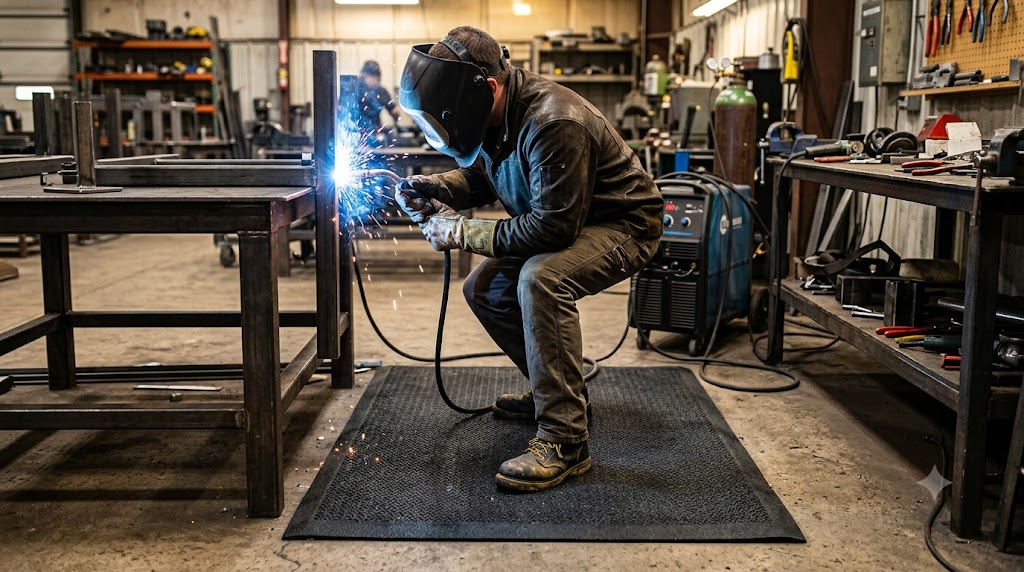
Put in a full day welding on a bare concrete floor and your knees, back, and feet will file a complaint by quitting time. Standing on hard concrete for hours is quietly brutal on the body, and welding adds a twist an ordinary kitchen mat cannot handle: sparks and hot slag rain down constantly. A regular foam anti-fatigue mat would melt or catch. What you want is a mat built for both jobs, cushioning your joints and shrugging off sparks. This guide covers what makes a welding floor mat different, what it can and cannot do, and which to buy.
Welding floor mats are spark-resistant anti-fatigue mats that cushion your feet and legs during long standing while resisting hot sparks and slag. They are made of heat-resistant rubber rather than meltable foam. Here is how to choose.
Why a welding-specific mat
A mat made for welding does two jobs a normal mat cannot combine:
- Anti-fatigue cushioning that reduces the strain of standing on concrete for hours.
- Spark and heat resistance, so falling slag does not melt or ignite the mat.
- Durability against the abuse of a shop floor, from dropped tools to ground-in grit.
- A stable, non-slip surface to stand on while you work.
An ordinary foam mat gives you the first and fails the second; a welding mat delivers both, which is the whole point.
Direct answer: what to look for
When choosing a welding floor mat, weigh these features:
- Spark- and heat-resistant material, typically nitrile or other tough rubber rather than soft foam.
- Anti-fatigue cushioning with enough thickness to relieve your joints.
- A durable, grease- and oil-resistant surface that holds up in a shop.
- Beveled edges so you do not trip and carts roll on and off easily.
- A size that covers where you actually stand.
Strong choices include the M+A Matting Hog Heaven anti-fatigue mat and the Wearwell natural-rubber WeldSafe mat.
Anti-fatigue: why it matters
The anti-fatigue part is not a luxury, it is real ergonomics. Standing still on hard concrete keeps your leg muscles statically loaded and restricts circulation, which is what makes your feet, knees, and lower back ache after hours at the bench. A cushioned mat encourages tiny, constant muscle movements as you subtly shift your weight, which keeps blood flowing and reduces fatigue over a long session. The payoff is not just comfort; less fatigue means steadier hands and better focus late in the day, which shows up in your welds. For anyone who stands at a welding bench for hours, a good anti-fatigue mat is one of the simplest upgrades to how your body feels at the end of a shift.
Spark resistance and the material question
Here is where welding mats diverge sharply from ordinary ones. A standard anti-fatigue mat is usually foam or soft PVC, and hot slag will melt pits into it or, worse, ignite it. A welding mat is made of tough, heat-resistant rubber, often nitrile, that shrugs off sparks and brief contact with hot metal without melting or burning. That resistance is the non-negotiable feature: if a mat is going anywhere near your arc, it must be rated for sparks and heat. Quality welding mats resist grease and oil too, which is handy on a shop floor, and they hold up for years of abuse. When you shop, confirm the mat is specifically described as spark-, flame-, or heat-resistant, not just anti-fatigue, because that single distinction is what keeps a falling bit of slag from ruining the mat or starting a problem.
What a welding mat is not
An honest clarification, because there is a common myth. A rubber welding mat is not a guaranteed electrical safety device, and you should not treat it as your shock protection. While rubber is not a great conductor, a floor mat is not a rated, tested electrical insulation barrier, and relying on it in place of proper practice is a mistake. Your real protection against electric shock comes from dry gloves and clothing, a well-maintained machine, good connections, keeping yourself and your work insulated from a live circuit, and never welding in wet conditions. Think of the mat as doing two jobs well, cushioning your joints and resisting sparks, and leave electrical safety to proper equipment and technique. A mat that helps your back is great; just do not ask it to be something it is not rated to be.
Which welding mats to buy
Here are two dependable options.
- M+A Matting Hog Heaven anti-fatigue mat pairs strong anti-fatigue cushioning with a spark- and heat-resistant, grease-proof surface, a durable mat for a welding bench area. Its limitation is that the premium construction makes it a step up from a basic mat.
- Wearwell natural-rubber WeldSafe anti-fatigue mat uses natural rubber built specifically to resist welding sparks while cushioning your feet, a purpose-made welding floor mat. The trade-off is that natural rubber mats want to be kept away from standing oil for longest life.
How to choose: for an all-around durable cushioned mat with spark resistance, the M+A Hog Heaven. For a mat purpose-built to take welding sparks, the Wearwell WeldSafe.
Who should skip a welding-rated mat: someone who only needs cushioning far from any sparks, who could use a standard anti-fatigue mat, though most welders are better served by the spark-rated kind.
The bottom line
A welding floor mat does two jobs an ordinary mat cannot combine: it cushions your feet, knees, and back through long hours on concrete, and it resists the sparks and slag that would melt or ignite a foam mat. Look for tough, heat-resistant rubber described specifically as spark- or flame-resistant, with real anti-fatigue thickness, a grease-resistant surface, and beveled edges. Just remember what a mat is not: it is not rated electrical shock protection, so keep your electrical safety in proper gloves, gear, and technique. The M+A Hog Heaven and Wearwell WeldSafe mats deliver the cushion and spark resistance that matter, and your body will thank you at the end of the day.
FAQ
Are anti-fatigue mats safe for welding? Only if they are spark- and heat-resistant. A standard foam or PVC anti-fatigue mat will melt or ignite from hot slag. A welding-rated mat is made of tough heat-resistant rubber that shrugs off sparks while still cushioning your feet, so confirm the mat is described as spark-, flame-, or heat-resistant before using it near your arc.
What are welding floor mats made of? Heat-resistant rubber, often nitrile or natural rubber, rather than the soft foam used in ordinary anti-fatigue mats. That rubber resists melting and burning from sparks and brief hot-metal contact, and quality mats also resist grease and oil, holding up to years of shop-floor abuse.
Do welding mats protect against electric shock? No, not reliably. A rubber mat is not a rated, tested electrical insulation barrier and should not be treated as shock protection. Your real protection comes from dry gloves and clothing, a well-maintained machine, good connections, and never welding in wet conditions. The mat’s jobs are cushioning and spark resistance.
Does an anti-fatigue mat really reduce fatigue? Yes. Standing still on hard concrete keeps leg muscles statically loaded and restricts circulation, causing aches. A cushioned mat encourages small constant muscle movements that keep blood flowing, reducing fatigue over long sessions. Less fatigue also means steadier hands and better focus late in the day.
How thick should a welding mat be? Thick enough to relieve your joints while staying stable to stand on, commonly around half an inch to three quarters of an inch for anti-fatigue models. Too thin and it cushions little; too soft or thick and it can feel unstable. Choose a mat that balances cushioning with a firm, secure footing.
How long do welding floor mats last? Quality spark-resistant rubber mats typically last several years even with regular abuse, resisting sparks, grease, and dropped tools. Lifespan depends on how heavy the use is and how much hot slag and oil the mat sees, but a purpose-built welding mat far outlasts a foam mat that would melt quickly.
References
- M+A Matting and Wearwell anti-fatigue and welding mat specifications, including spark and heat resistance (manufacturers), mattingexperts.com, wearwell.com.
- OSHA and general ergonomics guidance on standing fatigue and anti-fatigue matting (regulator and industry resources), osha.gov.
- Lincoln Electric and Miller Electric guidance on welding electrical safety and shock prevention (manufacturers), lincolnelectric.com, millerwelds.com.