Welding Gear for Winter and Cold Weather Shops
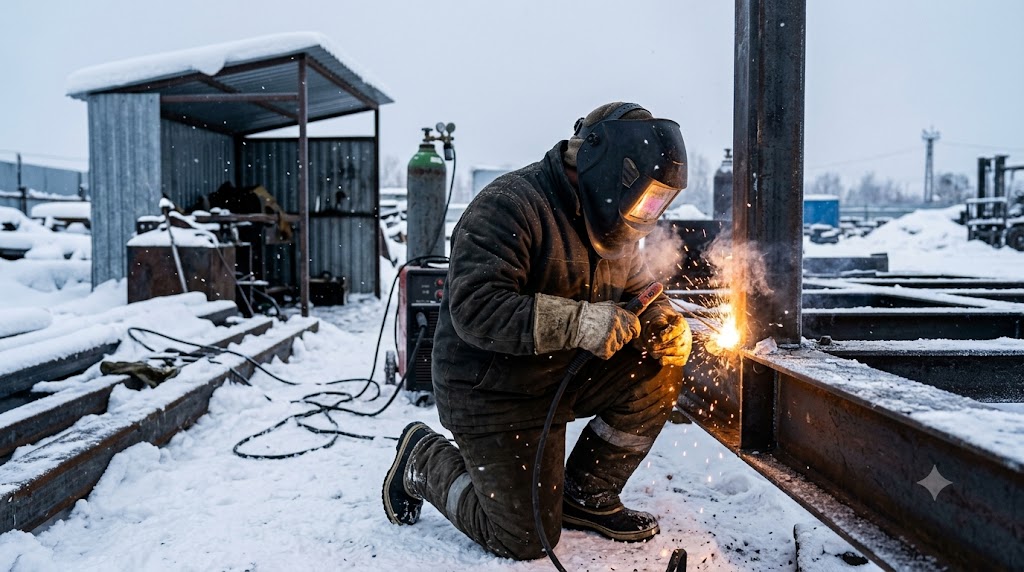
Cold weather welding presents a dual challenge: staying warm enough to work effectively while maintaining the dexterity and FR protection that welding requires. A poorly heated shop or outdoor job site in winter is genuinely dangerous - cold hands lose dexterity fast, and layering synthetic materials under FR outerwear can create fire hazards.
Layering Strategy for Cold Weather Welding
The core principle: every layer touching your skin must be either natural fiber or FR-rated. Synthetics (polyester, nylon) melt when exposed to spatter - even under FR outer layers.
Layer 1 (Base): FR Underlayer or Natural Fiber
- FR long underwear (available from Carhartt, Tyndale) - the safest option
- 100% cotton long underwear - natural fiber is acceptable if FR underlayer is unavailable
- Avoid: Polyester or nylon base layers (will melt against skin if the FR outer layer is breached)
Layer 2 (Mid): FR Cotton Sweatshirt / Hooded Layer
- Carhartt FR Force Sweatshirt - NFPA 2112 rated
- 100% cotton sweatshirt - natural fiber acceptable for moderate cold
- Avoid: Synthetic fleece or blended-fiber mid-layers under FR outerwear
Layer 3 (Outer): Insulated FR Jacket
- Carhartt FR Duck Active Jacket - 13 oz. FR duck, FR quilt lining; NFPA 2112 / HRC 4
- Carhartt FR Traditional Coat - Level 3 warmth; heaviest Carhartt FR option
- Black Stallion JF series - FR cotton insulated jackets
- Avoid: Standard insulated jackets with polyester fill under welding conditions
What Welding Gear Holds Up Best in Cold Weather Shops?
Helmet: No special concern
Welding helmets perform normally in cold. Solar + battery helmets (Lincoln Viking, Miller Digital Elite, YESWELDER) function well down to typical workshop temperatures. Extreme cold (-20°F and below) can reduce battery efficiency; keep a backup battery.
Jacket: Insulated FR
The Carhartt FR Duck Active Jacket is the most widely recommended insulated FR jacket for cold weather welding. Its FR quilt lining provides warmth without synthetic fill risk.
Gloves: Cold weather creates dexterity tradeoffs
This is where cold weather creates the hardest tradeoffs in welding PPE (see below).
Boots: Insulated welding boots
- Thorogood American Heritage with 400g insulation option
- Timberland PRO Boondock with 400g insulation
- Avoid: Uninsulated boots for extended cold weather shop work
Do Insulated Jackets Reduce Dexterity?
For most welding processes: minimal impact. The jacket protects the torso and arms - dexterity is primarily in the hands and fingers, which are covered by gloves.
Insulated jackets are bulkier, which matters for:
- Crawling through tight spaces (pipe welding, structural confined areas)
- Overhead welding where extra bulk makes positioning harder
For general shop welding in a stationary position, insulated jackets do not meaningfully reduce working effectiveness.
What Gloves Work Best for Winter Welding?
This is the central dexterity tradeoff in cold weather welding:
TIG Welding in Cold
- Problem: TIG requires thin, dexterous gloves. Insulated gloves reduce feel on the torch.
- Solution 1: Heat the shop adequately before TIG work. The precision of TIG demands real dexterity that thick gloves cannot provide.
- Solution 2: Caiman 1871 (Insulated Back) - goatskin unlined palm for dexterity, wool-insulated back for warmth. The best cold-weather TIG glove compromise.
- Solution 3: Short TIG sessions with TIG-grade gloves; warm hands between passes.
MIG/Stick Welding in Cold
- Caiman 1878 or Tillman 5218 (heavyweight cowhide) - heavier leather naturally provides more thermal insulation
- Extended arm coverage (21–23” sleeve/glove combo) for overhead work
FR Liner Gloves
- Some welders wear a thin FR liner glove under their welding gloves for additional warmth without sacrificing outer glove protection
Cold Weather Welding Gear Checklist
- FR or 100% cotton base layer
- FR or 100% cotton mid layer
- Insulated FR outer jacket (Carhartt FR, Black Stallion insulated FR)
- Insulated welding boots (400g or equivalent)
- Cold weather welding gloves (Caiman 1871 for TIG; heavyweight cowhide for MIG/stick)
- Backup helmet battery if working in extreme cold
- FR beanie or balaclava (100% cotton or FR rated; avoid synthetic)
FAQs
What welding gear holds up best in cold weather shops? Insulated FR jackets (Carhartt FR Duck Active), insulated welding boots (400g options from Thorogood or Timberland PRO), and cold weather gloves with insulated backs.
Do insulated jackets reduce dexterity? Minimal impact on most welding. Bulkier for confined-space work; no issue for stationary shop welding.
What gloves work best for winter welding? For TIG: Caiman 1871 (insulated back, unlined palm). For MIG/stick: heavyweight cowhide gloves with longer cuffs for radiant heat protection.