yeswelder large view welding helmet parts guide
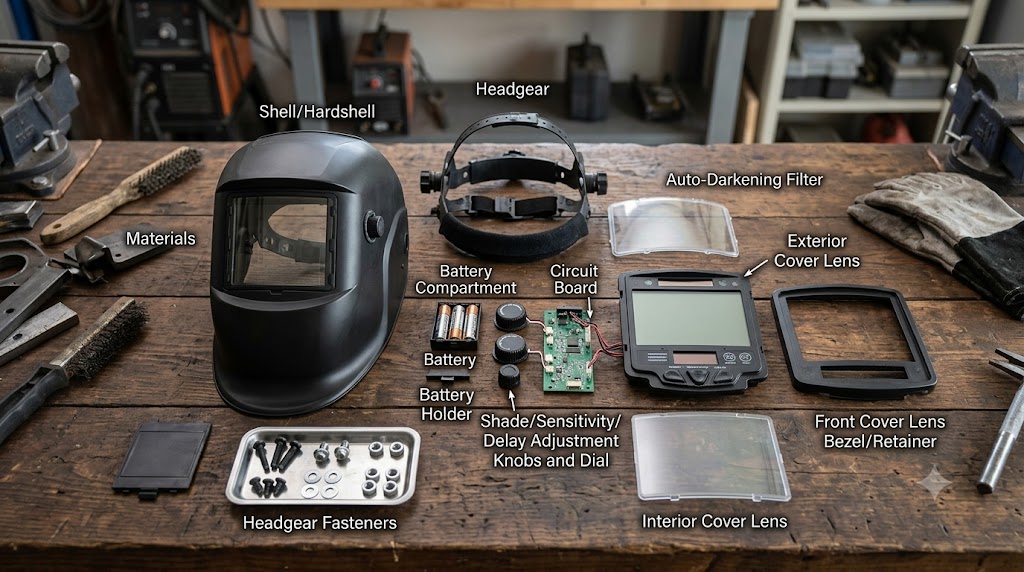
The YESWELDER Large View hood is the kind of helmet people buy because the lens feels generous on day one, then they forget about the small parts until the cover lens is scarred and the battery is tired. That is when yeswelder large view welding helmet parts becomes less of a search term and more of a way to save a hood that still has useful life left.
The YESWELDER Large View LYG-L500A and LYG-L600A family is an auto-darkening welding helmet line with a 3.64 by 1.67 inch viewing area, true-color 1/1/1/1 optical clarity on the official product pages I verified, two premium sensors, a solar cell, and a replaceable CR2450 battery. It is a simpler helmet than the M800H-style wide-screen models, but that simplicity is part of the appeal.
Direct answer: the Large View model uses a replaceable CR2450 battery with solar assistance, and replacement lenses are sold separately under the JP05-L500A family. My verdict: this is a serviceable entry-to-mid-level hood if you keep spare covers around, but it is not the model I would choose if you want a huge lens or four-sensor arc coverage.
Quick verdict: simple, serviceable, not huge
YESWELDER’s official L500A and L600A pages list the viewing size as 3.64 by 1.67 inches, with two premium sensors and 1/1/1/1 optical clarity. That combination makes sense for a compact, general-use helmet, not a panoramic shop hood.
The honest flaw is right in the name. “Large View” sounds bigger than it feels once you compare it with modern wide-screen helmets. It is larger than many tiny old cartridges, but it does not give you the window-like view of a Miller Digital Infinity, ESAB Sentinel A60, or YESWELDER M800H-style shell.
I would buy it for a home shop, training setup, or backup hood where clean parts support matters. I would skip it if you weld all day out of position, need maximum sensor coverage, or want the least restrictive view possible.
What battery does the YESWELDER Large View model use?
YESWELDER’s official L500A and L600A pages list a replaceable CR2450 battery and a solar cell power supply. The battery is the service item you can replace. The solar cell assists the auto-darkening system during use.
Do not confuse solar assisted with battery-free. If the helmet has been sitting in a cabinet, the CR2450 can still be weak. A solar panel on the front does not save you from testing the lens before you strike an arc.
Keep a CR2450 near your cover lenses. It is a small habit that keeps a simple hood from becoming a dead hood right when you need to tack a bracket back together.
Are replacement lenses sold separately?
Yes. The replacement lens family to look for is JP05-L500A for the L500A-style helmet. The official YESWELDER helmet pages also list included replacement lenses in some packages, but do not count on that forever. Cover lenses are consumables, not collector’s items.
A pitted outside cover lens is more than ugly. It scatters light, muddies your view, and makes a decent ADF feel cheap. If you are constantly wiping smoke film and spatter freckles off the same cover, replace it.
Compared with premium hoods, this is where the Large View model does well. The lens shape and battery are not exotic, and the parts are easy enough to search by model code. Compared with a generic no-name hood, the YESWELDER model numbers give you a better trail to follow.
What is the viewing area size?
The official YESWELDER L500A and L600A pages list the view area as 3.64 by 1.67 inches, or 92.5 by 42.5 mm. That is the number I would trust over marketplace copy that tries to make every helmet sound enormous.
The viewing area is enough for general MIG, stick, and TIG work, especially if you are welding at a bench. It is less forgiving when your head is twisted into a trailer frame, under a machine, or around a pipe where you want as much peripheral view as possible.
If you are choosing between this and the M800H-style YESWELDER, the M800H is the more open-feeling hood. If you are choosing between this and a basic fixed narrow cartridge, the L500A-style helmet is the easier one to live with.
Two sensors, not four
YESWELDER’s official L500A and L600A pages list two premium sensors. I would not claim four sensors for this helmet unless your exact product page and model label say it.
This matters because sensor count affects how forgiving the helmet can be when part of the arc is blocked by your hand, workpiece, torch angle, or a tight corner. Four sensors are not magic, but they do give a helmet more chances to see the arc.
The Large View model is fine for normal bench and shop work. If you regularly weld in awkward positions where sensors can get shadowed, I would step up to a four-sensor helmet.
Verified Amazon listings
I verified for a YESWELDER LYG-L500A-style auto-darkening welding helmet listing.I also verified for a black LYG-L600A-W variant listing.
My advice is to treat color and suffix variants carefully. If the listing says LYG-L600A-W, do not assume every L500A graphic shell uses the exact same accessories without checking the description.
The flaw in the marketplace experience is that titles can mix “L500A,” “L600A,” “large view,” and color suffixes loosely. The official YESWELDER pages are the better place to confirm battery, sensor count, and viewing area.
Headgear: replace it if it starts slipping
YESWELDER commonly uses TG02 headgear across parts discussions, but headgear compatibility should be checked against your exact helmet. A loose ratchet or cracked pivot makes a light hood feel worse than a heavier helmet that stays put.
If your helmet drops when you nod or will not hold the angle you set, do not blame the shell first. Check the headgear and pivot points. A replacement headgear can make an otherwise decent hood worth keeping.
Compared with ESAB’s HALO headgear or Miller’s higher-end headgear, YESWELDER’s headgear is more basic. That is not a dealbreaker for occasional work, but it is a real reason to skip this hood for all-day production welding.
Safety and lens maintenance
AWS notes that welding arcs can expose eyes to UV, visible, and IR radiation, and OSHA’s eye-protection guidance explains that shade selection depends on the intensity of the welding or cutting process. That is why a clean, functioning ADF matters.
Inspect the outside cover lens, inside lens, and ADF before you weld. Replace cracked, pitted, or deeply scratched covers. Test the auto-darkening function before trusting it near a live arc.
A cheap cover lens is not the place to stretch one more week. If you are squinting through scratches, your weld quality and your comfort both suffer.
Final verdict
The YESWELDER Large View L500A and L600A family is easy to understand once you cut through the listing noise. It uses a CR2450 battery, solar assistance, two sensors on the official spec, and a 3.64 by 1.67 inch viewing area.
I would buy it if you want a simple, serviceable hood and you can live with a moderate viewing window. I would skip it if you want four sensors, premium headgear, or a truly wide field of view.
Before ordering parts, look for the model code inside your helmet. If it says LYG-L500A or LYG-L600A, you have a much better shot at matching the right battery, lens covers, and headgear without guessing.
FAQ
What battery does the YESWELDER Large View model use?
The official YESWELDER L500A and L600A pages list a replaceable CR2450 battery. The helmet is also solar assisted.
Are replacement lenses sold separately?
Yes. Look for the JP05-L500A replacement lens family for L500A-style helmets, and verify the model code before ordering.
What is the viewing area size?
YESWELDER lists the view area as 3.64 by 1.67 inches, or 92.5 by 42.5 mm.
Does the L500A have two sensors or four sensors?
The official YESWELDER pages I verified list two premium sensors. Do not claim four sensors for this model unless your exact product page proves it.
Is the YESWELDER Large View solar powered?
It uses a solar cell plus a replaceable battery. Solar assistance does not remove the need to replace the CR2450 when it weakens.
Is the L500A good for TIG welding?
YESWELDER lists the model as suitable for TIG, MIG, stick, and grind. For low-amp or awkward TIG work, I would still prefer a higher-end four-sensor hood.
Who should skip the YESWELDER Large View helmet?
Skip it if you want a panoramic lens, premium headgear, or four-sensor arc detection. It is better as a simple general-use hood than a daily production helmet.
References
- https://yeswelder.com/products/welding-helmet-l500a
- https://yeswelder.com/products/welding-helmet-l500aa
- Check on Amazon
- Check on Amazon
- https://www.osha.gov/sites/default/files/publications/OSHAFACTSHEET-EYEPROTECTION-DURING-WELDING.pdf
- https://www.aws.org/magazines-and-media/welding-digest/2025/november/wd-nov-2025 - complete-welding-lens-shade-chart - safety-guide-for-eye-protection/