Best Welding Respirator: Full Buying Guide
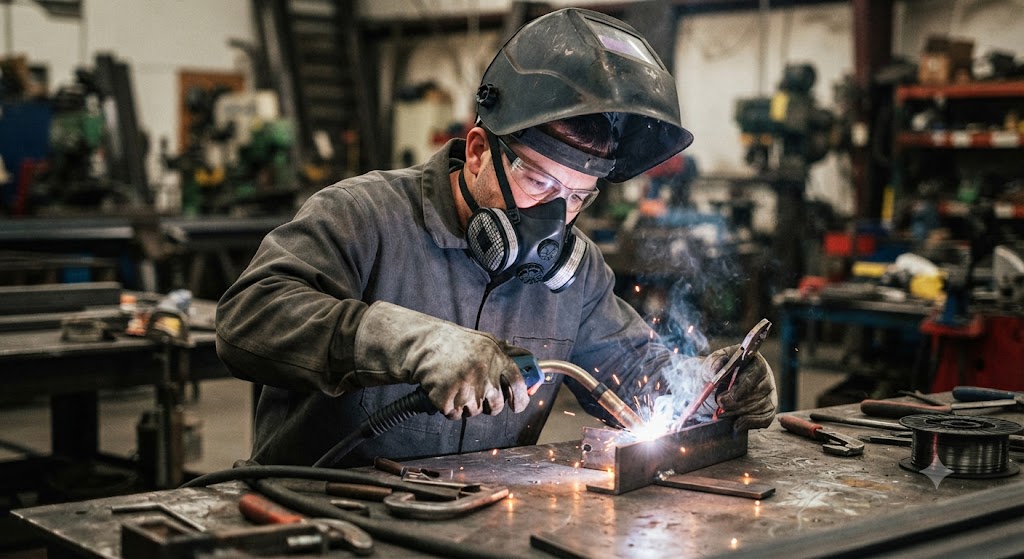
A helmet keeps the arc out of your eyes. A respirator keeps the fume out of your lungs. Most welders figure out the first one on day one and spend years ignoring the second. That’s the situation OSHA 29 CFR 1910.134 exists to address, and it’s the reason the welding respirator category has grown from a niche accessory to a standard part of the PPE stack in serious shops.
Here’s the ranked verdict: for most welders doing production work with mild steel, stainless, or galvanized material in a shop with general mechanical ventilation, a P100 half-mask respirator is the right tool. A PAPR makes sense for specific environments with elevated fume concentrations or when a half-mask can’t achieve a proper fit. Here’s how to choose, and the best options at each level.
What Does a Welding Respirator Actually Do?
A welding respirator is an air-purifying respirator (APR) designed to remove welding fumes, solid metal particulates, and aerosols from the air you breathe before it reaches your airway. Arc welding generates a complex aerosol: metal oxides, flux decomposition products, and base-metal fumes that vary by electrode, base material, and shielding gas. Many of these - hexavalent chromium from stainless, manganese from alloy steels, zinc oxide from galvanized, lead and cadmium from coated metals - are regulated substances with OSHA permissible exposure limits.
Respirators are the last line of defense in the hierarchy of controls. Ventilation and substitution come first. When those controls don’t reduce exposures below OSHA PELs, a properly selected, fit-tested respirator rated for the specific hazard is required.
The Direct Answer: What Rating Do Welders Need?
For welding fume particulates, the minimum filter class is P100. Here’s why P over N matters: welding environments can contain oil-based aerosols from cutting fluids, lubricants, and coatings. N-class filters (N95, N100) are not oil-resistant. P-class filters are. P100 delivers 99.97% filtration efficiency against both oil and non-oil-based particles and aerosols. A NIOSH-certified P100 filter is the correct baseline for any production welding respirator.
For environments with organic vapor hazards (coatings, solvents, isocyanate-containing primers), add an OV cartridge rated for the specific vapor. Particulate-only P100 filters block particles; they do not block gases or vapors.
For most welders in ventilated shops, a P100 half-mask with an APF of 10 is sufficient. For high-concentration environments, confined spaces, or regulated substances near or above the action level, step up to a full-face APR (APF 50) or a PAPR (APF 25 for loose-fitting).
Best Picks
Best Overall Half-Mask: GVS Elipse P100
The GVS Elipse P100 is the flattest, lightest NIOSH-certified P100 half-mask available, and it fits under virtually every welding helmet on the market. The low-profile pleated filter design keeps the cartridges close to the cheeks instead of projecting outward, which is how the Elipse became the OEM platform for both the Miller LPR-100 and the Klein Tools 60552. All three are the same mask in different packaging.
Verdict: the best all-around half-mask for welders who need helmet compatibility without sacrificing filtration. Named flaw: the integrated filter design means your cartridge options are limited to P100 and P100 with nuisance OV relief. There are no full OV or acid gas options for the Elipse platform, so it’s not the right choice for environments with significant vapor hazards requiring rated cartridge protection.
Best for Mixed Hazards: 3M 6502QL
If your welding environment includes organic vapors, acid gases, or other chemical hazards in addition to particulate fumes, the 3M 6500 series half-mask gives you access to the broadest cartridge selection of any half-mask respirator. The Quick Latch mechanism lets you drop the mask below your chin without removing head straps, which is genuinely useful when moving between clean and contaminated areas repeatedly.
The 3M 2091 P100 filter is the standard pairing for welding fume. For stainless or galvanized with both particulate and vapor concerns, the 60926 combination cartridge (OV/P100) handles both in one unit.
Verdict: the most versatile half-mask for complex shop environments. Named flaw: the wider cartridge profile makes it harder to fit under close-fitting helmets than the GVS Elipse. It also runs slightly heavier.
Best Budget Half-Mask: Klein Tools 60552
The Klein Tools 60552 is another GVS Elipse rebrand - the same mask body, same P100 filter system, same helmet compatibility. Klein Tools sells it through electrical and construction supply channels and it’s frequently available at competitive pricing. If you’re looking for the Elipse platform and the Klein listing is priced lower, buy that one.
Verdict: identical protection to the GVS Elipse and Miller LPR-100. Named flaw: replacement filters must be sourced from Klein or GVS; availability through general hardware stores is less consistent than the GVS direct listing.
Klein Tools 60552 P100 Half-Mask M/L
Best for Heavy Fume Environments: YESWELDER LYG-Q800D PAPR
When a half-mask APF of 10 isn’t enough - consistently high fume concentrations, poor ventilation, or metals with low PELs - a PAPR-integrated welding helmet provides both wide-field optics and powered air delivery in a single unit. The LYG-Q800D’s panoramic 180-degree view and 1/1/1/1 optical clarity are legitimate strengths as a helmet. The integrated PAPR provides airflow under positive pressure and doesn’t require fit testing.
Verdict: the right tool for high-fume environments or welders who can’t achieve a reliable tight-fitting respirator seal. Named flaw: verify current NIOSH certification documentation before using in a formal workplace respiratory protection program; the 3M Adflo and Miller T94i have cleaner compliance documentation for regulated industrial environments. The LYG-Q800D is best suited for personal shop use or environments where formal program compliance isn’t the primary driver.
Honorable Mention: Miller LPR-100 Gen II
The Miller LPR-100 is functionally identical to the GVS Elipse and worth mentioning because many welders already have it through their Miller dealer. If you own one, know that GVS SPR321 filters are cross-compatible with Gen II models, which lowers your consumable cost. If you’re buying new, compare current prices between the LPR-100 and the GVS Elipse directly.
Miller LPR-100 Gen II M/L (ML00895)
Is a Half-Mask Enough, or Do You Need a PAPR?
For the majority of welders in shops with general mechanical ventilation:
- Mild steel, carbon steel: P100 half-mask is sufficient at exposures below 10x PEL
- Stainless steel: P100 half-mask covers hexavalent chromium below 10x the Cr(VI) PEL (5 µg/m³ per OSHA 1910.1026); higher concentrations need full-face or PAPR
- Galvanized: P100 covers zinc oxide fumes; ensure ventilation is operating, as metal fume fever is a real risk even with a half-mask if exposure is high enough
- Confined spaces, poor ventilation, or repeated high-fume-load work: PAPR or full-face respirator
- Facial hair, fit-test failure on tight-fitting units: PAPR (no fit test required for loose-fitting)
How Often Should Filters Be Changed?
P100 particulate filters don’t have a fixed time-based replacement schedule. Replace them when:
- Breathing resistance increases noticeably during use
- The filter is physically wet, torn, or deformed
- The filter shows visible contamination or discoloration through the filter media
- The mask develops persistent odors that aren’t addressed by nuisance OV filters
In heavy fume production environments, that may be daily or every few shifts. In lighter use, a pair may last weeks. Never attempt to wash or reuse P100 filters; washing degrades the electrostatic fiber charge that enables the 99.97% efficiency rating.
Comparison Table
| GVS Elipse SPR457 | 3M 6502QL | Klein Tools 60552 | YESWELDER LYG-Q800D | Miller LPR-100 ML00895 | |
|---|---|---|---|---|---|
| NIOSH P100 | Yes | Yes (with 2091) | Yes | Verify certification | Yes |
| APF | 10 | 10 | 10 | 25 (loose-fitting PAPR) | 10 |
| Helmet clearance | Excellent | Good | Excellent | N/A (integrated) | Excellent |
| OV cartridge option | Nuisance only | Full rated OV | Nuisance only | Built-in airflow | Nuisance only |
| Fit test required | Yes | Yes | Yes | No | Yes |
FAQ
What respirator rating do welders need for fumes? P100 is the standard for welding fume particulates. P100 NIOSH-certified filters deliver 99.97% efficiency and are oil-resistant, making them appropriate for the mixed aerosol environment of arc welding. N-class filters are not oil-resistant and are not the right choice for most welding environments.
Is a half-mask enough, or do I need a PAPR? For most welders in ventilated shops doing mild to moderate fume work, a P100 half-mask (APF 10) is adequate. A PAPR (APF 25) is appropriate when half-mask protection isn’t sufficient for the fume concentration, when you can’t achieve a reliable fit-test seal, or when working in confined or poorly ventilated spaces.
How often should filters be changed? Replace P100 filters when breathing resistance increases, when they are physically damaged or wet, or when persistent odor indicates saturation. There is no fixed time interval. In heavy production environments, daily replacement may be necessary. Never wash and reuse P100 filters.
Do I need to be fit tested? Yes, for any tight-fitting respirator (half-mask or full-face) used under an OSHA-required respiratory protection program per 29 CFR 1910.134. Loose-fitting PAPRs do not require fit testing. Even for voluntary use, perform a positive/negative pressure seal check before every use.
Can I weld stainless with just a P100 half-mask? For hexavalent chromium exposures below 10x the OSHA PEL (50 µg/m³ for a P100 half-mask with APF 10, given a PEL of 5 µg/m³), yes. Above that concentration, a full-face respirator or PAPR is required. Industrial hygiene monitoring is the proper way to determine your actual exposure level.
What’s the difference between P100 and N95 for welding? P100 is oil-resistant and rated at 99.97% efficiency. N95 is not oil-resistant and rated at 95% efficiency. Welding environments contain oil-based aerosols. For general welding, P100 is the correct filter class. N95 is not recommended for production welding environments.
References
- https://www.osha.gov/laws-regs/regulations/standardnumber/1910/1910.134
- https://www.cdc.gov/niosh/npg/nengapdxe.html
- https://www.osha.gov/sites/default/files/publications/OSHA_FS-3647_WELDING.pdf
- https://www.gvs.com/en/catalog/elipse-p100-niosh-respirator
- https://www.millerwelds.com/en-US/safety-products/weld-fume/respiratory/half-mask-respirators-m00469/lpr-100-gen-ii-half-mask-respirator-m-l-294962
- https://www.3m.com/3M/en_US/worker-health-safety-us/personal-protective-equipment/welding-disposable-and-reusable-respirator-sample/
- https://www.kleintools.com/catalog/respirators/p100-half-mask-respirator-ml-0
Title: Best Welding Respirator: P100 Buying Guide Meta: Ranked guide to the best welding respirators including GVS Elipse, 3M 6502QL, Klein Tools, Miller LPR-100, and YESWELDER PAPR. Covers P100 vs PAPR and OSHA requirements. Slug: best-welding-respirator Excerpt: For most welders, a P100 half-mask is the right answer. For high-fume environments or fit-test failures, a PAPR steps up protection. Here are the best picks at both levels, with verified and honest named flaws.