Carbon Felt Welding Blanket: Full Buying Guide
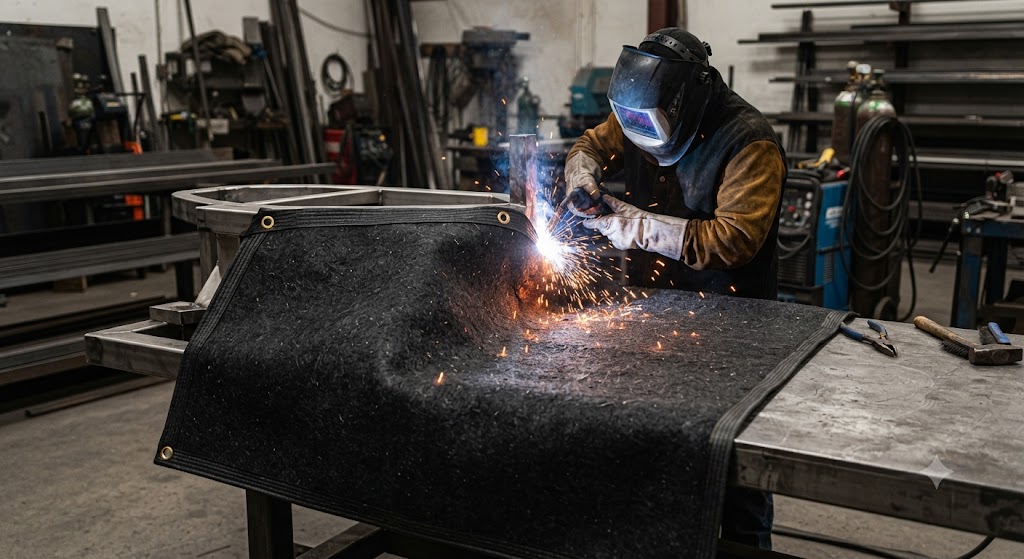
Pull a carbon felt welding blanket out of the box and your first reaction is usually surprise at how soft it feels. Nothing like fiberglass. No itch, no irritation, no glass strands working their way into your skin. The material is a dense, flexible felt made from carbonized fibers — the same basic chemistry behind carbon fiber but in a non-woven mat form — and it handles heat in a way that standard fiberglass simply can’t match at the high end.
A carbon felt welding blanket is a heat-resistant mat made from carbonized polyacrylonitrile (PAN) fibers. The fibers don’t burn or melt the way synthetic materials do; they char and maintain structure under extreme heat. Carbon felt is used as a welding blanket for high-temperature welding work, stress relief, and any application where the blanket may contact sustained high heat rather than just incidental sparks and spatter.
If you’re doing TIG welding on stainless or titanium, working around post-weld heat treatment, or you simply want the most thermally capable blanket available without stepping up to heavy ceramic fiber, carbon felt is the right material.
Verdict
Waylander is the top carbon felt pick for most welders — made in the USA, rated to 1800°F, and cuttable to any shape without fraying. For smaller format and bench work, Hansway’s carbon felt blanket covers localized applications well. If you want a brand name with established welding supply credibility, Tillman’s ThermoFelt 615B series is rated at 1800°F and available through mainstream welding channels.
What Makes Carbon Felt Different from Fiberglass
The short version: carbon felt runs hotter.
Standard fiberglass blankets are rated to 1000°F to 1022°F. Heavier vermiculite fiberglass (like the Tillman 596B) gets you to 1200°F on flat surfaces. Carbon felt — from Waylander, Hansway, and Tillman’s ThermoFelt line — is rated to 1800°F per manufacturer data.
That 600°F to 800°F gap matters for specific applications. Stress relief work, pipe preheat applications, or any setup where the blanket takes sustained radiant heat rather than just occasional spatter can push into the range where fiberglass degrades and carbon felt holds.
Beyond temperature: carbon felt is soft, flexible, and cuttable with scissors. No grommets, no rigid edges. You can cut it to fit around irregular shapes in a way that a fiberglass blanket can’t. The trade-off is that carbon felt typically comes in smaller sizes and doesn’t hang as a curtain the way fiberglass does.
Top Carbon Felt Welding Blanket Picks
1. Waylander Carbon Felt Welding Blanket — Top Pick
Waylander’s carbon felt blanket is made in the USA from high-quality PAN (polyacrylonitrile) fiber. The manufacturer rates it to 1800°F (1000°C), consistent with carbon felt’s performance as a material and confirmed on the brand’s own product page.
The design is intentionally simple: no threads, no grommets, no bound edges. The felt can be cut with large scissors to any size or shape, which makes it adaptable to setups where a fixed-size blanket won’t work. Available in multiple sizes including 24x24 inch and 36x36 inch.
Named flaw: no grommets means no built-in hanging points. If you need to hang the blanket vertically as a welding curtain, you’ll need clamps or improvised attachment hardware. For floor and flat surface applications this is not a problem; for curtain-style overhead use, it requires extra setup.
Waylander Carbon Felt Welding Blanket on Amazon
2. Hansway Carbon Felt Welding Blanket — Best for Smaller Format Work
Hansway makes carbon felt welding blankets in smaller configurations — the 12x12 inch square is practical for localized heat shielding, torch work, and desktop soldering setups. The 36x36 inch version covers more substantial work areas.
The 1800°F rating is consistent with standard PAN carbon felt performance, and is confirmed by independent product review of the Hansway blanket.
Named flaw: the largest standard Hansway format is 36x36 inches, which limits it for full-table or large floor coverage. If you need to cover a wide area, you’ll need multiple pieces. For localized protection and workbench use, the size is practical and the cost per piece is accessible.
Hansway Carbon Felt Welding Blanket (12x12 in.) on Amazon
Hansway Carbon Felt Welding Blanket (36x36 in.) on Amazon
3. Tillman ThermoFelt (615B) — Best for Welding Supply Chain Credibility
Tillman’s ThermoFelt line uses panoxidized felt — a material in the same family as carbon felt, made from pre-oxidized PAN fiber. The Amazon product listing for the 615B states a 1800°F working temperature. Tillman describes ThermoFelt as non-flammable, non-melting, non-shrinking, and scratch-free.
It’s notably softer than fiberglass alternatives and works well as a surface protector under workpieces. The trade-off: Tillman notes that smoking and loss of tensile strength will occur when the blanket is subjected to molten metal contact. Like carbon felt generally, this is a heat shield, not a weld backing.
Named flaw: Tillman’s ThermoFelt is available in relatively small sizes (6x6 ft and under for most listings), and the 16 oz weight is on the lighter side for high-volume spatter environments. It’s excellent for light welding protection and surface scratch resistance. In heavy production environments with significant spatter volume, the thicker Waylander carbon felt holds up better.
Tillman 615B ThermoFelt Welding Blanket on Amazon
What About Klutch Carbon Felt?
Klutch makes a carbon felt welding blanket (18x18 inch, black) available from Northern Tool. A current Amazon listing for Klutch carbon felt blankets could not be verified at the time of writing. If you’re a Northern Tool customer, check their site directly at northerntool.com. For a verified Amazon purchase, Waylander or Hansway are the alternatives.
Can Carbon Felt Be Cut to Size?
Yes, and this is one of its real advantages over fiberglass. Carbon felt without bound edges or embedded threads can be cut cleanly with heavy-duty scissors or a utility knife. Waylander specifically calls this out — no threads means clean cuts without fraying.
This makes carbon felt practical for wrapping irregular shapes: pipe sections, valve bodies, curved surfaces. You cut it to fit. Fiberglass blankets with bound edges and grommets don’t give you that flexibility without degrading the hem.
Comparison Table
| Blanket | Temp Rating | Cuttable | Format | Best Use |
|---|---|---|---|---|
| Waylander | 1800°F | Yes | Multiple sizes up to 36x36 in | General high-temp, custom fit |
| Hansway | 1800°F | Yes | Up to 36x36 in | Bench work, localized protection |
| Tillman 615B ThermoFelt | 1800°F | Yes | Up to 6x6 ft | Shop use, scratch protection |
| Klutch | Not verified on Amazon | Yes | 18x18 in | Northern Tool customers |
FAQ
What is a carbon felt welding blanket used for? Carbon felt welding blankets protect surfaces and materials from weld spatter, radiant heat, and high-temperature exposure. They’re used for welding, stress relief, pipe preheat, torch work, and any application requiring heat shielding at temperatures above what standard fiberglass handles.
Can carbon felt blankets be cut to size? Yes. Carbon felt without bound edges or embedded threads can be cut with large scissors or a utility knife. This makes it easy to custom-fit around irregular shapes. Waylander and Hansway blankets are both cuttable.
How does carbon felt compare to fiberglass for heat resistance? Carbon felt is typically rated to 1800°F, compared to 1000°F for standard fiberglass and 1200°F for heavy vermiculite fiberglass (Tillman 596B). For applications involving sustained high heat or temperatures above 1200°F, carbon felt is the appropriate material. For standard shop spatter protection, fiberglass is sufficient and costs less.
Does carbon felt itch like fiberglass? No. Carbon felt is made from PAN fibers that are soft to the touch. There is no glass strand shedding and no skin irritation from handling. This is one of its practical advantages over fiberglass in applications where the blanket is handled frequently or repositioned.
Can carbon felt take direct contact with molten metal? No. Like fiberglass blankets, carbon felt is a heat shield, not a weld backing material. It protects surfaces from spatter and radiant heat, but sustained contact with a weld puddle or molten slag will damage the material.
What is the difference between carbon felt and carbon fiber fabric? Carbon felt is a non-woven mat made from carbonized fibers — thick, soft, and flexible. Carbon fiber fabric is a woven textile used in structural composites. In welding applications, you want carbon felt for thermal insulation and heat shielding. Woven carbon fiber fabric is not appropriate for welding blanket use.
Is carbon felt safe to handle without gloves? Generally yes, compared to fiberglass. Carbon felt does not shed glass strands. Basic precautions during cutting (dust mask, eye protection) are reasonable since cutting produces fine carbon dust.
References
- Waylander Welding Product Page — waylanderwelding.com
- Tillman ThermoFelt Product Line — jtillman.com
- OSHA Hot Work Safety — osha.gov
- AWS Safety and Health Fact Sheets — aws.org
URL slug: carbon-felt-welding-blanket Excerpt: Carbon felt welding blankets are rated to 1800°F and cut to any shape — making them the right choice for high-temp work where fiberglass falls short. This guide compares Waylander, Hansway, and Tillman ThermoFelt with verified specs.