DIY Welding Rod Oven Guide
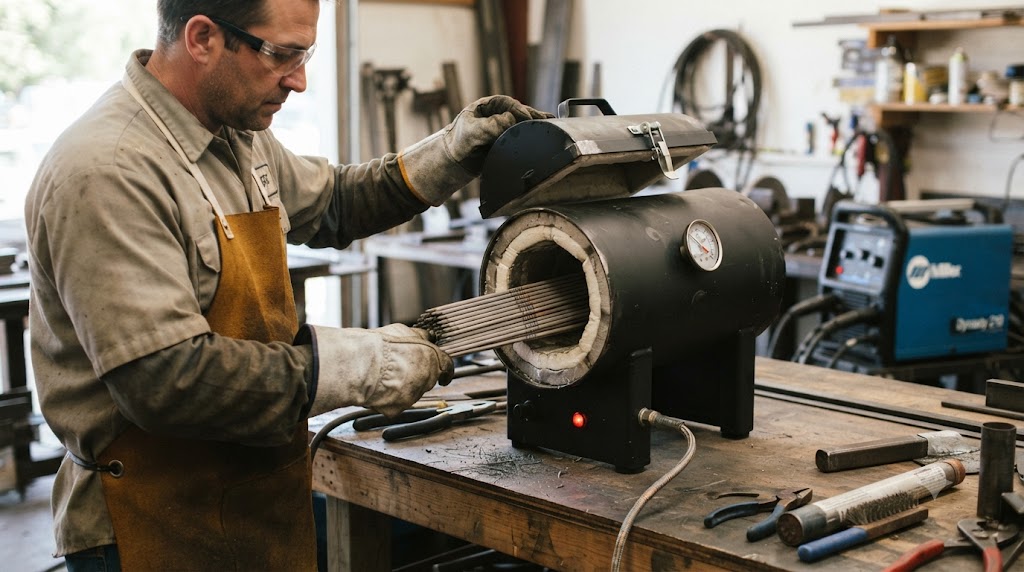
Plenty of welders have looked at a simple heated box and thought, I could build that. And you can: a basic DIY welding rod oven is a classic shop project, usually an insulated metal box warmed by a light bulb or heating element to keep 7018 dry. But there is a right way and a dangerous way to do it, and a few honest limits worth knowing before you trust your welds to a homemade box. This guide covers how a DIY rod oven works, the critical safety point, and when to just buy one instead.
A DIY welding rod oven is a homemade insulated box, often heated by a light bulb or a tubular heating element, used to keep welding rods warm and dry. It works for basic dry storage but has real safety and temperature limits. Here is how to build one safely and where it falls short.
Why build one
A homemade rod oven appeals for a few reasons:
- Simplicity, since the basic idea is just gentle heat inside an insulated box.
- Using what you have, like an old ammo can, tool box, or length of steel pipe.
- Keeping rods dry between uses without a store-bought oven.
- A satisfying shop project that solves a real problem.
For keeping a working supply of rods warm and dry, a careful DIY build can do the job, as long as you respect its limits.
Direct answer: how it works
A basic DIY rod oven has a few parts:
- An insulated enclosure, a metal box or pipe lined with heat-resistant insulation (fiberglass, not foam).
- A gentle heat source, commonly a light bulb in a porcelain socket or a tubular heating element.
- A way to hold temperature, ideally a thermostat so it does not overheat or run cold.
- A thermometer to confirm it is actually reaching a useful temperature.
- A proper ground, which is the safety point that matters most.
Built well, it keeps rods warm and dry; built carelessly, it can be a fire or shock hazard.
The heat source and insulation
The classic heat source is an incandescent light bulb in a porcelain socket, and it does put out steady, gentle heat. The honest catch is that a single bulb in a large box often struggles to reach and hold the 250 to 300 degrees F that low-hydrogen rods really want, so many DIY builds end up as warm, dry storage rather than true holding ovens. Welders who have built them report bulbs burning out quickly and foam insulation melting, so use heat-resistant fiberglass insulation, not styrofoam, and consider a tubular (golden rod style) heating element for more usable heat. Adding a thermostat, even one salvaged from an old kitchen range, lets the oven control its temperature instead of drifting, and a simple oven thermometer tells you what it is actually doing. Match the heat to the size of the box, and keep the build small for the rod supply you carry.
The safety point you cannot skip
This is the part to take seriously: a homemade metal oven with mains wiring must be properly grounded. If a heating element or wire faults against the metal box and the box is not connected to ground, the whole oven can become electrically live, and touching it while you touch anything grounded (like your welding table) can cause a serious shock. Any mains-powered electrical device needs an earth (ground) connection unless it is certified double-insulated, so wire your build with a three-conductor cord, bond the ground to the metal enclosure, and use proper heat-rated wiring and a porcelain (not plastic) socket. If you are not confident wiring this safely, that is a strong reason to buy a listed oven instead. A rod oven that keeps your rods dry is worthless if it puts you at risk of electrocution.
Add a desiccant
A simple upgrade that makes any DIY box work better: toss in a packet of desiccant. Silica gel packs, especially the kind with a cobalt-chloride indicator that turns from blue when dry to pink when saturated, help pull moisture out of the enclosed air and give you a visual cue when the desiccant needs drying out. Combined with gentle heat, desiccant keeps the small volume of a rod box genuinely dry between openings. Dry the packs out (in a metal pan) when the indicator turns, and reuse them. It is a small touch that helps a modest DIY oven punch above its heat output.
When to just buy one
Here is the honest verdict. A careful DIY rod oven, properly grounded and insulated, is fine for a hobbyist keeping non-critical rods warm and dry. But it has two real limits: it often cannot reliably hold true holding temperature, and it definitely cannot reach the several-hundred-degree range needed to rebake rods that have gotten wet. If you weld to code, do structural work, or need guaranteed dry 7018, a purpose-built oven removes the doubt and the safety worry. Ready-made portable ovens run on standard 110V, hold a proper holding temperature, and are listed for electrical safety. For many welders, the honest move is to build a warm box for casual use or simply buy an oven for anything that matters.
A ready-made alternative
If the wiring or temperature limits give you pause, a purpose-built oven solves both.
- YESWELDER 15 pound portable rod oven is a light, temperature-controlled oven adjustable from about 85 to 300 degrees F, holding 15 pounds of rods up to 14 inches, running on standard 110V with a proper holding temperature and a carry handle. Its limitation is the 14 inch rod length, so confirm your rods fit.
Who should skip the DIY route: anyone welding to code or structural spec, or anyone not confident wiring mains power safely, who is better off with a listed oven.
The bottom line
A DIY welding rod oven is a rewarding project and can keep rods warm and dry for casual use, but build it right. Use a metal or pipe enclosure with heat-resistant fiberglass insulation, a gentle heat source (a tubular element beats a lone bulb for reaching temperature), a thermostat and thermometer to control and confirm the heat, and a packet of indicating desiccant to fight moisture. Above all, ground the box properly, because an ungrounded homemade oven can become live and dangerous. And be honest about the limits: a DIY box rarely rebakes wet rods and may not hold true holding temperature, so for code or critical work, a listed portable oven is the safer, surer choice.
FAQ
Can you build a working rod oven at home? Yes, for basic use. A DIY rod oven is typically an insulated metal box or pipe warmed by a light bulb or heating element, and built carefully it keeps rods warm and dry. Its limits are that it often cannot hold true holding temperature reliably and cannot rebake wet rods, so it suits casual, non-critical use.
Is a light bulb enough heat for rod storage? A light bulb provides steady gentle heat and can keep a small box warm and dry, but a single bulb in a larger box often struggles to reach the 250 to 300 degrees F low-hydrogen rods want. For more usable heat, a tubular heating element works better, and a thermostat helps control the temperature.
What insulation works best for a DIY rod oven? Heat-resistant fiberglass insulation, not foam or styrofoam, which can melt. Line a metal enclosure with fiberglass to hold heat efficiently while tolerating the temperature. Keeping the box appropriately small for your rod supply also helps it reach and hold a useful temperature.
Is a homemade rod oven safe? Only if wired correctly. A mains-powered metal oven must be properly grounded with a three-conductor cord bonded to the enclosure, or a fault can make the box electrically live and cause a serious shock. Use heat-rated wiring and a porcelain socket. If you are not confident wiring it safely, buy a listed oven.
Can a DIY oven rebake wet welding rods? Generally no. Rebaking rods that have absorbed moisture requires several hundred degrees, well beyond what a light-bulb box reaches. A DIY oven is at best a holding or warm-storage box for already-dry rods. To recover wet rods, you need a purpose-built high-temperature oven.
Does adding desiccant help a homemade rod oven? Yes. A packet of silica gel, especially one with a cobalt-chloride indicator that turns from blue (dry) to pink (saturated), pulls moisture from the enclosed air and shows when it needs drying. Combined with gentle heat, desiccant keeps the small volume of a rod box genuinely dry between uses.
References
- Lincoln Electric and Hobart guidance on low-hydrogen electrode storage, holding temperatures, and reconditioning (manufacturers), lincolnelectric.com, hobartbrothers.com.
- The Fabricator guidance on electrode storage myths and rod oven temperatures (industry publication), thefabricator.com.
- General electrical safety guidance on grounding mains-powered equipment (safety practice), osha.gov.