Downdraft Welding Table Guide
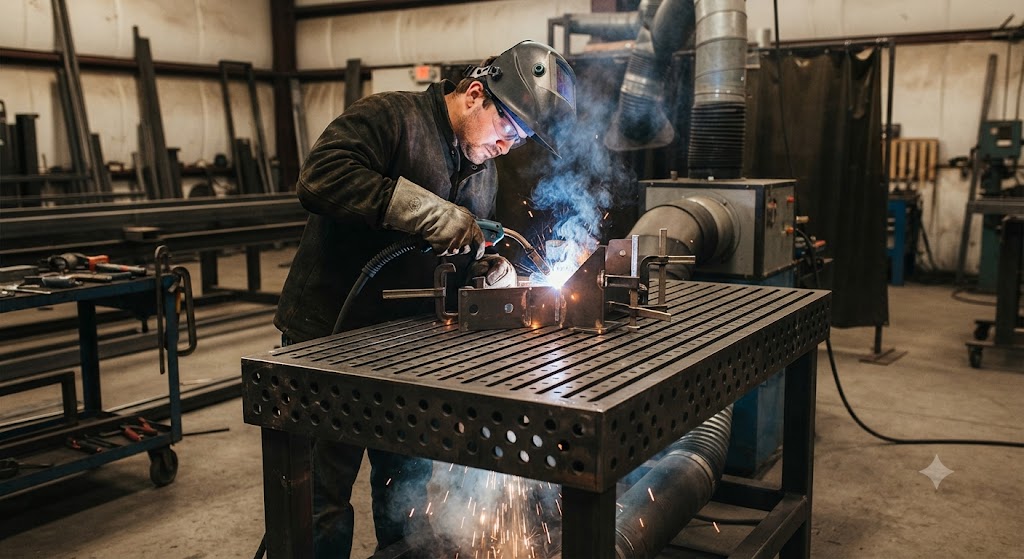
Stand over a weld or a grinding wheel for any length of time and you see the problem hanging in the air: a plume of fine particles and fumes drifting straight up into your face. A downdraft table attacks that plume from an unexpected direction, pulling it down and away through the table surface itself before it reaches your lungs. It is a clever, effective idea, and it is also more table than many home welders realize. This guide explains how downdraft tables work, where they shine, and the honest question of whether you actually need one.
A downdraft welding table is a work surface with built-in fume extraction that pulls smoke, dust, and fumes down through a perforated or slotted top and into a filter, capturing them at the source. Here is how they work, their strengths and limits, and practical alternatives for a home shop.
How a downdraft table works
The principle is simple and effective. Instead of letting fumes and dust rise, a downdraft table pulls them downward. The tabletop is perforated or slotted, and a fan or blower beneath the surface draws air (and the contaminants in it) down through those openings. The captured air then passes through a filter that traps particulates before clean air is returned to the shop or vented outside. Because the extraction happens right at the work surface, the table captures fumes and dust at or near the source, which is far more effective than trying to clear them from the room after they have already spread. Industrial examples include Lincoln’s DownFlex line and dedicated downdraft benches from fume-control makers.
What downdraft tables are best at
Downdraft tables shine in specific situations:
- Grinding and finishing, where they excel, since heavy dust and sparks are generated right at the surface and pulled straight down and away.
- Small-part welding and production work, where parts sit flat on the table and the downward airflow can capture fumes effectively.
- Consistent, repeatable capture, because the extraction is built into the surface rather than depending on positioning a separate arm each time.
- Keeping a shop cleaner, by trapping dust and particulates at the source instead of letting them settle across the room.
For a shop doing a lot of grinding or repetitive small-part work, a downdraft table is a genuinely effective air-quality tool.
The limits you should know
Downdraft tables are not a universal answer, and honesty matters here:
- Large parts block the airflow. A big workpiece sitting on the perforated top covers the openings, so the downdraft cannot pull air through where the part is, reducing capture exactly where you are working.
- The capture zone is the surface. Fumes that rise before reaching the top, or work done off the table, escape the downdraft entirely.
- They are industrial in scale. Downdraft tables are sizable, powered, and built for production environments, which is more equipment than most home shops need.
- Filters need maintenance. The filter media loads up with particulate and must be cleaned or replaced to keep the extraction working.
Know these limits before assuming a downdraft table is the right tool for your work.
Do you need a downdraft table at home?
For most home welders, honestly, no. A downdraft table is production-scale equipment that makes the most sense in a shop doing heavy grinding or repetitive small-part work. For a home shop, more practical fume control usually starts with good general ventilation (opening doors, using a shop fan to move air, and never welding in a sealed space), and steps up to a source-capture portable fume extractor with a movable arm. A portable extractor arm has a real advantage over a downdraft table for varied work: you position the intake right at the arc no matter where or how the part sits, so it captures fumes even on large or oddly shaped assemblies that would block a downdraft top. For most home and hobby welders, ventilation plus a source-capture extractor is the more sensible and flexible path.
Downdraft table versus portable fume extractor
A useful comparison, since these are the two main source-capture approaches:
- A downdraft table captures at the surface, is built in and consistent, and excels at grinding and flat small-part work, but struggles when large parts block the top and is production-scale equipment.
- A portable fume extractor uses a movable arm you position right at the arc, so it captures fumes on parts of any size or shape and moves between workstations, though you must reposition the arm as you work and it takes up floor or bench space.
For fixed, repetitive, grinding-heavy work, the downdraft table wins on consistency. For varied welding on parts of different sizes, especially in a home shop, the portable extractor’s flexibility usually wins. Many well-equipped shops use both.
The bottom line
A downdraft welding table is a clever, effective air-quality tool that pulls fumes and dust down through the work surface and into a filter, capturing them at the source. It shines at grinding, finishing, and flat small-part production work, but large parts block its airflow, and it is production-scale equipment that most home shops do not need. For home and hobby welding, good general ventilation plus a source-capture portable fume extractor with a movable arm is usually the more practical and flexible path, since you can position the intake right at the arc on parts of any size. Match the fume-control tool to the work you actually do, and protect your lungs either way.
FAQ
What is a downdraft welding table? A downdraft welding table is a work surface with built-in fume extraction. The perforated or slotted top pulls smoke, dust, and fumes downward through the surface and into a filter, capturing contaminants at the source instead of letting them rise into your breathing zone.
How does a downdraft table work? A fan or blower beneath the perforated tabletop draws air and contaminants down through the openings. The captured air passes through a filter that traps particulates, then clean air is returned to the shop or vented outside, so capture happens right at the work surface.
Are downdraft tables good for welding? They are very good for grinding, finishing, and flat small-part production work, where dust and fumes are generated at the surface. They struggle with large parts that block the airflow, and they are production-scale equipment, so they are less suited to varied home-shop work.
Do I need a downdraft table for a home shop? Usually not. A downdraft table is production-scale equipment. Most home welders are better served by good general ventilation plus a source-capture portable fume extractor with a movable arm, which captures fumes at the arc on parts of any size or shape.
What is the difference between a downdraft table and a fume extractor? A downdraft table captures at the surface and is built in and consistent, best for grinding and flat small-part work. A portable fume extractor uses a movable arm you position at the arc, so it captures on parts of any size and moves between workstations. Each suits different work.
Do downdraft tables need filter maintenance? Yes. The filter media traps particulate and gradually loads up, so it must be cleaned or replaced on a schedule to keep the extraction working effectively. Neglecting the filter reduces airflow and capture over time.
References
- OSHA guidance on welding fume and dust control, including source-capture ventilation (government), osha.gov.
- American Welding Society guidance on ventilation and fume extraction for welding (industry authority), aws.org.
- Lincoln Electric downdraft table and fume extraction equipment information (manufacturer), lincolnelectric.com.