Fiberglass Welding Blanket: Full Buying Guide and Top Picks
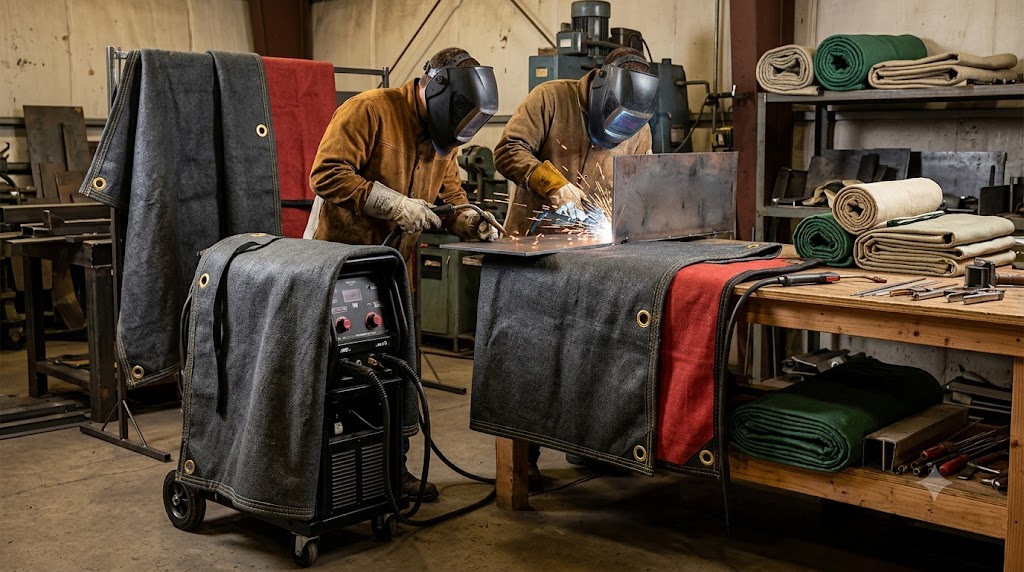
The first time a spark jumped off your weld puddle and landed on a cardboard box three feet away, you understood why welding blankets exist. Fiberglass welding blankets are the most common solution to that problem — they go between your work and anything you don’t want burned, and they stay in place through a full shift.
A fiberglass welding blanket is a woven, heat-resistant blanket made from fiberglass strands, sometimes coated with acrylic, vermiculite, or silicone compounds to improve thermal performance and durability. These blankets shield nearby materials from weld spatter, sparks, and radiant heat. They’re used in shops, on job sites, in automotive work, and for pipe welding where surrounding surfaces need protection.
If you need blanket-style protection for a standard shop welding setup, a mid-weight fiberglass option rated to 1000°F handles most MIG, TIG, and stick applications. For heavier work, higher spatter loads, or vertical applications where hot slag may contact the blanket directly, step up to 25 oz or higher.
Verdict
The Tillman 590 is the top pick for most shop welders. It’s the most proven fiberglass welding blanket in the market with a 1000°F melt temperature and FM approval for use as a welding curtain. For heavier duty work or where slag contact is expected, the Tillman 596B (vermiculite impregnated, rated 1200°F flat / 1700°F vertical) is the better call. YESWELDER’s fiberglass blanket is the strongest value pick for welders who want capable protection without the Tillman spend, and without the documentation requirement.
What Fiberglass Welding Blankets Actually Do
Fiberglass can withstand high temperatures without combusting because glass simply doesn’t burn. The woven fiberglass fabric absorbs radiant heat and physically blocks sparks and spatter from reaching the surface underneath. When you hang a fiberglass blanket in front of a wall, drape it over a machine, or lay it flat under a workpiece, you’re putting a non-combustible barrier between the weld and everything else.
The limitations are real. Standard fiberglass blankets at 24 oz will protect the surface beneath from spatter and light slag. They are not rated for sustained contact with molten metal. They protect a car door from weld spatter; they will not survive being used as a weld backing.
Coating type matters:
- Uncoated fiberglass: Lightest, most flexible, lowest thermal capacity. Good for light spatter protection.
- Acrylic coated: More durable, resists abrasion and chemical exposure. Most common for everyday shop use.
- Vermiculite impregnated: Higher thermal capacity, better protection from direct slag contact.
- Silicone coated: Highest abrasion resistance, elevated thermal ratings in some configurations.
Top Fiberglass Welding Blanket Picks
1. Tillman 590 — Best Overall for Shop Use
The Tillman 590 is a 24 oz acrylic-coated fiberglass blanket that’s been the default recommendation in welding supply houses for years. It carries FM approval as a welding curtain, which means it’s been independently tested, not just labeled by the manufacturer.
Verified specs (per Tillman and Amazon product listing): 24 oz/yd2, acrylic coated fiberglass, 1000°F melt temperature, 0.034 inch thickness.
Named flaw: the 590 is not recommended for stress relief applications or direct slag contact on a flat surface. It protects the surface beneath; it doesn’t absorb molten material.
Tillman 590 Fiberglass Welding Blanket on Amazon
2. Tillman 596B — Best for Heavy-Duty and Slag Contact
When you need a step up from the standard 590, the Tillman 596B is the answer. It uses 25 oz vermiculite-impregnated fiberglass. Tillman’s product listing rates it at 1200°F for flat surfaces and 1700°F for vertical plane applications.
That’s a meaningful gap from the 590’s 1000°F ceiling. The 596B takes direct slag exposure better and is built for structural welding and high-spatter environments.
Verified specs: 25 oz black vermiculite impregnated fiberglass, 1200°F flat surface / 1700°F vertical, 0.06 inch thick, FM approved.
Named flaw: the 596B is significantly stiffer than the 590. Draping it over a curved surface or storing it compactly takes effort. For hanging and vertical applications it’s excellent; for contouring around pipe or irregular equipment, it’s less cooperative.
Tillman 596B Heavy Duty Welding Blanket on Amazon
3. YESWELDER Fiberglass Welding Blanket — Best Value
YESWELDER’s fiberglass blanket uses 24.7 oz/yd2 fiberglass material. Per their product listing, it carries a working temperature rating of 1022°F (550°C). Brass grommets are spaced every 11 inches, which makes hanging it straightforward.
The 4x6 ft size covers most shop applications. A 6x8 ft silicone-coated version is also available for larger setups.
Verified specs: 24.7 oz/yd2 fiberglass, up to 1022°F (550°C), 0.31 inch thickness, grommets every 11 inches.
Named flaw: YESWELDER does not provide FM approval certification for this blanket. For shops with formal hot work programs requiring FM-approved welding curtains, the Tillman 590 is the appropriate choice. For general shop protection without that documentation requirement, the YESWELDER performs at a comparable level.
YESWELDER Heavy Duty Fiberglass Welding Blanket on Amazon
4. VEVOR Fiberglass Welding Blanket — Budget-Accessible Option
VEVOR’s fiberglass blanket runs 19.8 oz/yd2 and carries a 1022°F (550°C) working temperature rating per the Amazon listing. It’s lighter than the Tillman and YESWELDER options, which means more flexibility but less thermal capacity under sustained spatter load.
For occasional welding, protecting equipment during grinding, or covering a large area without heavy expense, VEVOR fills the gap.
Verified specs: 19.8 oz/yd2 fiberglass, up to 1022°F (550°C), brass grommets.
Named flaw: at 19.8 oz/yd2, the VEVOR is lighter than either Tillman option. Under high-volume spatter or sustained heat, it degrades faster. Fine for light use; in production environments with heavy weld loads, step up to a 24 oz option.
VEVOR 8x10 Ft Fiberglass Welding Blanket on Amazon
5. Steiner 372 Toughguard — Best for Light-Duty and Vertical Surfaces
The Steiner 372 uses 18 oz heat-cleaned fiberglass and is rated at 1000°F per the Steiner product listing. It’s one of the more pliable fiberglass options, which makes it easy to hang and drape on vertical surfaces.
Verified specs: 18 oz/yd2 heat cleaned fiberglass, 1000°F temperature rating, 0.035 inch thick.
Named flaw: at 18 oz, the Steiner 372 is the lightest option in this guide. Steiner specifies it protects against sparks on the vertical plane only — it’s not designed for flat-surface slag contact. Use it as a hanging curtain or vertical barrier, not as a floor mat under active welding.
Steiner 372 Toughguard Welding Blanket on Amazon
Comparison Table
| Blanket | Weight | Coating | Temp Rating | FM Approved | Best Use |
|---|---|---|---|---|---|
| Tillman 590 | 24 oz | Acrylic | 1000°F | Yes | General shop, curtain use |
| Tillman 596B | 25 oz | Vermiculite | 1200°F flat / 1700°F vertical | Yes | Heavy duty, slag contact |
| YESWELDER | 24.7 oz | None listed | 1022°F (550°C) | Not listed | Value shop protection |
| VEVOR | 19.8 oz | None listed | 1022°F (550°C) | Not listed | Light duty, large coverage |
| Steiner 372 | 18 oz | Heat cleaned | 1000°F | FM Approved | Vertical / hanging use |
How to Size Your Fiberglass Blanket
Measure the area you need to cover, then add 12 inches on each side for overlap and drape. A blanket hung as a welding curtain should reach the floor with some slack. A blanket laid flat should extend beyond the expected spatter zone.
Standard sizes run 4x6 ft, 6x8 ft, 8x10 ft, and 10x10 ft. For large structural jobs, welding blanket rolls are available from Tillman and VEVOR in 5-foot-wide formats.
FAQ
What is a fiberglass welding blanket used for? A fiberglass welding blanket shields nearby surfaces, equipment, and materials from welding sparks, spatter, and radiant heat. It’s used to protect cars, machinery, floors, and adjacent structures during welding, cutting, and grinding operations.
How much heat can a fiberglass blanket withstand? This depends on the specific product. Standard 24 oz acrylic-coated fiberglass blankets like the Tillman 590 are rated at 1000°F. Heavier vermiculite-impregnated options like the Tillman 596B are rated at 1200°F on flat surfaces and 1700°F on vertical surfaces. Always check the manufacturer’s published specification rather than assuming based on brand alone.
Is fiberglass or carbon felt better for welding protection? It depends on what you’re protecting against. Fiberglass blankets rated at 1000°F handle most standard MIG, TIG, and stick welding spatter protection. Carbon felt blankets are typically rated to 1800°F and offer higher peak thermal resistance, making them better for applications involving sustained high heat, stress relief, or preheat work. Fiberglass is generally more affordable and easier to hang; carbon felt is more thermally capable.
Do fiberglass welding blankets need to be FM approved? Not for all applications. FM approval indicates independent testing for use as a welding curtain in hot work programs. If your shop has a formal hot work permit program or requires FM-approved welding curtains, look for that certification. For general shop protection without a documentation requirement, FM approval is a quality signal but not always mandatory.
Can you reuse a fiberglass welding blanket? Yes. Fiberglass blankets are designed for repeated use. Surface fiber shedding is normal over time. Replace the blanket when you see significant degradation, holes, or areas where spatter has burned through.
Can a fiberglass blanket be used as an emergency fire blanket? Some fiberglass welding blankets are dual-rated for emergency fire suppression. Check the specific product. Not all welding blankets are tested and certified for emergency fire blanket applications.
What size fiberglass welding blanket do I need? Measure your coverage area and add 12 inches on each edge for overlap. A 4x6 ft blanket covers most automotive work and small-area shop protection. For machine protection or large welding screens, 6x8 ft or larger is more practical.
References
- Tillman Blanket Product Line — jtillman.com
- YESWELDER Product Listing — yeswelder.com
- OSHA Hot Work Safety — osha.gov
- AWS Safety and Health Fact Sheet — aws.org
- FM Approvals Welding Curtain Standards — fmapprovals.com
URL slug: fiberglass-welding-blanket Excerpt: Fiberglass welding blankets protect surfaces from weld spatter and heat. This guide ranks the top options including Tillman, YESWELDER, VEVOR, and Steiner by verified heat rating, coating type, and real-world performance.