Fireball Tool Welding Table Review
If you have spent any time watching welding and machining videos, you know Fireball Tool. Jason and his crew built a huge following by testing tools to destruction, obsessing over flatness, and explaining fixturing better than almost anyone. That reputation carries over to Fireball’s own fixture tables, which have become an aspiration for a lot of fabricators. So the real question is not whether Fireball is legitimate (it clearly is) but whether its tables make sense for you, and what to do if they do not fit your shop.
Fireball Tool is a legitimate, well-regarded maker of precision welding fixture tables built around a 3/4 inch hole system on a 2 inch grid, aimed at serious hobbyists and professionals who want accuracy and a deep fixturing ecosystem. Here is what sets them apart and solid alternatives if they are more table than you need.
What Fireball Tool is
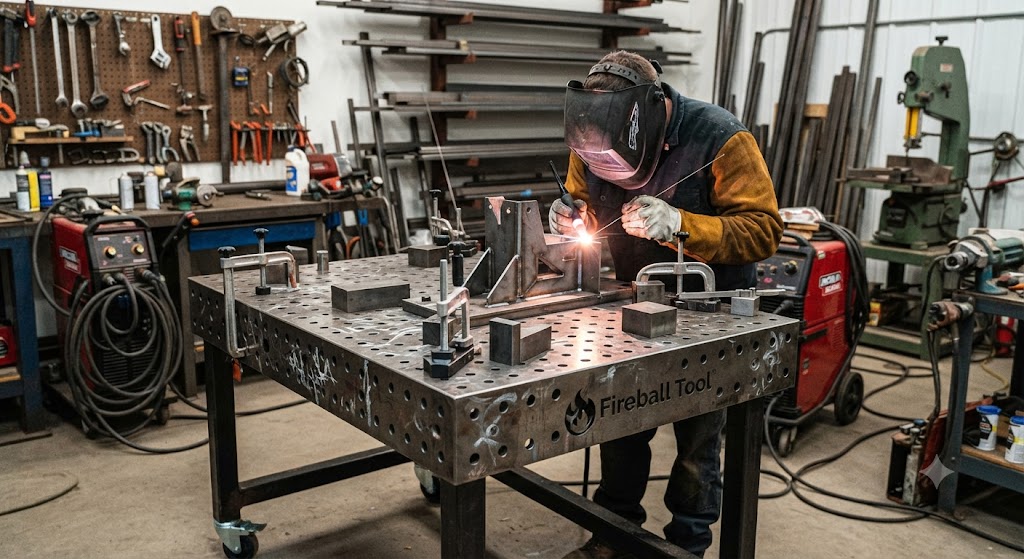
Fireball Tool is an American company (founded by Jason, a welder and content creator) that grew from a huge YouTube following into a real tool and fixture-table business. Their signature is a fixture-table system built around 3/4 inch diameter holes on a 2 inch grid, paired with a deep line of fixtures, clamps, blocks, and tooling that all work together. The tables themselves are gray cast iron, cast overseas and then machined and quality-checked, while much of the tooling is made in the USA. The whole system is engineered so that every fixture works on every table in the lineup, from a small portable plate to a heavy production table. It is a serious, well-thought-out fixturing ecosystem.
Direct answer: is Fireball Tool worth it?
Yes, Fireball Tool tables are worth it if you are a serious hobbyist or professional who wants precision fixturing and plans to invest in the ecosystem. What sets them apart:
- A 3/4 inch hole system on a 2 inch grid, larger and stronger than 5/8 inch or 16mm systems.
- A deep, well-designed line of compatible fixtures, clamps, and blocks.
- Precision-machined cast iron tables focused on flatness.
- A brand with genuine expertise and a strong support community.
Where to be honest: this is a premium, specialty system aimed at people who care about fixturing accuracy and will build out tooling over time. If you weld occasionally or just need a flat steel surface, it is more table (and more system) than you need, and an accessible fixture-hole table will serve you well.
The 3/4 inch hole system
The heart of Fireball’s approach is the hole size. Most fixture tables use 5/8 inch (imperial) or 16mm (metric) holes, and a few heavy industrial tables use 28mm. Fireball chose 3/4 inch, which sits between those worlds: the holes have a much larger cross section than 5/8 inch or 16mm (Fireball cites around 45 percent larger), giving stronger bolts and clamps, while still keeping a practical 2 inch grid. Their fixtures use 2 inch by 1 inch profiles and a tooth-block design that spans three holes, so fixtures stay square to the table while still adjusting. If you are building a fixturing system to keep parts dead square and repeatable, that engineering is the appeal.
Cast iron and precision
Fireball tables are gray cast iron rather than fabricated steel plate, a deliberate choice: cast iron is stable, damps vibration, and machines to a flat, durable surface. The tables are cast overseas, then machined and quality-checked, with tooling largely made in the USA. Fireball is open about this split, and their reputation for testing and flatness gives buyers confidence in the result. The focus throughout is accuracy: a flat, precise reference surface that stays true, which matters when your fixturing depends on the table itself being square and flat. For precision fabrication, that is the whole point of stepping up to a system like this.
If Fireball is more than you need
Here is the honest part. A full Fireball system is a serious commitment aimed at people who fixture seriously. If you weld occasionally, do general fabrication, or just want a flat steel surface with clamping, you do not need it, and there are accessible fixture-hole tables that give you a hole grid without the full ecosystem. Two Amazon-available options cover most home and light professional needs:
- BuildPro (Strong Hand Tools) modular welding table, 5/8 inch holes on a 2 inch grid is a professional modular fixture table with precision-ground, reversible steel plates and a deep 5/8 inch tooling ecosystem, the closest widely available step toward a serious fixturing system. Its limitation is that it is a professional-grade table, more than a casual user needs.
- VEVOR welding table (36 by 18 inch, 5/8 inch fixture holes, on wheels) gives you a fixture-hole grid, tool slots, and mobility in an accessible home-shop package. The trade-off is that it is not precision-ground like a Fireball or professional table, so it suits general work rather than production precision.
How to choose: buy into Fireball if you want a precise, deep fixturing ecosystem and will use it. Choose BuildPro for a professional modular table that is widely available, or VEVOR for an accessible fixture-hole table for home and light work.
The bottom line
Fireball Tool is a legitimate, well-earned name in precision fixturing, and its 3/4 inch hole system on a 2 inch grid, backed by a deep line of compatible tooling and precision-machined cast iron tables, is a genuinely excellent system for serious hobbyists and professionals who care about accuracy. It is a premium, specialty commitment, so if you weld occasionally or just need a flat surface with clamping, it is more than you need. In that case a BuildPro modular table or an accessible VEVOR fixture-hole table gives you real work-holding without the full ecosystem. Match the table to how seriously you fixture.
FAQ
Is Fireball Tool a legitimate welding table brand? Yes. Fireball Tool is an American company that grew from a large YouTube following into a real tool and fixture-table business, with a well-engineered 3/4 inch hole fixturing system, precision-machined cast iron tables, and a strong support community.
What makes Fireball tables different from Strong Hand or BuildPro? Fireball uses a 3/4 inch hole system on a 2 inch grid, larger than the 5/8 inch (BuildPro) or 16mm systems, giving stronger bolts and clamps while keeping a practical grid. Its fixtures use a tooth-block design that keeps parts square while adjusting.
Are Fireball tables made in the USA? The cast iron tables are cast overseas and then machined and quality-checked, while much of the tooling is made in the USA. Fireball is open about this split, and the tables are known for their focus on flatness and precision.
Are Fireball Tool tables worth it? For serious hobbyists and professionals who want precision fixturing and will invest in the ecosystem, yes. For occasional welders or those who just need a flat steel surface with clamping, they are more table and system than necessary.
Why did Fireball choose a 3/4 inch hole system? A 3/4 inch hole has a much larger cross section than 5/8 inch or 16mm (about 45 percent larger), allowing stronger bolts and clamps, while still fitting a practical 2 inch grid. It aims for the strength of larger systems with the flexibility of smaller ones.
What is a good alternative to a Fireball table? For a professional modular fixture table that is widely available, the BuildPro (Strong Hand Tools) 5/8 inch system. For an accessible fixture-hole table for home and light work, a VEVOR table with a 5/8 inch hole grid.
References
- Fireball Tool welding table system overview, detailing the 3/4 inch hole system on a 2 inch grid, fixture design, and compatibility (manufacturer), fireballtool.com.
- Fireball Tool forum statements on table casting overseas and tooling made in the USA, with US machining and quality control (manufacturer community), fireball.discourse.group.
- Strong Hand Tools BuildPro 5/8 inch modular table specifications for comparison (manufacturer), stronghandtools.com.