Folding Welding Table Guide
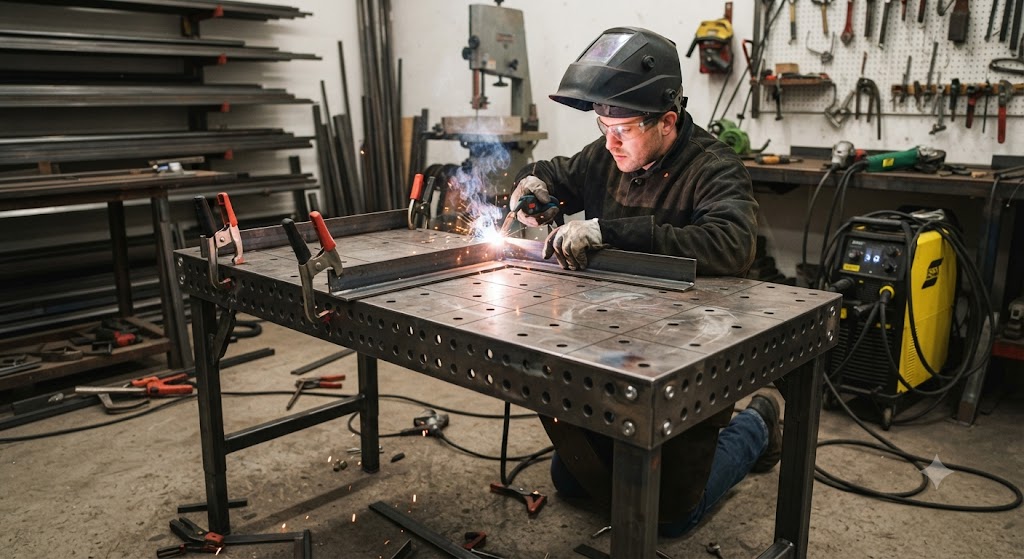
Space is the quiet enemy of the home welder. You want a real steel surface to weld on, but a fixed table eats a chunk of the garage whether you are using it or not. A folding welding table solves that standoff: it gives you a solid work surface when you need it, then folds flat to hang on the wall or lean in a corner when you do not. The catch is that folding introduces a hinge, and a hinge can wobble, so the trick is choosing one that stays rock solid when it is open.
A folding welding table is a steel welding table with a collapsible frame that folds flat for storage and transport, giving you a real weldable surface in tight spaces. The best ones lock rigid when open and fold compact when done. Here is how to choose.
Why go folding
A folding table earns its place for reasons a fixed table cannot match:
- It reclaims floor space, folding flat to hang on a wall hook or slide behind a bench when idle.
- It travels, collapsing to fit in a truck for repairs and job sites.
- It sets up fast, giving you a steel surface and a clean ground path in under a minute.
- It suits shared spaces, so a garage can be a workshop today and a parking spot tomorrow.
For anyone welding in a home garage or small shop, that flexibility is the whole point.
Direct answer: what to look for
When choosing a folding welding table, weigh these features:
- Rigidity when open, the single most important trait, so the table does not rack or wobble as you work. Look for a positively locking folding mechanism.
- A solid steel top that resists heat and gives a clean ground path.
- A compact fold, flat enough to hang or store easily.
- Adjustable height and tilt on better models, which add versatility.
- Clamping slots or fixture holes so you can secure and square work.
Strong picks include the Hobart steel folding table, the VEVOR foldable table with wheels and tilt, and the Strong Hand Nomad, which folds and hangs on a wall.
Rigidity: the make-or-break feature
Everything good about a folding table falls apart if it wobbles, so this is where to focus. A folding table relies on a hinge and a locking mechanism to hold its shape, and a flimsy latch that flexes will make every weld frustrating. Look for legs that splay to a wide, stable stance, a locking mechanism that engages positively (not a loose pin), and leveling feet to kill wobble on an uneven floor. Heavier-gauge steel adds rigidity but also weight, so there is a balance between how solid it feels and how easily you carry it. The best folding tables feel planted when open, and you forget they fold at all.
Storage and portability
The payoff for a folding table is what happens when you are done. A good one folds nearly flat, dropping from a full work surface to a slim profile you can hang on two wall hooks, slide behind a workbench, or stand in a corner. That reclaimed space is significant in a one-car garage. Some models add wheels so you can roll the folded table out of the way, and the lightest fold-and-carry designs go in a truck for mobile work. When comparing, look at the folded dimensions and the weight, since those decide how easy the table is to actually stow and move.
Are folding tables sturdy enough for real welding?
A fair question, and the honest answer is yes, for most home and light fabrication work. A quality folding table with a solid steel top and a positive locking mechanism handles MIG, stick, and flux-core welding on typical projects without issue. Where folding tables give ground is at the heavy end: large, heavy assemblies and constant production work are better on a thick fixed table that prizes mass over portability. For the welding most home shops actually do, a good folding table is plenty sturdy, as long as you buy one with a locking frame rather than the flimsiest option on the shelf.
Which folding welding tables to buy
Here are three dependable folding options.
- Hobart steel folding welding table (35 by 19.5 inch) gives you a solid steel top on a sturdy folding frame from a trusted welding name, at a practical 34 inch working height. Its limitation is that it is a straightforward flat top without a fixture-hole grid, so you clamp at the edges.
- VEVOR foldable welding table (30 by 20 inch, on wheels) folds flat, rolls on wheels, and adds adjustable height with three tilt angles plus tool slots, a versatile pick for a home shop. The trade-off is that its lighter build suits general and light fabrication rather than the heaviest work.
- Strong Hand Tools Nomad welding table (30 by 20 inch) folds down in seconds, rolls on two wheels, hangs on a wall, and includes a MagSpring clamp with clamping slots for real fixturing. Its limitation is the 14 gauge top, which is lighter than a thick fixed plate for heavy assemblies.
How to choose: for a simple, sturdy folding top from a welding brand, the Hobart. For adjustable height, tilt, and wheels, the VEVOR. For fold-and-hang storage with an included clamp, the Strong Hand Nomad.
Who should skip a folding table: welders with a dedicated shop and heavy daily production work, who are better served by a thick fixed table built for mass.
The bottom line
A folding welding table is the answer for anyone short on space: a real steel surface when you need it, folded flat when you do not. Prioritize rigidity when open, since a positive locking mechanism is what separates a solid table from a wobbly one, then look at the folded size, weight, and clamping features. The Hobart is the straightforward welding-brand pick, the VEVOR adds tilt and wheels, and the Strong Hand Nomad folds to hang on a wall with a clamp included. Buy one with a locking frame and you get shop-table function without giving up your garage.
FAQ
Are folding welding tables sturdy enough for MIG welding? Yes, a quality folding table with a solid steel top and a positive locking mechanism handles MIG, stick, and flux-core welding on typical home and light fabrication projects. For very heavy assemblies and constant production, a thick fixed table is better.
How much storage space does a folding welding table save? A lot. A good folding table drops from a full work surface to a slim profile you can hang on wall hooks, slide behind a workbench, or stand in a corner. In a one-car garage, that reclaimed floor space is significant.
Do folding legs affect stability? They can if the locking mechanism is weak. That is why rigidity when open is the key feature to check. Look for a positive locking latch, a wide leg stance, and leveling feet, which keep a good folding table from racking or wobbling.
What should I look for in a folding welding table? Prioritize rigidity when open, a solid steel top with a clean ground path, a compact fold, and clamping slots or fixture holes. Adjustable height and tilt add versatility, and wheels help you move the folded table out of the way.
Can a folding welding table handle heavy fabrication? For most home and light fabrication, yes. Where folding tables give ground is at the heavy end, with large, heavy assemblies and production work, which suit a thick fixed table built for mass over portability.
Can you weld on a folding table right out of the box? Generally yes. Fold it open, lock the frame, level the feet, and clamp your work lead to the steel top for a ground. Confirm the locking mechanism is fully engaged before you lean on the table.
References
- Hobart Welders steel folding welding table product specifications, including 35 by 19.5 inch top and 34 inch height (manufacturer), hobartwelders.com.
- Strong Hand Tools Nomad folding welding table specifications, including fold-and-hang design and clamping slots (manufacturer), stronghandtools.com.
- Miller Electric and Lincoln Electric guidance on welding table grounding and setup (manufacturers), millerwelds.com, lincolnelectric.com.