GVS Respirator Size Chart: Which Elipse Size Do You Actually Need?
The GVS Elipse ships in a sealed box with no returns once opened, and the size chart is buried on a PDF most sellers don’t link to. Get it wrong and you’re either squeezing a mask that gaps at the jawline or drowning inside one that leaks at every breath. The wrong size isn’t a comfort issue - it’s a protection issue. Here’s exactly how to measure, what the numbers mean, and when each size applies.
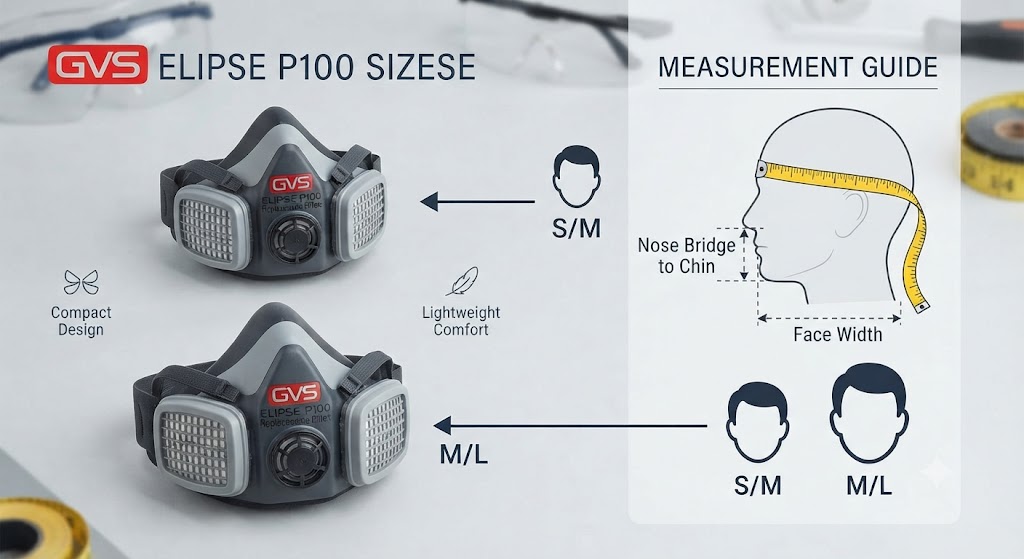
The GVS Elipse P100 is a reusable elastomeric half-mask respirator that uses low-profile pleated HESPA filters rated to capture 99.97% of airborne particles at 0.3 microns, including welding fumes, metal dust, silica, and manganese. It comes in two sizes: S/M (model SPR451) and M/L (model SPR457). The body is made from hypoallergenic thermoplastic elastomer, latex-free and silicone-free, with a four-point adjustable strap.
For most adult men, the M/L (SPR457) is the right call. Most adult women fit the S/M (SPR451). But face shape varies enough that you should measure before ordering. GVS provides a two-measurement sizing grid - cross-reference your face length against your face width and the chart tells you which size to buy.
GVS SPR457 Elipse P100 Half Mask Respirator, M/L
How to Measure Your Face for the GVS Elipse
You need two measurements, both in inches:
Face Length (A): Measure from the bridge of your nose (just below the bony ridge, where eyeglasses sit) straight down to the bottom of your chin. Pull the tape snug but don’t compress tissue.
Face Width (B): Measure horizontally from one cheekbone (zygomatic arch) to the other across the widest point of your face.
Take both measurements twice. If they differ, use the larger number.
GVS Elipse Size Chart
Cross-reference your face length (rows) against your face width (columns):
| Face Length | Width 4.7-5.2 in | Width 5.2-5.7 in | Width 5.7-6.2 in |
|---|---|---|---|
| 5.1-5.5 in | M/L | M/L | M/L |
| 4.7-5.1 in | S/M | M/L | M/L |
| 4.3-4.7 in | S/M | S/M | M/L |
| 3.9-4.3 in | S/M | S/M | S/M |
Source: GVS official size guide (gvs-rpb.com). GVS notes this chart is a guide only; a quantitative or qualitative fit test per OSHA 29 CFR 1910.134 is required to confirm fit for occupational use.
What the Two Models Actually Mean
SPR451 (S/M): Designed for smaller faces, typically face lengths under 5.1 inches combined with narrower widths. The fit check matters more here because a small-faced wearer can be borderline between sizes. If the chin cup rides up off your chin when you open your mouth, go up to M/L.
SPR457 (M/L): The most commonly stocked size. If you’re a medium or large in most safety gear, start here. The TPE material deforms to the face on use, so it feels firmer the first time you wear it and settles in after a few sessions.
Both sizes use the same replacement filters (SPR321), which fits the SPR451, SPR457, and most other Elipse P100 variants. You don’t need different filters for each size.
GVS Elipse P100 Filter Types
The Elipse filter system is worth understanding before you buy, because the base mask accepts several cartridge types:
SPR321 (P100 particulate only): The standard filter that ships with most Elipse masks. Blocks 99.97% of particulates including welding fumes, metal dust, silica, mold, and general airborne particles. This is the right filter for most welding and fabrication work.
SPR450 (P100 + nuisance OV): Adds a thin carbon layer for nuisance-level organic vapor odor reduction. Does not provide OV protection at OSHA PEL levels. Useful for light paint overspray odor or solvent smell at low concentrations.
SPR473/SPR472 (OV/AG P100): Full organic vapor and acid gas cartridge for chemical environments. Overkill for most welding shops unless you’re working with coated metals that release chlorine or fluoride fumes.
For welding fumes specifically, the SPR321 P100-only filter is the correct choice. NIOSH and 3M both confirm that welding fume hazard is primarily particulate, not vapor - the P100 filter handles it without the added breathing resistance of a combination cartridge.
GVS SPR321 Elipse P100 Replacement Filters (2-Pack)
How Often Should You Replace GVS Elipse Filters?
P100 particulate filters don’t have a fixed calendar-based replacement schedule under OSHA 29 CFR 1910.134. The standard says to replace them when:
- Breathing resistance increases noticeably during normal use. The filter loads with particulate over time; increased draw effort is the clearest signal.
- The filter surface is visibly soiled or wet. Moisture compromises filtration efficiency.
- Physical damage is visible: torn filter media, cracked housing, bent frame.
For oily aerosol environments (cutting oil mist, metalworking fluids), 3M’s published guidance on P-series filters recommends a maximum of 40 hours of use or 30 days, whichever comes first, even without visible degradation.
For dry welding fume environments (MIG on mild steel, TIG on aluminum), filters can last several weeks to months in a part-time shop. Production welders doing full shifts in heavy fume environments will see resistance build much faster - sometimes within a single week. Inspect the filter before each use. Replacing a pair of SPR321 filters before a critical job is a minor expense compared to cumulative manganese or hexavalent chromium exposure.
GVS lists a shelf life of three years for unopened masks and filters in original packaging.
Can GVS Filters Fit Other Half-Mask Respirators?
The SPR321 filter is a proprietary push-in format specific to GVS Elipse-platform masks. It does not attach to 3M bayonet-style facepieces or any other standard filter thread. However, it is cross-compatible across the GVS product family: the SPR321 fits the SPR451, SPR457, SPR449, SPR456, and related Elipse variants.
The filter also fits the Miller LPR-100 and Klein Tools 60552/60553 - both are GVS Elipse masks sold under different brand names with the same filter interface.
Who Should Skip the GVS Elipse
The Elipse’s one honest flaw is the exhalation valve. It uses a large central umbrella-style flapper valve that, on some units, stays partially open longer than it should after exhalation. This is a widely reported finding across user reviews and independent assessments. In a standard welding environment where outward source control is not the goal, this doesn’t affect protection because the concern is inward leakage, not outward. But if you need source control (healthcare, cleanrooms, or environments where you’re protecting others from what you exhale), the Elipse standard P100 is not the right choice. GVS makes a Source Control variant without a valve for those applications.
If you have a narrow, shallow face (face length under 4 inches), neither size of the Elipse is likely to seal reliably. GVS’s own guide shows no sizing data for face lengths below 3.9 inches. A full-facepiece respirator or a different half-mask design with more adjustable sealing geometry would serve better.
Verdict
Measure face length and width before ordering. Most men wearing a size L hat need the M/L (SPR457). Most women and smaller-framed men will be in the S/M (SPR451). If you’re borderline on the chart, order the M/L - it’s harder to make a too-small mask seal than to cinch down a slightly larger one. Either way, confirm with a fit test before using it in a hazardous environment; the chart is a starting point, not a guarantee.
FAQ
How do I know what size GVS respirator to buy? Measure your face length (nose bridge to chin) and face width (cheekbone to cheekbone), both in inches. Cross-reference those two numbers on the official GVS size chart. Face lengths under 4.7 inches typically indicate S/M; 4.7 inches and above, or any face with a width over 5.7 inches, typically indicates M/L. A formal fit test is required to confirm for occupational use.
What is the difference between GVS SPR451 and SPR457? SPR451 is the S/M size and SPR457 is the M/L size. Both use identical P100 HESPA filters (SPR321), the same TPE facepiece material, and the same four-point strap. The only difference is the facepiece dimensions.
Can I use the same SPR321 filters in both size Elipse masks? Yes. The SPR321 P100 replacement filter is compatible with both the SPR451 (S/M) and SPR457 (M/L) facepieces. The filter pushes into the same bayonet slot on both sizes.
How often should I replace GVS Elipse filters? Replace them when breathing resistance increases noticeably, when the filter surface is visibly dirty or wet, or when the media or housing is physically damaged. There is no fixed calendar schedule for P100 particulate-only filters under OSHA regulations. In oily aerosol environments, replace at 40 hours of use or 30 days, whichever comes first.
Can GVS SPR321 filters fit other half-mask respirators like 3M? No. The SPR321 is a proprietary push-fit format designed for GVS Elipse-platform masks. It does not fit 3M bayonet-connection facepieces or any other brand’s standard filter thread. It does fit the Miller LPR-100 and Klein Tools 60552/60553, which are GVS Elipse masks sold under different brand names.
Is the GVS Elipse NIOSH approved? Yes. The Elipse P100 carries NIOSH approval TC-84A-6949 under 42 CFR Part 84 as a half-mask air-purifying respirator. Both the S/M and M/L sizes carry the same approval number.
What does P100 mean on the GVS filter? P100 is a NIOSH filter efficiency rating meaning the filter captures at least 99.97% of airborne particles at 0.3 microns under test conditions. The “P” designates oil-proof, meaning it maintains efficiency in environments with oil mist present. It is the highest particulate filtration class available for half-mask respirators.
References
- https://www.gvs.com/en/catalog/elipse-p100-niosh-respirator
- https://www.gvs-rpb.com/assets/resources/GVS-RPB-Elipse-Size-Guide_NIOSH.pdf
- https://www.osha.gov/etools/respiratory-protection/change-schedules
- https://multimedia.3m.com/mws/media/259820O/3m-cartridge-change.pdf
- https://www.cdc.gov/niosh/npg/nengapdxe.html
URL slug: gvs-respirator-size-chart Excerpt: The GVS Elipse P100 comes in two sizes - S/M (SPR451) and M/L (SPR457). Use your face length and face width measurements with the official GVS sizing grid to find the right fit. This guide also covers filter types, replacement schedules, and which version ships with the SPR321 replacement filter.