Magnetic Welding Ground Clamp: What It Is and When to Use One
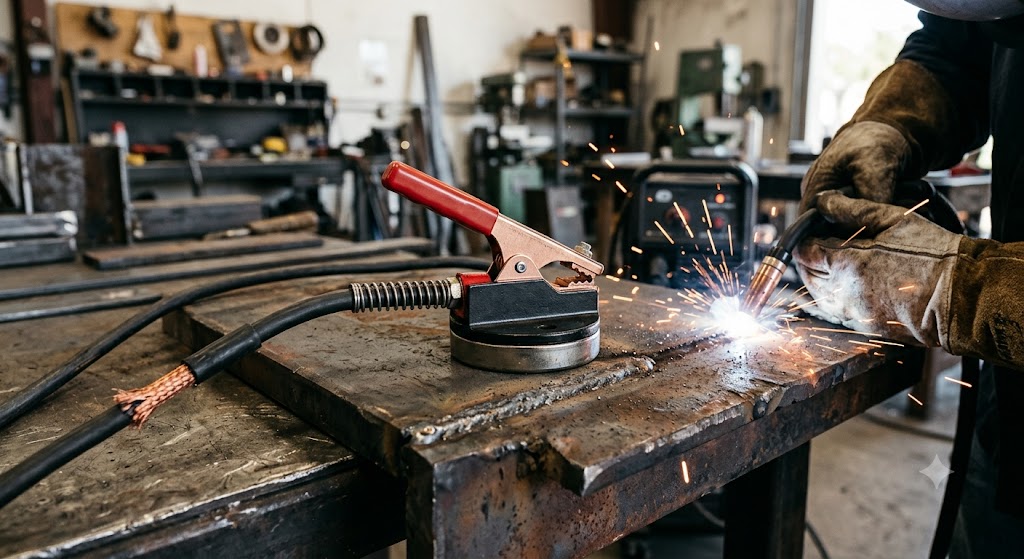
You’re mid-bead, arc looking good, and then the current starts wandering. The weld goes ugly, the spatter picks up, and you spend the next ten minutes chasing an intermittent arc. Half the time, the culprit is the ground. A loose clamp, a coated surface, or a cable you’ve kicked out of position. The magnetic welding ground clamp exists to fix that specific headache - it sticks to your work surface magnetically, turns on and off with a knob, and stays put while you move around the piece.
A magnetic welding ground clamp is a grounding device that uses a switchable permanent magnet to attach the welding circuit’s ground lead directly to a ferrous metal surface. Unlike a spring-loaded jaw clamp, it grips through magnetic attraction, which means no teeth to damage thin stock and no jaw to loosen as the cable shifts. You twist a knob to engage the magnetic field, connect your ground cable to the terminal on the body, and the clamp holds itself in place until you twist it off.
The short answer to whether you need one: if you weld on pipe, tube, or curved plate - or if you’re constantly moving the ground around a large workpiece - a magnetic ground clamp is faster and more reliable than a jaw clamp for clean bare steel. If you weld on coated, painted, or galvanized material, it is not the right tool without prep work.
How a Magnetic Ground Clamp Works
The mechanism inside is a rotary permanent magnet assembly, the same technology used in Magswitch’s industrial switchable magnets. When you rotate the external knob to the “on” position, the internal magnet aligns with two pole pieces that contact the work surface, creating a closed magnetic circuit. Rotating back to “off” cancels the field. No electricity required to hold it, no battery to die mid-job.
The grounding cable attaches to a terminal on the clamp body. Current flows from the work, through the magnetic contact interface, through the body, and out the cable to the machine. The quality of that magnetic contact - surface area, surface cleanliness, magnetic force - determines the effective ground resistance and the weld quality downstream.
OSHA’s electrical safety standards for arc welding (29 CFR 1910.254) require that welding return cables be “adequate capacity” and make “good electrical contact” with the work. A magnetic clamp with high contact force on a clean surface satisfies that requirement more reliably than a worn jaw clamp with one spring-loaded jaw pressing against a round pipe.
When Magnetic Ground Clamps Work and When They Fail
Magnetic ground clamps work on clean, bare ferrous steel and iron. Flat plate, round pipe, square tube - the geometry doesn’t matter as much as the surface condition. The magnetic field bridges small gaps, so light mill scale is usually not a problem.
They fail on:
Painted or powder-coated surfaces. Even a thin coating creates a non-conductive barrier between the magnet poles and the metal. The clamp may hold physically but pass little or no current. You will get a bad ground and a bad arc. Grind or sand the contact area before placing the clamp.
Galvanized steel. Zinc coating is both non-conductive (bad for grounding) and releases toxic fumes when heated. Always grind the ground contact area on galvanized material and follow ventilation requirements from NIOSH and the American Welding Society (AWS F2.2).
Stainless steel, aluminum, and non-ferrous materials. Magnets do not hold on these materials. A conventional jaw clamp is your only option.
Hot surfaces. Permanent magnets lose holding force as they heat up. If you’re placing the ground near a weld zone that’s been running for a while, the clamp may release. Keep the clamp away from the heat-affected zone and check it hasn’t walked off on its own.
The Magswitch Line: Verified and Built for This
Magswitch (magswitch.com) is the company that put the switchable-magnet ground clamp on the map. Their units are specified by amperage rating, which determines the cable and terminal size, and by the magnetic holding force of the body itself.
Magswitch 300 Amp Switchable Magnetic Welding Ground Clamp (Model 8100746)
The 300-amp version is the workhorse for hobbyist and light production welding. It delivers 300 amps of weld current capacity and 200 pounds of magnetic breakaway force on a flat clean surface. The finned body is a heat management feature - the fins increase surface area and lower operating temperature during sustained runs. The on/off knob requires deliberate rotation, so it doesn’t accidentally disengage when a cable pulls against it.
Named flaw: the 200-pound holding force is strong on flat plate but drops significantly on smaller-diameter pipe where the contact footprint shrinks. On 1-inch pipe, you may find the clamp tilts and releases if the cable pulls at an angle. For pipe work, position the clamp on a flat face or use additional support.
Magswitch 600 Amp Switchable Magnetic Welding Ground Clamp (Model 8100747)
Same mechanism, larger body, higher current rating, and improved fin design for production environments. Rated for 600 amps, which covers MIG and flux-core on heavy plate, pipe welding on structural members, and any application where the 300-amp version would run hot. If your welder is rated above 300 amps or you’re doing long, continuous runs, the 600-amp version is the correct choice.
Named flaw: the body is substantially larger and heavier than the 300-amp version. In tight spaces - inside a box section, for example - the size works against you. The 300-amp version fits where the 600-amp won’t.
Choosing the Right Amp Rating
Match the clamp’s amp rating to your welder’s output, not to what you typically run. If your machine is rated at 200 amps but you occasionally push it to 250 on thick plate, the 300-amp clamp gives you headroom. Undersizing the clamp means the terminal and cable connection run hot, which accelerates corrosion and degrades the ground connection over time.
For shop MIG, stick, or TIG welding under 300 amps: the Magswitch 300-amp is sufficient. For production welding, heavy structural work, or machines rated above 300 amps: the 600-amp version or the 800-amp variant (model 8100552) is appropriate.
The American Welding Society’s D1.1 structural welding code and manufacturer guidance from Lincoln Electric and Miller Electric both point to proper ground placement and connection quality as a baseline requirement for consistent weld properties. A magnetic clamp that maintains consistent contact pressure contributes directly to that consistency.
Magnetic vs. Standard Jaw Ground Clamp: An Honest Comparison
A conventional spring-loaded jaw clamp is cheaper, works on any conductive material including aluminum and stainless, and doesn’t care about surface coatings if the jaw teeth bite through. For a welder who works on mixed materials - mild steel one day, stainless the next - a jaw clamp is still the more versatile tool.
The magnetic clamp wins on:
- Speed of placement: Twist on, twist off. No jaw to open and close around a cable or an edge.
- Contact stability: The magnetic force doesn’t reduce as cable tension increases. A jaw clamp under cable tension can rotate and reduce its contact area.
- Round stock: A jaw clamp on pipe grips on two small contact points. The Magswitch contacts the pipe along the full face of the pole pieces, which increases contact area and reduces resistance.
- Repositioning: On a large flat workpiece, you can slide the clamp from point to point without disconnecting the cable. Flick the knob off, move it, flick it back on.
For coated, non-ferrous, or very small-diameter work: use a jaw clamp.
Comparison Table
| Feature | Magswitch 300A | Magswitch 600A |
|---|---|---|
| Max weld current | 300A | 600A |
| Magnetic hold force | 200 lbs | 200+ lbs |
| Best for | Hobbyist, light production | Heavy production, structural |
| Works on coated surfaces | No (prep required) | No (prep required) |
| Amazon link | View | View |
What to Know Before You Buy
A magnetic ground clamp is a premium-tier grounding accessory. If your welding is light, occasional, and always on clean flat plate, a standard jaw clamp does the job and costs less. The magnetic clamp pays for itself in shops that weld pipe, move the ground frequently, or run long-duration arcs where connection stability matters.
Before you place your first bead with a magnetic ground clamp, grind or wire-brush the contact area. Mill scale is usually fine; paint, powder coat, or galvanizing is not. A 30-second prep is all it takes. This applies to jaw clamps too, but the magnetic clamp will remind you more clearly - a poor ground shows up immediately as arc instability rather than just a weak jaw grip.
Keep the contact faces of the clamp clean. Weld spatter and shop grime build up on the pole pieces over time and reduce holding force. A wire brush takes care of it.
FAQ
What is a magnetic welding ground clamp used for? It grounds the welding circuit to the workpiece or welding table using magnetic force instead of a spring-loaded jaw. It gives a stable, high-contact-area ground connection on ferrous steel, which improves arc consistency and reduces the chance of a loose or intermittent ground during welding.
Is a magnetic ground clamp as reliable as a standard clamp? On clean bare ferrous steel, yes - often more reliable, because the magnetic contact force doesn’t drop when cable tension pulls on the body. On painted, coated, or non-ferrous material, it is not reliable and should not be used without surface prep or should not be used at all.
What amp rating do I need for my welder? Match or exceed your welder’s maximum output. A 200-amp MIG welder is safely covered by the Magswitch 300-amp model. A welder rated above 300 amps needs the 600-amp or 800-amp version. Running a clamp at or above its rating causes the terminal to overheat and the connection to degrade.
Can I use a magnetic ground clamp on stainless steel or aluminum? No. Permanent magnets do not hold on non-ferrous metals. Use a conventional jaw clamp on stainless, aluminum, copper, or brass.
Do magnetic ground clamps work on round pipe? Yes, and they’re often better than jaw clamps on pipe because the magnetic face contacts more surface area than two jaw teeth. Holding force decreases on smaller-diameter pipe; for pipe under 1 inch diameter, test the hold before you rely on it.
Can the magnet in the clamp interfere with the arc? Magnetic fields near the weld zone can cause arc blow - the arc deflects toward or away from the magnetic source. Keep the clamp as far from the actual weld area as practical. This is the same guidance that applies to welding near any strong magnet.
Is it safe to leave the clamp switched on between welds? Yes. The magnet doesn’t consume electricity or heat up when idle. Switch it off when repositioning to avoid dragging spatter and debris across the contact face.
References
- OSHA 29 CFR 1910.254 - Welding, Cutting, and Brazing
- American Welding Society - Welding Safety
- AWS F2.2 Lens Shade Selector and Fume Resources
- Magswitch 300 Amp Ground Clamp specs (magswitch.com)
- Magswitch 600 Amp Ground Clamp specs (magswitch.com)
- Miller Electric - The Importance of a Good Welding Ground (millerwelds.com)