Magnetic Welding Square: The Buyer's Guide to Getting Angles Right
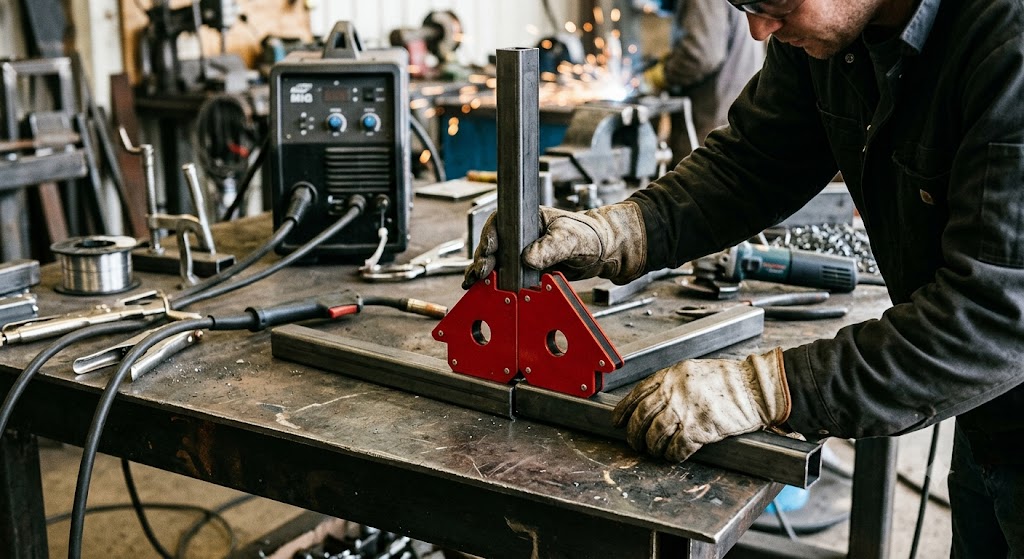
You tack four corners of a frame, pull the clamps, and the whole thing is out of square by a quarter inch. It happens to everyone who has tried to hold metal by hand while tacking. The fix isn’t steadier hands. It’s a magnetic welding square - a block of magnetized steel that holds your work at a precise angle while you make the tacks, so you’re not guessing and you’re not using a third hand you don’t have.
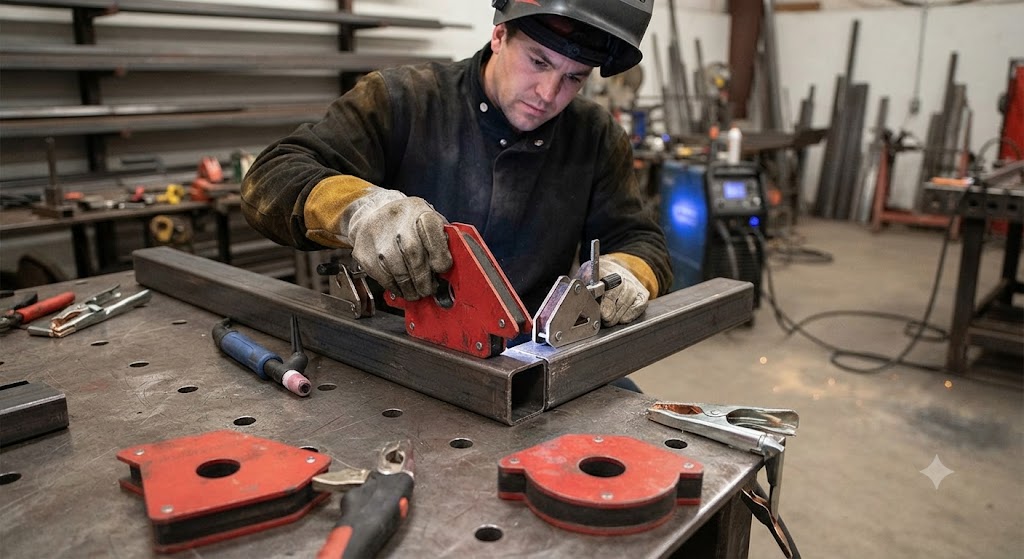
A magnetic welding square is a magnetized holding tool that presses against two faces of a metal workpiece to hold them at a fixed or adjustable angle during welding. The magnet grips the ferrous metal from outside, leaving the joint itself open for tack welds. No clamps to reposition, no hands in the way of the torch. Once you tack the corners, you pull the magnets off and run your full beads.
If you’re welding box frames, tube structures, table legs, or anything where square corners or specific joint angles matter, a magnetic welding square cuts layout time in half and removes the variable of human hold. Here’s how to pick the right one.
Fixed Angle vs. Adjustable: Which Do You Actually Need?
Fixed-angle squares hold at preset angles - typically 45, 90, and sometimes 30/60 degrees. They’re simpler, usually more compact, and stronger for their size because there are no adjustable parts to flex under load. If 90 percent of your work is right-angle joints, fixed-angle squares are the right tool.
Adjustable squares have a pivot mechanism and an angle-setting pin or lock. You can set them anywhere from 30 to 270 degrees (in some models), which makes them useful for miter joints, angled brackets, and anything that isn’t a right angle. The tradeoff is that adjustable squares are larger, the locking mechanism adds a failure point, and the holding force at any given angle is typically lower than a same-sized fixed square at 90 degrees.
For a general fabrication shop: start with fixed-angle squares for 90-degree work, add an adjustable if you find yourself regularly working at other angles.
Pull Force: What Number Actually Matters
Pull force ratings on welding magnets are measured perpendicular to a clean flat steel surface. In real fabrication use, the force you experience depends on:
- Surface condition: Mill scale, rust, and debris reduce effective force. A clean surface achieves rated pull force. A scale-covered surface might achieve 60 to 70 percent of rated.
- Contact geometry: Flat-on-flat maximizes contact area. Tube or pipe against a flat face reduces contact area and therefore reduces force.
- Angle of pull: The rated pull force is straight-off-the-face. Pulling at a sideways angle (shear) requires much less force - relevant because weld distortion pulls in shear. A 30-pound rated magnet may release under 10 to 15 pounds of shear force from thermal distortion in a constrained joint.
For tacking light plate (under 3/16 inch): 25 to 55 pounds of rated pull force is sufficient. For structural work on heavier plate: 100 pounds or more gives you confidence the square won’t release during tacking. For large fabrication jigs where you’re holding heavy members: look at the 325-pound class, or use multiple squares.
Strong Hand Tools: The Adjustable Standard
Strong Hand Tools (stronghandtools.com) makes the magnetic square that comes up in nearly every fabrication shop conversation. Their Adjust-O series features a rotary on/off switch - a genuine differentiator. When the magnet is switched off, it releases completely, which means it doesn’t drag spatter and metal chips across your workpiece when you lift it. Switchable magnets stay cleaner and maintain closer to their rated holding force over time because the face doesn’t accumulate debris the way always-on magnets do.
Strong Hand Tools Adjustable Angle Magnetic Square (MLA series, 30-270 degrees)
Adjustable from 30 to 270 degrees with an angle-setting pin that locks the pivot. Inside and outside magnet faces mean you can hold the square from inside a corner or outside it, depending on joint access. Rated pull force is 26 pounds on the 4-inch size.
Named flaw: the angle lock is a small pin that takes two hands to set - one to hold the angle, one to seat the pin. On a workbench with a reference square, this is fine. Trying to set an angle freehand while the workpiece is already positioned is awkward. Set the angle before placing the square.
Strong Hand Tools Fixed Angle Magnetic Square Kit (MLDT350)
A kit containing fixed-angle squares at 90 degrees (with 30/60 degree faces). Rated pull force of 20 lbs on the 3-inch and 33 lbs on the 5-inch. These are the always-useful shop squares for right-angle work. If you’re doing tube frames or box sections and most joints are 90 degrees, this kit gives you redundant squares so you can tack multiple corners before pulling any.
Named flaw: these are always-on permanent magnets. They pick up chips and spatter constantly. Keeping the faces clean requires regular wire-brushing, or you’ll find the effective holding force gradually drops as a layer of fine steel debris builds up on the contact face.
MAG-MATE: American-Made Workhorses at Multiple Sizes
MAG-MATE (a brand within the Magnet Source / Mag-Mate line) makes welding squares in several sizes, all with large finger holes for easy grip and placement. Their standard line is always-on permanent magnets; their switchable (on/off) line is marked with an “R” suffix.
MAG-MATE WS300 Compact Magnetic Welding Square
The WS300 is the small one: compact enough to fit in tight corners, 55 pounds of holding capacity. It holds steel sheet stock, plate, and tubing at 90 degrees. The large finger hole is a real convenience - you can seat it with one finger while the other hand positions the workpiece.
MAG-MATE WS820 Large Magnetic Welding Square
The large version at 325 pounds of holding capacity. This is the industrial tier - for heavy plate, large structural members, and situations where you need the square to stay put even when a heavy section tries to pull away as it cools. The physical size gives more reference surface for keeping things aligned.
Named flaw: 325 pounds of holding force means 325 pounds of effort to remove it from a flat steel surface. That’s not a complaint for a weld square holding structural steel in position - but on lighter work, you’ll wish for a switchable version. MAG-MATE makes on/off switchable versions (WS0150R, WS0450R) if release ease matters more than cost.
Comparing the Main Options
| Model | Angle | Hold Force | On/Off Switch | Best For |
|---|---|---|---|---|
| Strong Hand Adjustable MLA | 30-270° | 26 lbs | Yes | Mixed-angle fabrication |
| Strong Hand Fixed Kit MLDT350 | 90° / 30/60° | 20-33 lbs | No | High-volume right-angle tacking |
| MAG-MATE WS300 | 90° | 55 lbs | No | General shop use, light to medium plate |
| MAG-MATE WS820 | 90° | 325 lbs | No | Heavy structural work |
Can Magnetic Squares Hold at Angles Other Than 90 Degrees?
Fixed-angle squares are built for specific angles. The Strong Hand MLDT350 kit includes faces for 30/60 degrees in addition to 90. The MAG-MATE WS11094 multi-angle version covers 30/60/45/90 degrees.
For truly arbitrary angles, you need an adjustable-angle square like the Strong Hand MLA. These pivot to any angle in their range and lock in place. The limitation is that adjustable squares have lower holding force than same-sized fixed squares because the adjustable joint introduces compliance in the structure.
What Pull Force Is Strong Enough for Fabrication Work?
A rough rule: for tacking (not holding through full weld runs), 25 to 55 pounds of pull force handles light plate fabrication under 3/16 inch. Heavier plate, longer tack intervals, or joints where thermal distortion is high (like welding on pipe that wants to pull as it cools) benefit from 100 pounds or more per square. Using two smaller squares on a joint beats using one large one - the redundancy catches the release if one side lets go.
Always test the hold before welding. Place the square, try to knock it off with a light tap. If it moves too easily, either the surface needs cleaning or you need a higher-rated square.
FAQ
What is a magnetic welding square used for? It holds two pieces of ferrous metal at a fixed or adjustable angle so you can tack weld them without using your hands or additional clamps. It keeps corners square and angles consistent across multiple joints on the same project.
What pull force is strong enough for fabrication work? For light plate tacking under 3/16 inch, 25 to 55 pounds is workable. For medium plate or joints with significant thermal distortion, 100 pounds or more per square gives better security. Use multiple squares on large joints.
Can magnetic squares hold at angles other than 90 degrees? Yes, in two ways. Some fixed-angle squares have multiple faces that provide 30, 45, 60, and 90-degree positions. Adjustable-angle squares (like the Strong Hand MLA series) pivot to any angle in their range and lock in place.
Do magnetic welding squares work on stainless or aluminum? No. Permanent magnets only grip ferrous steel and iron. For non-ferrous materials, use mechanical clamps or fixturing.
Why does my magnetic square keep releasing during welding? Three common causes: (1) the contact face is contaminated with debris or spatter and the effective holding force is lower than rated; (2) thermal distortion from the weld is pulling the joint in shear, which requires much less force than straight pull to release the magnet; (3) the magnet is positioned too close to the weld zone and is losing holding force from heat.
What is the benefit of an on/off switch on a welding magnet square? Switchable magnets release completely when turned off, so they don’t drag debris and spatter across the work surface when repositioned. They stay cleaner, which keeps their effective holding force closer to their rated force over time.
Should I use one magnetic square or multiple on a frame project? Multiple. On a rectangular frame, placing a square on two or three corners simultaneously ensures the whole structure stays in the right geometry, not just the corner you’re currently tacking. Use at least two squares per right-angle joint on production work.
References
- Strong Hand Tools Magnet Squares lineup (stronghandtools.com)
- American Welding Society - Welding Safety
- Miller Electric welding tips (millerwelds.com)
- Lincoln Electric welding guidance (lincolnelectric.com)