MSA Welding Respirator Review: Is It Worth It for Welders?
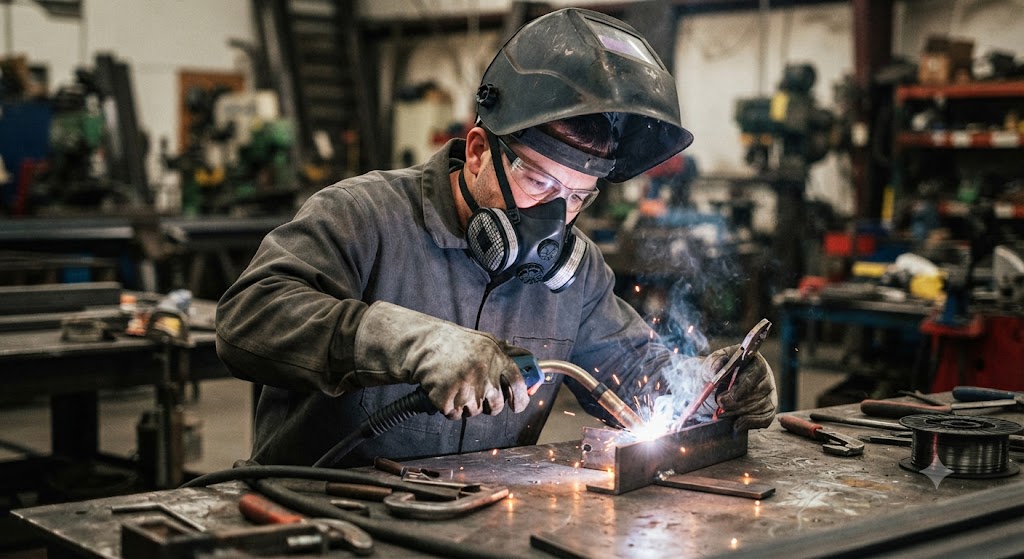
MSA Safety has been making respiratory protection since 1914. That’s over a century of mining, construction, and industrial use before most welding respirator brands existed. When welders ask whether MSA half-masks belong in the same conversation as 3M and GVS, the honest answer is yes - but with some specifics worth knowing before you buy.
Here’s what the MSA Advantage 200 LS does well, where it falls short compared to competitors, and what filter rating you actually need for welding fumes.
What Is the MSA Advantage 200 LS?
The MSA Advantage 200 LS is a half-facepiece air-purifying respirator (APR) designed for industrial use. “LS” stands for lighter and softer, referring to the thermoplastic rubber facepiece construction that replaced the older, stiffer Advantage 200 body.
It covers the nose and mouth, accepts a wide range of MSA Advantage cartridges and filters, and carries NIOSH approval under 42 CFR Part 84. As a half-mask, it provides an Assigned Protection Factor (APF) of 10 - meaning it reduces your exposure to one-tenth of the ambient concentration. For most welding fume scenarios below 10x the permissible exposure limit, that APF is adequate when combined with proper ventilation controls per OSHA 29 CFR 1910.134.
The MultiFlex system, MSA’s name for the two-section facepiece with a flexible sealing surface and a rigid structural shell, is the Advantage 200 LS’s defining ergonomic feature. It lets the soft sealing surface conform to your face independently of the rigid outer body, which helps with fit across a wider range of facial geometries than single-piece rubber designs.
Is MSA a Trusted Brand for Welders?
MSA Safety is one of the oldest and most established names in industrial PPE. Their products are used in mining, oil and gas, firefighting, and heavy industrial manufacturing. NIOSH approval is NIOSH approval - it doesn’t matter what brand is on the facepiece. What matters is that the respirator you use is NIOSH-certified, properly selected for the hazard, and fit-tested.
For welding fumes from mild steel, stainless, galvanized, and similar metals, the MSA Advantage 200 LS with P100 filters (MSA part 815369 or similar P100 cartridges) meets the minimum NIOSH protection requirement. P100 filters deliver 99.97% efficiency against particles at 0.3 microns, covering the solid and liquid aerosol fumes produced in arc welding.
For environments with hexavalent chromium (stainless welding), manganese (alloy welding), or other regulated metals, OSHA 29 CFR 1910.1026 and related standards require at minimum a P100 half-mask when exposures fall below 10x the PEL, and a full-face or supplied-air respirator when concentrations are higher.
MSA vs 3M vs GVS for Welding
These three brands dominate the half-mask welding respirator space. Here’s how they compare in practical terms:
3M 6500QL Series (6502QL, medium): The 3M half-mask has a larger range of available cartridges and is the most widely distributed respirator in industrial supply chains. The Quick Latch mechanism lets you drop the mask below your chin without removing head straps, which welders appreciate when moving in and out of confined areas. The 3M bayonet cartridge system has the broadest selection for mixed-hazard environments. Flaw: the wider profile is harder to fit under tight helmet shells.
GVS Elipse P100 (SPR457/SPR451): The flattest and lightest option of the three. Designed for compatibility with welding helmets and safety eyewear. Filters integrate directly into the facepiece body rather than attaching as separate cartridges, which keeps the profile compact. Flaw: fewer organic vapor and gas cartridge options compared to 3M.
MSA Advantage 200 LS: Comfortable for extended wear due to the MultiFlex facepiece. Good facial fit across diverse face shapes. A strong choice for welders who have had trouble sealing other half-masks. Flaw: the cartridge-forward design adds more profile depth than the GVS Elipse, which can interfere with some helmet shells.
If helmet clearance is your top priority, GVS Elipse wins. If you need the broadest cartridge selection for variable hazard environments, 3M wins. If comfort on a wide range of face shapes is the deciding factor, MSA is worth serious consideration.
What Filter Rating Do Welders Need?
For welding fumes, the standard recommendation is a P100-rated filter. Here’s why the P-class matters:
- P100 filters are resistant to oil-based aerosols (“P” = oil-proof)
- Welding produces both solid metal fumes and oil-based mist from cutting fluids, lubricants, and coatings
- N-class filters (N95, N100) are not oil-resistant and degrade faster in environments with oil aerosols
NIOSH P100 delivers 99.97% filtration efficiency. For stainless, alloy, or galvanized welding where you’re producing regulated-substance fumes (hexavalent chromium, manganese, cadmium, lead), P100 is the minimum filter class for a half-mask.
For organic vapors from coatings, primers, or solvents, you need a separate OV cartridge or a combination P100/OV cartridge. Particulate-only P100 filters do not block gases or vapors.
Named Flaw
The MSA Advantage 200 LS has a deeper cartridge profile than the GVS Elipse or Miller LPR-100. The cartridges protrude forward and to the sides more than the flat-folding Elipse filters. Under a standard auto-darkening helmet this is usually fine. Under tight-profile helmets, especially import brands with narrow inner clearances, the cartridges can press against the lens assembly and distort the face seal. If you need the flattest possible respirator for a close-fitting helmet, the Elipse platform wins that specific comparison.
MSA on Amazon
Note: The MSA Advantage 200 LS half-mask has limited direct Amazon availability as a confirmed single-unit listing at time of research.The appeared in search results with an inconsistent product title. MSA Safety products are widely available through industrial safety distributors including Grainger, Fastenal, and the MSA Safety website directly. If you need to verify a live Amazon listing, search “MSA Advantage 200 LS half mask” and confirm NIOSH certification in the product listing before purchasing.
Comparison Table
| MSA Advantage 200 LS | GVS Elipse SPR457 | 3M 6502QL | |
|---|---|---|---|
| NIOSH P100 | Yes (with P100 cartridge) | Yes | Yes (with 2091 filter) |
| APF | 10 | 10 | 10 |
| Helmet clearance | Moderate | Excellent | Good |
| Face fit versatility | Excellent (MultiFlex) | Good | Good |
| Cartridge variety | High | Low | Very high |
| Amazon availability | Limited (verify) | Confirmed | Confirmed |
FAQ
Is MSA a trusted respirator brand for welders? Yes. MSA Safety is one of the oldest industrial PPE brands in existence, with over 100 years of NIOSH-certified respiratory protection. Their Advantage 200 LS is a genuine half-mask respirator with the same APF-10 rating as 3M and GVS alternatives. What matters in practice is NIOSH certification, proper cartridge selection, and fit testing, not brand name.
How does MSA compare to 3M and GVS for welding? All three are solid options with NIOSH P100 certification. The GVS Elipse wins on helmet clearance. The 3M 6500 series wins on cartridge variety for mixed hazards. The MSA Advantage 200 LS wins on facepiece fit versatility through its MultiFlex sealing system. Choose based on your helmet setup and face shape, not brand loyalty.
What filter rating should welders use? P100 is the standard recommendation for welding fumes. P100 filters are oil-resistant and deliver 99.97% efficiency, covering solid metal fumes and oil-based aerosols. N-class filters (N95, N100) are not oil-resistant and are not the right choice for welding environments with lubricants or cutting fluids. For gas and vapor hazards, add an OV cartridge.
Does the MSA Advantage 200 LS fit under a welding helmet? For most standard auto-darkening helmets, yes. The MultiFlex cartridge design adds more forward depth than the GVS Elipse, so verify clearance with your specific helmet before a full shift. Tight-profile helmets may cause cartridge contact with the lens.
Is fit testing required for the MSA Advantage 200 LS? Yes. Under OSHA 29 CFR 1910.134, all tight-fitting half-mask respirators require qualitative or quantitative fit testing when used in an employer-required respiratory protection program. Voluntary use requires at minimum a user seal check before each use.
What is OSHA’s rule on welding respirators? OSHA 29 CFR 1910.134 requires employers to provide respirators when engineering controls and work practices do not reduce welding fume exposure below permissible exposure limits. The standard covers respirator selection, fit testing, medical evaluation, training, and maintenance. Specific fume types (hexavalent chromium, manganese) have their own regulatory standards under 29 CFR 1910 Subpart Z.