P100 Welding Respirator Masks Compared
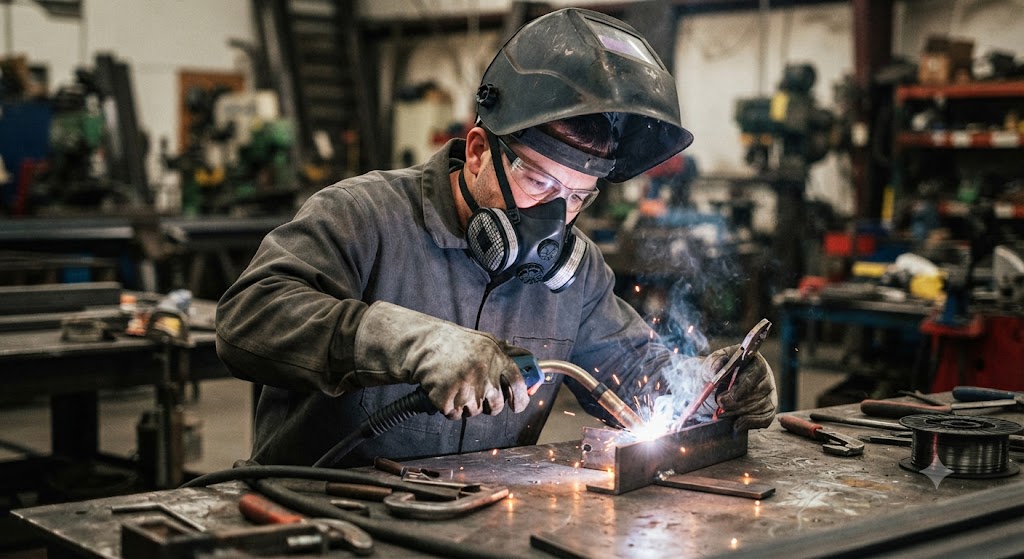
When I switched from an N95 disposable to a P100 half-mask for shop welding, my first reaction was that the P100 felt like more work. It took time to get the straps right, it needed a seal check every time, and the cartridges cost more than a box of disposables. About three months in I stopped noticing any of that because the P100 had become habit. What I did notice was that my throat and lungs felt genuinely better at the end of a long welding day. If you are ready to step up from disposables to a real P100 respirator for your welding work, this guide compares the three most popular options currently on the market.
What P100 Actually Means
P100 is a NIOSH filter efficiency classification. It means the filter removes 99.97% of airborne particles, both oil-based and non-oil-based. The P designation stands for oil-proof, meaning the filter maintains its efficiency against oil-based aerosols as well as dry particles. For welding fumes, which include metallic oxides, organic decomposition products from coatings, and ozone, P100 filtration provides the highest available protection in a cartridge respirator.
For comparison, N95 disposable masks remove 95% of non-oil-based particles. The 95% versus 99.97% difference sounds small until you calculate the actual particle passage. An N95 passes roughly 5 out of 100 particles. A P100 passes 0.03 out of 100. In a welding environment with sustained fume generation, that gap is significant.
All three respirators compared here are NIOSH-approved P100 half-mask designs. NIOSH approval means the respirator and cartridge combination was independently tested to meet the stated filtration efficiency. Never buy a respirator for welding protection without a NIOSH approval marking on the device and packaging.
3M P100 Half-Mask Respirator
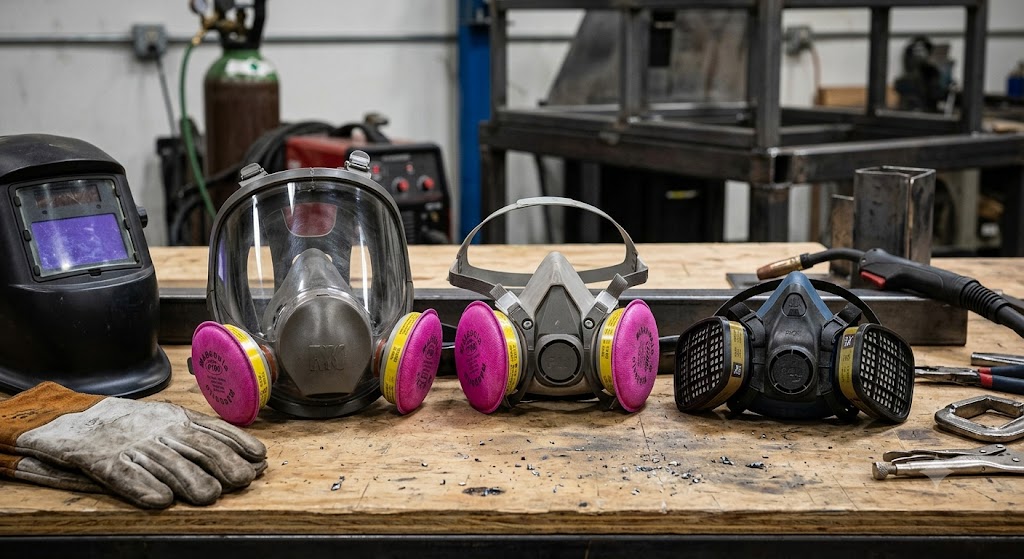
The 3M 7500 series is the most widely used P100 half-mask in professional environments. The 7501, 7502, and 7503 cover small, medium, and large face sizes. The facepiece uses a soft silicone seal that conforms well to a variety of face shapes. The dual-cartridge design accepts the full range of 3M 60 series cartridges, including the 2091 P100 particulate cartridge and combination cartridges for welding environments that also need organic vapor or acid gas filtration.
The 7500 series is not specifically designed for welding helmet compatibility. It sits at a moderate profile that can interfere with some helmet headgear, particularly compact helmets with limited interior depth. It is the most recommended choice for general industrial and welding use where helmet compatibility is not the primary constraint.
GVS Elipse P100 Half-Mask
The GVS Elipse has become the most talked-about low-profile P100 respirator among welders specifically because of its remarkably slim profile. The Elipse sits nearly flush to the face, with a very shallow protrusion from the face seal surface to the cartridge face. This profile fits under most auto-darkening welding helmets without pressing the helmet off the face or creating pressure points at the cheekbones.
The Elipse uses a proprietary cartridge that is not interchangeable with 3M cartridges. You buy GVS cartridges for the GVS mask. The replacement cartridge cost is comparable to 3M cartridges in most supply channels. The Elipse seal is also silicone-based and is well-regarded for conforming to a wide range of face shapes. One downside is that the Elipse comes in a single size, which means it fits most adult face shapes but not all.
Miller LPR-100 Low Profile Respirator
The Miller LPR-100 was designed specifically for welding helmet compatibility. Miller welding, a major helmet manufacturer, built the LPR-100 to pair with their welding helmets and the result is the thinnest profile of the three respirators compared here. The LPR-100 sits exceptionally close to the face, allowing most Miller helmet headgear to seat correctly without the respirator pushing the helmet forward.
The LPR-100 uses 3M 60 series cartridges, which is a meaningful convenience since 3M cartridges are available at virtually every welding supply store. The facepiece is a soft pliable material that conforms to the face but is slightly less durable than the rigid silicone of the Elipse or 3M 7500 over extended time.
P100 Respirator Comparison
| Feature | 3M 7500 Series | GVS Elipse P100 | Miller LPR-100 |
|---|---|---|---|
| NIOSH approval | Yes | Yes | Yes |
| Profile height | Moderate | Very low | Very low |
| Welding helmet fit | Moderate, varies by helmet | Excellent | Excellent, designed for welding helmets |
| Cartridge compatibility | 3M 60 series | GVS proprietary | 3M 60 series |
| Face sizes | Small, medium, large | One size fits most | One size |
| Seal material | Soft silicone | Soft silicone | Soft pliable rubber |
| Availability | Excellent, widely distributed | Good | Good through welding supply |
| All-day comfort | Very good | Very good | Very good |
When to Use Combination Cartridges
For welding stainless steel, galvanized steel, or any material with coatings that generate organic vapor or acid gas fumes in addition to particles, switch from a pure P100 cartridge to a combination P100 plus OV/AG cartridge. The 3M 60921 combination cartridge fits 3M 7500 series and Miller LPR-100 masks and provides P100 particulate filtration plus organic vapor and acid gas protection in a single cartridge. GVS makes equivalent combination cartridges for the Elipse.
The Bottom Line
For welders who do not regularly use a welding helmet, the 3M 7500 series is the most practical choice: widely available, well-fitting across face sizes, and compatible with the full range of 3M 60 series cartridges. For welders who wear a helmet daily, the GVS Elipse or Miller LPR-100 eliminates the helmet fit problem and provides the same P100 protection in a profile that works under most helmets. If you already run Miller helmets, the LPR-100 with its 3M cartridge compatibility is the clean pairing.
Frequently Asked Questions
What is the difference between P100 and N95 for welding? P100 removes 99.97% of all particles including oil-based aerosols. N95 removes 95% of non-oil particles only. For welding fume protection in most indoor scenarios, P100 is the correct choice.
Does the GVS Elipse fit under a welding helmet? Yes. The Elipse is one of the most popular choices specifically because its low profile fits under most auto-darkening welding helmets without breaking the helmet seal at the face.
Are Miller LPR-100 cartridges the same as 3M cartridges? Yes. The Miller LPR-100 accepts standard 3M 60 series cartridges, making replacement cartridges easy to find at any welding supply store.
How often should I replace P100 cartridges? Replace when you notice increased breathing resistance. For combination P100 plus organic vapor cartridges, replace on a schedule based on your exposure level and usage duration, not just when breathing becomes labored.
Can one size GVS Elipse fit everyone? The Elipse fits most adult face shapes but some individuals with very small or very large faces may find the seal less reliable. If the Elipse does not seal correctly for your face shape, the 3M 7500 series in the appropriate size is the better choice.
Should I use a full-face respirator for welding? For most welding scenarios, a half-mask P100 provides adequate protection. A full-face respirator adds eye protection but is bulkier and does not combine well with a welding helmet. A PAPR is the better upgrade from a half-mask for extended high-exposure welding rather than a full-face respirator.
References
https://www.cdc.gov/niosh/topics/welding https://www.osha.gov/laws-regs/regulations/standardnumber/1910/1910.134 https://www.3m.com/3M/en_US/safety-centers-of-expertise-us/respiratory-protection
SEO Title: P100 Welding Respirator Masks Compared