Phoenix Dry Rod Oven Review
Ask a room full of pipe welders which rod oven they trust and one name comes up again and again: Phoenix. The company has been making DryRod ovens in the USA since 1950, and its Type 300 bench oven and portable DryRod units have become the quiet standard in shops and on jobsites where dry rods are not optional. This review looks at what makes Phoenix ovens the reference, what the Type 300 is known for, and whether the name is worth choosing over lesser brands, plus the Phoenix portable ovens you can buy directly.
Phoenix International makes the DryRod line of welding electrode ovens, widely regarded as the industry standard for durability. The flagship Type 300 is a thermostatic bench oven, and Phoenix also makes portable Type 5 ovens. Here is the honest review.
What Phoenix makes
Phoenix builds a full range of electrode and flux ovens around one goal, keeping consumables moisture-free:
- Bench ovens like the Type 300, holding large quantities with adjustable thermostatic control.
- Portable ovens like the Type 5, carrying a working supply to the jobsite.
- Rod canisters and Safetube storage for rods away from power.
- Flux and wire ovens for submerged-arc and other processes.
Across the line, the reputation is the same: rugged, made in the USA, and built to last, which is why Phoenix ovens are a fixture in serious shops.
Direct answer: is Phoenix worth it?
The short verdict:
- For durability and consistency, Phoenix DryRod ovens earn their reputation and are a safe long-term choice.
- The Type 300 bench oven is the workhorse, with adjustable thermostatic control and large capacity for shops that process a lot of rod.
- Portable Type 5 ovens bring the same build quality to the field in a carryable size.
- For a home hobbyist, a simpler portable oven from another brand may be all you need, and Phoenix shines most for professional and code work.
If you weld to code or run a busy shop, Phoenix is hard to argue with; casual users can weigh a lighter-duty oven.
The Type 300: what it is known for
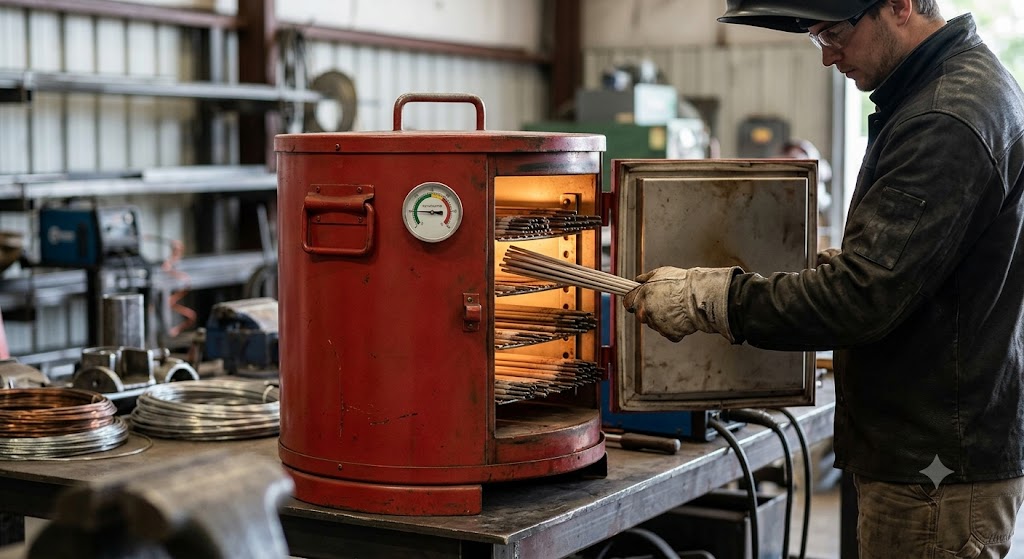
The Type 300 is the oven that built the reputation. It is a bench or floor oven with a circular chamber that heats the interior evenly, using natural air currents to carry moisture toward door vents, with aluminized steel construction to resist corrosion. Its adjustable thermostatic control lets you dial in a holding temperature, and the range reaches well above the 300 degrees F needed for 7018 (the family spans up to the 550 degree F range on higher models), with an indicator light showing when the elements are heating. A single-action door latch that can be padlocked, metal-sheathed heating elements, and thick glass-fiber insulation round out a design meant to run for years in a working shop. In large capacities it holds hundreds of pounds of electrodes, which is why it anchors so many fabrication shops. It is professional equipment, sold mainly through welding distributors rather than as a carry-home item.
Phoenix versus lesser brands
Here is the honest comparison. A wave of lesser import rod ovens now does the basic job of holding rods at temperature, and for a hobbyist keeping a few pounds of 7018 dry, one of those can be perfectly adequate. What Phoenix brings is proven durability, consistent even heating, serviceable construction, and a track record in code and production environments where an oven failure is a real problem. The DryRod’s rugged build and long service life are the reasons professionals keep buying them. So the choice comes down to use: for critical, code, or heavy daily work, Phoenix’s reliability prizes itself over a lighter unit that may not hold up; for occasional home use, a simpler oven may serve fine. You are choosing between proven professional durability and lighter-duty convenience.
Which Phoenix ovens to buy
The Type 300 bench oven is sold through welding distributors and is aimed at shops. For a Phoenix oven you can order directly, the portable Type 5 line is the pick.
- Phoenix DryRod Type 5 portable electrode oven (50 pound) is a rugged 50 pound portable oven, 120/240V with a wire-wrapped heating element for even, constant heat and made in the USA, bringing Phoenix build quality to the field. Its limitation is that 50 pounds is more capacity (and weight) than a light hobby oven.
- Phoenix DryRod Type 5 portable oven with thermometer adds a door-mounted thermometer for immediate temperature indication on the same rugged 50 pound Type 5 platform, useful when you want to verify holding temperature at a glance. The trade-off is, again, a professional-sized unit rather than a compact one.
How to choose: for a rugged portable Phoenix, the Type 5 50 pound. For the same oven with temperature readout, the Type 5 with thermometer. For a large bench oven, the Type 300 through a welding distributor.
Who should skip a Phoenix: a casual home welder keeping a few pounds of rod dry, who may be well served by a smaller, lighter portable oven from another brand.
The bottom line
Phoenix earns its standing as the reference in rod ovens through decades of rugged, made-in-the-USA DryRod units that professionals trust. The Type 300 bench oven is the workhorse, with even heating, adjustable thermostatic control, and the durability that matters where dry rods are mandatory, and the portable Type 5 brings that build quality to the field. Whether Phoenix is right for you comes down to use: for code, production, or heavy daily welding, its reliability is hard to beat, while a casual home welder can reasonably choose a lighter-duty oven. If you want an oven you will not have to think about for years, Phoenix is a safe bet.
FAQ
Is Phoenix the industry standard rod oven brand? Phoenix is widely regarded as the reference in welding rod ovens, making DryRod ovens in the USA since 1950 with a reputation for durability and consistent heating. Its ovens are a fixture in professional shops and on jobsites, which is why many welders treat the brand as the standard.
What is the Phoenix Type 300 known for? The Type 300 is Phoenix’s workhorse bench oven, known for a circular chamber that heats evenly, aluminized steel corrosion resistance, adjustable thermostatic control, thick insulation, and large electrode capacity. It is built to run for years in a working shop, which is why it anchors many fabrication operations.
Is a Phoenix rod oven worth it over lesser brands? For code, production, or heavy daily work, yes, because Phoenix’s proven durability and consistent heating matter where an oven failure is a real problem. For occasional home use, a simpler portable oven from another brand can be adequate, so the choice depends on how critical and how heavy your welding is.
Where can you buy Phoenix rod ovens? The large Type 300 bench ovens are sold mainly through welding distributors, since they are professional equipment. Phoenix’s portable Type 5 ovens are more widely available to order directly, bringing the same build quality in a carryable size for field and shop use.
What temperature does a Phoenix rod oven reach? Phoenix ovens hold the temperatures low-hydrogen rods need, comfortably reaching the 250 to 300 degrees F holding range for 7018, with higher Type 300 models spanning up to the 550 degree F range for more demanding conditioning. Adjustable thermostatic control lets you set the right holding temperature.
Are Phoenix DryRod ovens made in the USA? Yes. Phoenix International manufactures its DryRod ovens in the USA, and the made-in-USA construction is part of the brand’s reputation for durability. That build quality is a key reason professionals choose Phoenix for shop and jobsite electrode storage.
References
- Phoenix International DryRod and Type 300 electrode oven specifications, including construction, temperature range, and capacity (manufacturer), dryrod.com.
- Airgas and distributor listings for Phoenix DryRod Type 300 and Type 5 oven specifications (industry distributors), airgas.com.
- AWS and Lincoln Electric guidance on low-hydrogen electrode storage temperatures (industry standards and manufacturer), aws.org, lincolnelectric.com.