Pipe Welding Alignment Clamps Guide
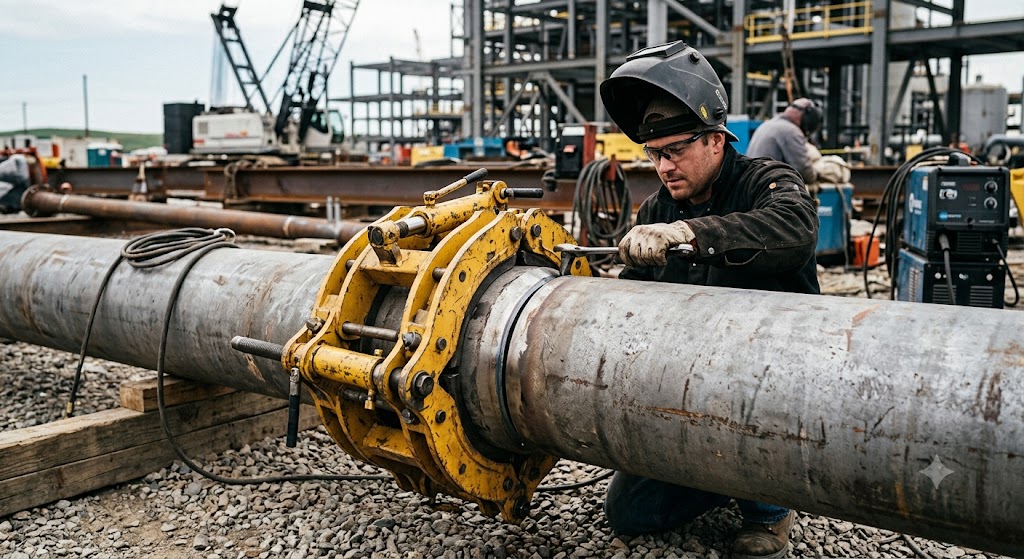
Welding pipe well starts before the arc ever strikes. Get two pipe ends lined up straight, with the right gap between them, and a good weld follows almost naturally. Get the fit-up wrong, with the ends offset or the gap uneven, and no amount of skill at the torch fully saves it. That is the entire job of a pipe alignment clamp: to hold two pipe sections in perfect alignment, with a consistent root gap, so you can tack and weld a joint that is straight and sound. This guide covers the clamp types, how they hold a gap, and whether to rent or buy.
Pipe welding alignment clamps hold two pipe sections in line with a consistent root gap for welding. The main types are chain clamps for larger pipe, cage clamps for precise fit-up, and quick clamps for small pipe. Here is how they work and how to choose.
Why fit-up decides the weld
In pipe welding, alignment is not a nicety, it is the foundation of the weld:
- Straightness (low offset) keeps the two pipe bores lined up, avoiding a stress-concentrating step at the joint.
- A consistent root gap gives the root pass the space it needs for full penetration all the way around.
- A held position stops the joint from moving while you tack, so it stays true.
- Repeatability lets you reproduce good fit-up joint after joint.
Alignment clamps exist to lock in all four, which is why serious pipe work always starts with the right clamp.
Direct answer: which clamp type
The right alignment clamp depends on the pipe:
- Chain clamps wrap a chain around the pipe and tension it with a jackscrew, aligning a wide range of pipe sizes; the go-to for medium and large pipe.
- Cage (line-up) clamps encircle the joint in a rigid cage for very precise alignment and root-gap control, favored on high-quality and code work.
- Quick alignment clamps use a fast screw or lever to line up small pipe and tube, handy for lighter fabrication.
Match the type to your pipe diameter and how precise the job needs to be.
Chain clamps: the workhorse
For most pipe fit-up, the chain clamp is the workhorse. It works by wrapping a chain around both pipe sections at the joint and tensioning it with jackscrews, which pull the pipes into alignment and let you set the root gap. The beauty of a chain clamp is its range: by adding or removing chain links, one clamp handles a wide span of pipe diameters, and the jackscrews let you reform slightly out-of-round pipe into alignment. Because the chain sits back from the joint, you can tack and often weld with the clamp still in place. A double chain clamp adds a second chain for extra reforming strength on heavy pipe. For pipe-to-pipe, pipe-to-elbow, and pipe-to-flange fit-ups across many sizes, a chain clamp is the versatile first choice.
How clamps maintain the root gap
The root gap, the small, consistent space between the two pipe ends, is what lets the root pass fully penetrate, and holding it evenly all the way around the joint is exactly what a good clamp does. With the pipes drawn into alignment by the chain or cage, you set the gap using spacers, gap tools, or the clamp’s own adjustment, then lock the clamp so the ends cannot drift closer or farther apart as you tack. Cage clamps are especially good here, because their rigid structure holds the whole circumference in position, keeping the gap uniform all the way around while you place your root tacks. Once the joint is tacked at several points, the tacks hold the gap and you can remove the clamp to complete the weld. Consistent gap in, sound root pass out.
Rent or buy?
A practical question, since good pipe clamps are an investment. The honest answer depends on how often you do pipe work. If you weld pipe regularly, buying is worth it: you always have the clamp on hand, sized to your common pipe, and it earns its place in fit-up quality and time saved. If you face a one-off job or an unusual pipe size you rarely see, renting a professional cage or chain clamp for that project makes more sense than owning a clamp that sits idle. Many welders own a chain clamp or two for their common sizes and rent specialty cage clamps for the occasional large or high-spec job. Match your ownership to your workload, and rent the rest.
Which alignment clamps to buy
Here are three options across the range.
- Irwin Vise-Grip 20R locking chain clamp wraps and locks a chain around pipe and round stock with one-handed operation, a handy, portable clamp for holding and aligning smaller pipe and awkward shapes. Its limitation is that it suits lighter fit-up rather than heavy reforming of large pipe.
- Sawyer double chain clamp is a professional pipe alignment and reforming clamp with dual chains and heavy jackscrews, built to align and reform large pipe with precision. The trade-off is that it is heavy, professional-grade equipment aimed at serious pipe work.
- Alwalkee heavy-duty pipe alignment clamp (4 to 11 inch) uses wide grip plates and a quick release to line up medium pipe fast, a practical middle-ground fit-up tool. Its limitation is the fixed capacity range compared with an adjustable chain.
How to choose: for small pipe and awkward shapes, the Irwin chain clamp. For serious large-pipe alignment and reforming, the Sawyer double chain clamp. For fast medium-pipe fit-up, the Alwalkee clamp.
Who should skip a heavy chain clamp: welders who only occasionally fit small tube, who can use a quick clamp or rent for the rare big job.
The bottom line
Pipe welding is won at fit-up, and an alignment clamp is what locks in the straightness and consistent root gap a sound weld depends on. Chain clamps are the versatile workhorse, adjusting to a wide range of pipe sizes and letting you weld with the clamp in place; cage clamps hold the whole circumference for the most precise gap control on code work; quick clamps handle small pipe. Buy the clamp sized to the pipe you weld regularly, and rent specialty clamps for one-off or unusual jobs. Get the fit-up right, and the weld follows.
FAQ
What clamp is used to align pipe before welding? The main tools are chain clamps, which wrap a tensioned chain around the pipe to align a wide range of sizes; cage (line-up) clamps, which encircle the joint in a rigid cage for very precise alignment; and quick clamps for small pipe. Chain clamps are the versatile first choice for most fit-up.
How do chain clamps maintain root gap? The chain and jackscrews pull the two pipe ends into alignment, then you set the root gap with spacers or the clamp’s adjustment and lock it so the ends cannot drift. The clamp holds the gap while you place root tacks; once tacked, the tacks hold the gap and the clamp comes off.
Are pipe alignment clamps rentable or should you buy? Both, depending on workload. If you weld pipe regularly, buying a clamp sized to your common pipe is worth it for the fit-up quality and time saved. For a one-off job or an unusual size you rarely see, renting a professional cage or chain clamp for that project makes more sense than owning an idle tool.
What is the difference between a chain clamp and a cage clamp? A chain clamp wraps a tensioned chain around the joint, adjusts to many pipe sizes, and can reform out-of-round pipe. A cage clamp is a rigid structure that encircles the whole joint for the most precise alignment and uniform root gap, favored on high-quality and code work but sized to specific diameters.
Why is root gap important in pipe welding? The root gap is the small, consistent space between the pipe ends that gives the root pass room to penetrate fully around the joint. If the gap is uneven or wrong, the root pass may lack penetration or burn through, so holding a consistent gap is central to a sound pipe weld.
Can you weld with the alignment clamp still on the pipe? Often yes. Chain clamps sit back from the joint, so you can tack and frequently weld with the clamp in place, then remove it. Cage clamps with a no-tack (arched) design allow 360 degree welding access; others are removed after tacking so the tacks hold the gap for the finish weld.
References
- Sawyer Manufacturing chain clamp and double chain clamp specifications, including pipe size range and alignment within 1/64 inch (manufacturer), sawyermfg.com.
- Mathey Dearman pipe alignment and reforming clamp information, including chain, cage, and line-up clamps (manufacturer), mathey.com.
- ASME B31.3 and AWS guidance on pipe joint alignment and root gap tolerance (industry standards), aws.org.