Portable Welding Rod Oven Guide
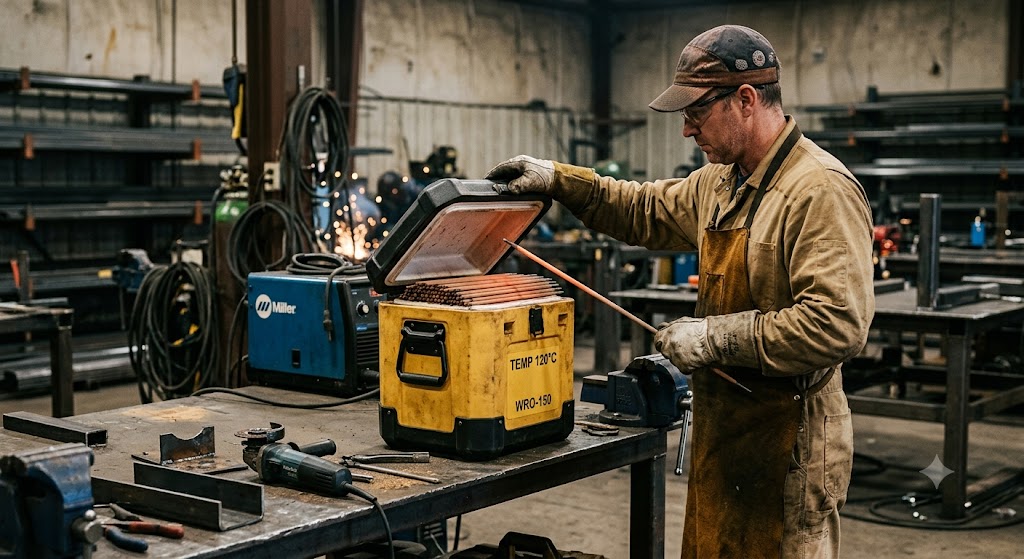
The rod oven bolted to the wall of the shop does you no good when the work is forty feet up on a beam or out on a pipeline in the rain. That is the whole case for a portable welding rod oven: a small, heated box you can carry to the joint so your low-hydrogen rods stay dry right where you are welding. If you do field work, run a mobile rig, or just want an oven you can move around the shop, a portable unit is the tool. This guide covers sizing, running one off a generator, and which to buy.
A portable welding rod oven is a lightweight, heated electrode box, usually 110V and holding around 10 to 22 pounds of rods, that keeps low-hydrogen electrodes like 7018 dry on the jobsite. Here is how to size and choose one.
Why go portable
A portable oven solves problems a stationary one cannot:
- Dry rods at the joint, so your 7018 stays code-ready wherever the work is.
- Field and mobile use, carried up scaffolding, out to the field, or between shop stations.
- Fast setup, plugging into standard 110V power or a generator.
- Right-sized capacity, holding a working supply of rods without the bulk of a bench oven.
For anyone who welds away from a fixed bench, portability is the feature that actually keeps rods dry.
Direct answer: what to look for
When choosing a portable rod oven, weigh these features:
- Capacity matched to a working supply, commonly 10 to 22 pounds of rods.
- Rod length, confirming it fits 14 inch or 18 inch electrodes as needed.
- Temperature control, ideally adjustable to hold 250 to 300 degrees F for low-hydrogen rods.
- 110V operation so it runs from standard outlets or a generator.
- A secure latch and handle so rods stay put and the oven is easy to carry.
Strong choices include the YESWELDER 15 pound oven, a 22 pound adjustable oven for larger supplies, and the Ridge Products 11 pound oven.
Sizing a portable oven
The first decision is capacity, and the honest guide is to match it to how much rod you actually burn between refills, not to buy the biggest box. A 10 to 15 pound oven suits a hobbyist or a welder carrying a working supply to the joint, staying light enough to haul up a ladder. A 20 to 22 pound oven makes sense if you go through more rod in a session or want to top up several times a day without returning to a bench oven. Check rod length too: many portable ovens fit 14 inch electrodes, while some accept 18 inch rods, so match the oven to the rods you run. A portable oven is often a companion to a larger stationary oven, filled from the big one and carried out to the work.
Can it run off a generator?
A common field question, and the answer is usually yes. Most portable rod ovens are modest heaters, often in the range of a few hundred watts, so a typical portable generator or inverter has ample capacity to run one alongside your other tools. Because the oven only draws power to hold temperature, not continuously at full load, its average draw is low. The practical points are to confirm the oven’s wattage against your generator’s rating and to give it time to come up to temperature after you power it, since a cold oven takes a while to reach and stabilize at holding temperature. Plug it in when you arrive on site and let it heat while you set up, and your rods will be dry and ready by the time you strike an arc.
Which portable ovens to buy
Here are three portable options.
- YESWELDER 15 pound portable rod oven is a light, temperature-controlled oven adjustable from about 85 to 300 degrees F, holding 15 pounds of rods up to 14 inches, with a carry handle, a strong all-around field oven. Its limitation is the 14 inch rod length, so confirm your rods fit.
- 22 pound portable welding rod oven (110V, adjustable) steps up to a 22 pound capacity with adjustable temperature around 80 to 300 degrees F and a safety locking latch, good for welders who burn more rod per session. The trade-off is more size and weight to carry.
- Ridge Products 11 pound portable rod oven is a compact 110V, 300 watt oven holding 11 pounds and fitting 18 inch rods, with a locking lid, handy when you run longer electrodes in a small package. Its limitation is the smaller capacity.
How to choose: for a light all-around field oven, the YESWELDER 15 pound. For a bigger working supply, the 22 pound oven. For 18 inch rods in a compact unit, the Ridge Products 11 pound.
Who should skip a portable oven: shop welders who never leave a fixed bench, who are better served by a larger stationary oven that holds more rod.
The bottom line
A portable welding rod oven keeps your low-hydrogen rods dry right where the work is, which a wall-mounted oven cannot do out in the field. Match the capacity to how much rod you burn between refills, confirm it fits your 14 inch or 18 inch electrodes, and look for adjustable temperature that holds 250 to 300 degrees F. It will run happily off a standard outlet or a portable generator, so long as you give it time to reach temperature. The YESWELDER 15 pound is a dependable all-around choice, the 22 pound oven suits heavier use, and the Ridge Products oven handles longer rods in a compact body. Carry your rods dry, and weld with confidence anywhere.
FAQ
What size portable rod oven do I need? Match capacity to how much rod you burn between refills. A 10 to 15 pound oven suits hobbyists and field welders carrying a working supply, staying light to haul around, while a 20 to 22 pound oven suits heavier use or fewer refills. Also confirm it fits your 14 inch or 18 inch electrodes.
Can a portable rod oven run off a generator? Usually yes. Most portable rod ovens draw only a few hundred watts, so a typical portable generator or inverter can run one easily alongside other tools. Confirm the oven’s wattage against your generator’s rating, and give the oven time to reach holding temperature after powering it.
How long does a portable rod oven take to reach temperature? A cold oven takes a while to heat and stabilize at holding temperature, so it is not instant. The practical habit is to plug it in when you arrive on site and let it heat while you set up, so rods are dry and ready by the time you start welding.
What temperature should a portable rod oven hold? For low-hydrogen rods like 7018, a holding temperature around 250 to 300 degrees F keeps them dry and ready. An oven with adjustable temperature lets you set the right holding range for your electrodes rather than relying on a single fixed setting.
Can a portable oven rebake wet rods? Generally no. Portable ovens are holding ovens that keep already-dry rods dry, typically topping out around 300 degrees F. Restoring rods that have absorbed moisture (rebaking) needs much higher temperatures in a suitable bench oven, so use a portable oven to hold dry rods, not to recover wet ones.
Do portable rod ovens fit 18 inch rods? Some do and some do not. Many portable ovens are sized for 14 inch electrodes, while others accept 18 inch rods. Since electrode length varies, check the oven’s stated rod length against the rods you run before buying so your electrodes fit.
References
- YESWELDER portable welding rod oven specifications, including temperature range and capacity (manufacturer), yeswelder.com.
- Lincoln Electric and Hobart guidance on low-hydrogen electrode storage and holding temperatures (manufacturers), lincolnelectric.com, hobartbrothers.com.
- AWS guidance on storage and conditioning of low-hydrogen SMAW electrodes (industry standards), aws.org.