RIVERWELD Magnetic Corner Square Review
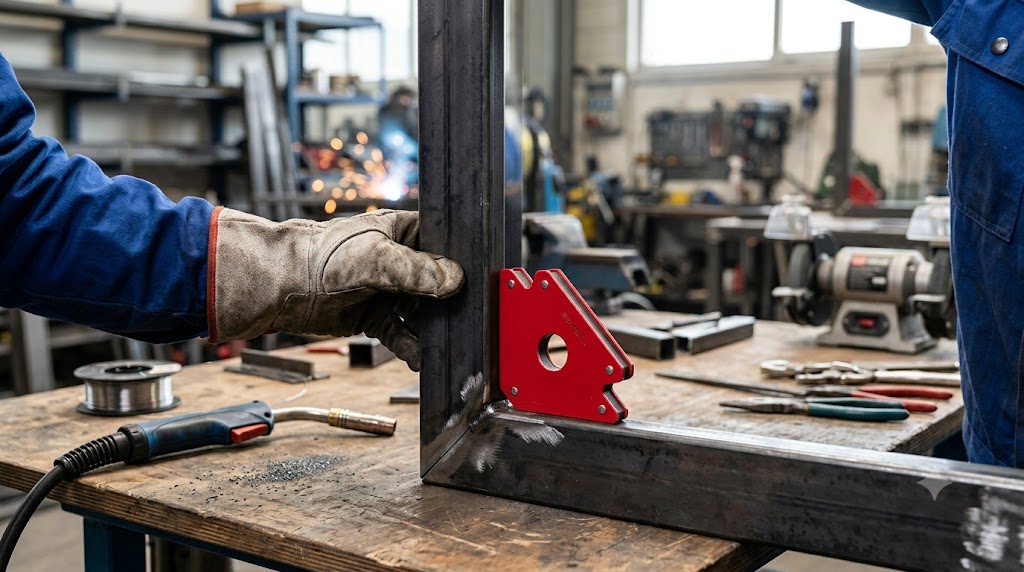
Setting a 90-degree outside corner for welding sounds simple until you’ve tried to hold it. The workpiece wants to splay open as you reach for the torch, or it’s sitting flat on the table with no room to clamp from the outside, or you’re working on pipe and the regular square won’t sit flat against both faces. The corner square design - a magnet that works from outside the corner and creates an unobstructed inside for tack welds - solves all three at once.
RIVERWELD (riverweldstore.com) is a welding accessory brand with over fourteen years of online selling and over a thousand products in their catalog. Their magnetic corner square set is one of the more specific products in the welding magnet category - it’s not a general-purpose multi-angle holder, it’s built to set and hold one thing:outside corners at 60 and 90 degrees. This review tells you what it does, what it doesn’t, and how it compares to what Strong Hand Tools offers.
The RIVERWELD Magnetic Corner Squares is a 2-pack of permanent magnetic corner-holding tools. Each magnet holds at 60 and 90 degrees, with a maximum pull force of 30 pounds. Dimensions are 3-1/4 by 3-3/4 by 5/8 inches. The corner design allows placement from the outside of a joint, leaving the full inside face clear for tack welds.
Verdict: for occasional fabrication use where you need a quick outside-corner holder at 90 or 60 degrees and you’re working on light to medium plate, the RIVERWELD corner square is a practical, affordable choice. If you need to set arbitrary angles, higher holding force, or you want on/off switchability, the Strong Hand Tools line covers those requirements better.
The Corner Square Design and Why It’s Different
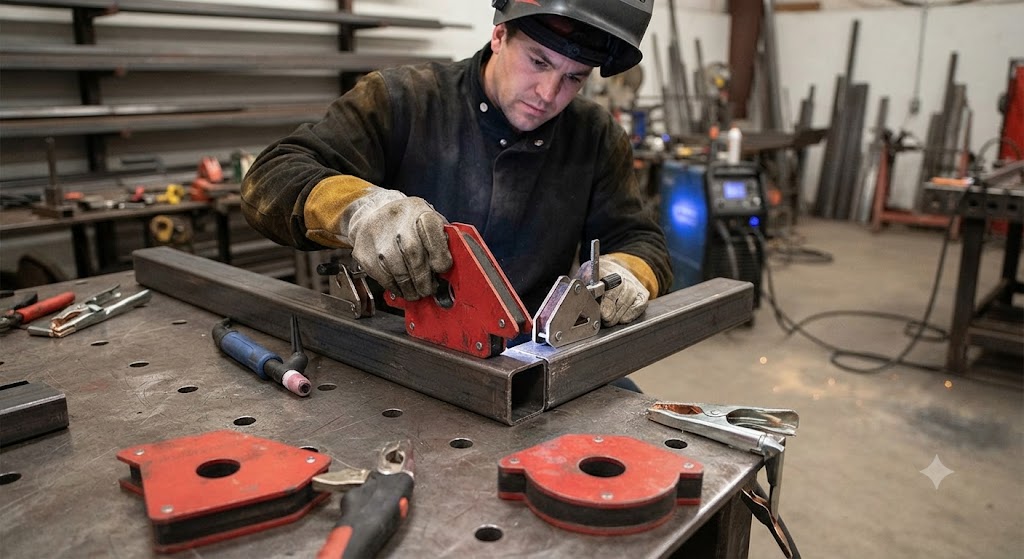
Standard welding magnets - the triangular or rectangular holders - press against one or both faces of a joint from inside the corner. This gives them good contact area but puts the body of the magnet in the welding zone, which can obstruct the torch and create arc blow from the magnet sitting too close to the weld.
The corner square design inverts this. The magnet presses against the outside faces of the corner joint. The inside - where you actually need to run the tack weld - is completely unobstructed. One relief edge is built into the side of the corner magnet to provide clearance for tall material lips, so you’re not fighting the geometry when the material has an edge that won’t let the magnet sit flush.
The RIVERWELD design creates the 90-degree corner by pressing against the outer two faces, with the magnetic force holding both pieces in alignment. The 60-degree angle uses the outer edges of the magnet body to set that position. Two pieces in the pack means you can hold both ends of a joint simultaneously, which is the correct way to prevent racking as you tack.
Specs: Verified from the Amazon Listing
- Pull force: 30 lbs maximum (confirmed from Amazon listing)
- Angles: 90 degrees and 60 degrees
- Pack: 2 pieces
- Dimensions: 3-1/4 by 3-3/4 by 5/8 inches
- Style: permanent magnet (no on/off switch)
Note on the 30-lb pull force: this is measured straight off a clean flat steel surface. The effective holding force in corner use is lower than this number, because the magnet contacts two faces at angles rather than one flat face. In practice, 30-lb rated corner squares handle light to medium plate (up to about 3/16-inch steel) comfortably. For heavier material, or for joints where thermal distortion is going to pull hard against the corner, you want more holding force or more magnets per joint.
The Named Flaw: No On/Off Switch
The RIVERWELD corner squares are always-on permanent magnets. This is a real limitation in day-to-day shop use.
Without a switch, repositioning the magnet means physically pulling it off the workpiece against the full 30-pound magnetic force. That sounds manageable until you’re working on a large piece and repositioning a dozen times in a session, or until you pull it off and drag it across a finished surface leaving a scratch. Strong Hand Tools’ Adjust-O series with their on/off switch mechanism addresses this directly: you click off the field, lift the magnet cleanly, move it, click on. The RIVERWELD offers no equivalent.
Always-on magnets also accumulate steel chips and spatter on their faces continuously. A switchable magnet releases this debris when switched off; an always-on magnet requires manual cleaning every few uses to maintain full contact force.
If repositioning speed and face cleanliness matter in your workflow, the lack of a switch is a genuine tradeoff, not a minor inconvenience.
RIVERWELD vs. Strong Hand Tools Corner Squares
Strong Hand Tools makes dedicated corner squares in their magnet line as well. The direct comparison is on holding force, adjustability, and switchability.
Strong Hand Tools’ corner-style products (available through their Magnetic Corner Square line) generally offer higher holding forces and the option for on/off switching, which is their core differentiator. The tradeoff is a higher price point.
For a shop that uses corner squares occasionally and works on light to medium plate: the RIVERWELD at 30 lbs of pull force and a 2-pack price is a reasonable starting point. For production fabrication, daily use, or heavier material: the Strong Hand Tools line’s higher-force and switchable options are worth the investment. The RIVERWELD corner square is not trying to be a Strong Hand Tools competitor - it’s a value-tier entry into the corner square category that does its job at light-work scales.
Comparison Table
| Feature | RIVERWELD | Strong Hand Tools Corner (typical) |
|---|---|---|
| Pull force | 30 lbs | 40-65 lbs (varies by model) |
| Angles | 60° and 90° | 90° fixed or adjustable |
| On/off switch | No | Available (select models) |
| Pack | 2 pieces | Varies |
| Best for | Light plate, occasional use | Production, heavier plate |
Who Should Buy the RIVERWELD Corner Square
If you’re doing occasional fabrication at home - small frames, welding table legs, simple brackets - and you want the corner square design without the cost of the Strong Hand Tools line, the RIVERWELD is a functional choice. Two pieces in the pack is the right starting quantity; you cover both ends of a joint and tack before anything can rack.
If you’re welding in production, working on heavier plate regularly, or you already know you’ll reposition magnets frequently, skip the RIVERWELD and go directly to a switchable design with higher holding force. The RIVERWELD will frustrate you in that context - not because it’s poorly made, but because it’s built for a lighter-duty use case than production fabrication demands.
FAQ
Is RIVERWELD a trusted welding magnet brand? RIVERWELD has been selling welding accessories online since 2004 and has a wide product catalog. Their corner square is a consistent listing with verified specs. They’re a value-tier brand rather than a professional-grade one, but the product delivers what the listing describes.
What angles does the RIVERWELD corner square set? 90 degrees and 60 degrees, confirmed from the Amazon listing (Check on Amazon). The 90-degree position is the primary use case - holding outside corners for tack welding. The 60-degree position uses the outer edges of the magnet body.
How does it compare to Strong Hand Tools corner squares? Strong Hand Tools offers higher holding force and switchable magnet options, which are more appropriate for production use or heavier plate. The RIVERWELD is a value-tier alternative that works for light to medium plate at lower cost. For occasional home shop use, the RIVERWELD is adequate. For daily production use, Strong Hand Tools is the better investment.
What is the holding power of the RIVERWELD corner square? 30 lbs maximum pull force, verified from the Amazon listing. This is the rated force on a clean flat surface; expect lower effective force in actual corner use because the magnet contacts two faces at angles rather than a single flat.
Why does the corner design leave the inside open? The outside corner design places the magnet against the outer two faces of the joint. The inside face of the corner - where you make the tack weld - has no magnet in the way. This eliminates the torch access problem that standard inside-corner magnets create and reduces arc blow risk from having a magnet too close to the weld zone.
Do I need 2 corner squares or just 1? Two, at minimum, for a single joint. One square at each end of the joint holds both pieces in alignment and prevents the joint from racking as you tack. One square alone lets the far end drift as you weld. The RIVERWELD pack includes two pieces, which is the correct starting quantity.
Can I use the RIVERWELD corner square on round pipe? The corner design is optimized for flat plate and rectangular tube with flat faces. On round pipe, the magnet contact area shrinks and holding force drops significantly. For round pipe, a standard multi-angle magnet with a V-groove or curved face is more appropriate.
References
- RIVERWELD official store (riverweldstore.com)
- American Welding Society - Welding Safety
- Strong Hand Tools Magnet Squares for comparison (stronghandtools.com)
- Miller Electric welding resources (millerwelds.com)