Steiner Welding Blanket Review: Two Materials, Two Different Jobs
The first time you lay a Steiner 316 carbonized fiber blanket over your arm, you understand why shops that do pipe welding or overhead work specifically ask for it. It doesn’t feel like a welding blanket. It feels like a soft, heavy cloth. There are no glass fibers to embed themselves in your skin when you adjust it mid-job. It drapes around pipe runs and curved surfaces the way fiberglass won’t. And it takes 1800°F. That’s the Steiner 316.
Then there’s the Steiner 372. Heat-cleaned tan fiberglass, 18 oz per square yard, FM approved, built for the FM-certification crowd who needs a documented, tested blanket for commercial installations. It’s stiffer, it sheds more than the carbonized fiber, and its 1000°F rating puts it in the same tier as a Tillman 590. The 372 is a professional fiberglass blanket with a pedigree. The 316 is something different.
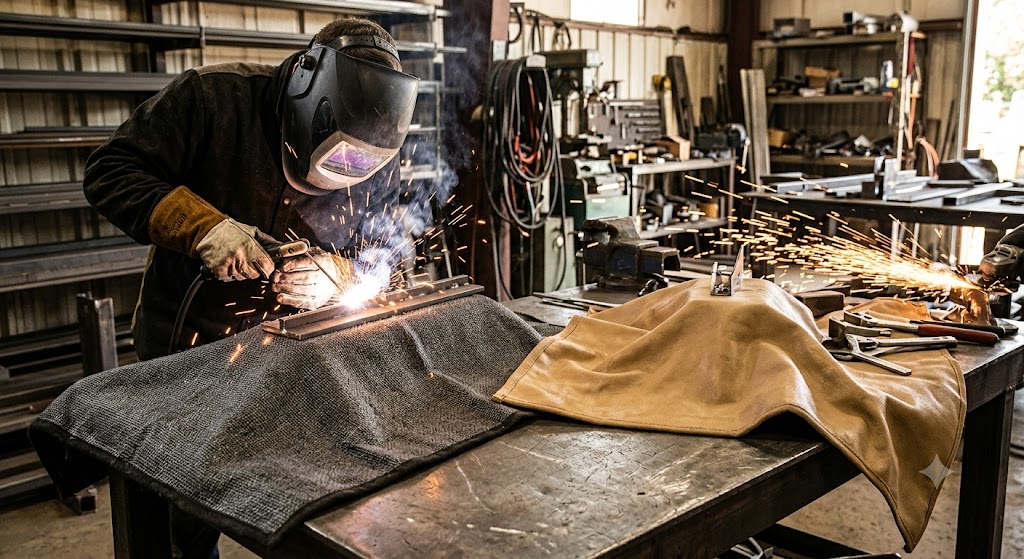
Welding blankets exist to keep sparks, spatter, and radiant heat away from surfaces, cables, and people that can’t withstand them. Steiner covers both ends of that requirement: a certified fiberglass product for shops that need documentation, and a high-heat carbonized fiber product for applications that demand flexibility and exceptional thermal resistance at the same time. Understanding which one fits your work is the whole decision.
Short answer: If you weld in positions that require a soft, conformable blanket and your heat exposure routinely reaches the upper range of welding temperatures, the Steiner 316 is the right buy. If you run a commercial shop that specifies FM-approved materials and fiberglass is fine for your workflow, the Steiner 372 fits. If cost is the primary driver and FM certification isn’t required, Tillman 590 competes directly with the 372, and YESWELDER undercuts both on price with acceptable performance for home use.
Steiner 316 Velvet Shield: Carbonized Fiber Explained
The Steiner 316 (Check on Amazon) is built from carbonized fiber, which is oxidized acrylic fiber that has been heat-treated until it carbonizes. The result is a soft, flexible black fabric that does not shed glass particles, resists ignition, and maintains structural integrity at temperatures up to 1800°F. At 16 oz per square yard, it’s lighter than Steiner’s own fiberglass option, which means the 316 is both the cooler-rated and the softer-feeling product in Steiner’s lineup.
1800°F is a meaningful ceiling. Most MIG, TIG, and stick welding applications generate spatter in the 2000 to 2700°F range at the point of contact, but by the time sparks and spatter land on a blanket a foot or two away, surface temperature is substantially lower. The 316’s 1800°F rating gives a real thermal buffer for heavy stick welding, overhead work, and applications where the blanket is close to the arc.
The soft texture also matters for wrapping. If you’re protecting a finished weld joint, a hydraulic line, or a painted surface during nearby heat work, a soft blanket causes less abrasion on contact than a stiff fiberglass one.
The named flaw in the 316: it is not FM approved. For shops that require FM certification on protective materials, the 316 does not satisfy that requirement regardless of its performance. You’ll need the 372 or Tillman for FM compliance.
Steiner 372 Tough Guard: The Fiberglass Option
The Steiner 372 (Check on Amazon) is Steiner’s FM-approved fiberglass blanket. The “heat cleaned” description means the fiberglass has been processed to remove binders and sizing materials, leaving behind a purer fiberglass weave. Heat-cleaned fiberglass tends to have less surface contamination, making it more suitable for environments where cleanliness matters (aerospace, food processing, pharmaceutical adjacent).
At 18 oz per square yard and a 1000°F rating, the 372 operates in the same envelope as the Tillman 590. Both are FM approved, both cover standard MIG/TIG/stick applications. The 372 comes in tan rather than Tillman’s gold, and Steiner’s quality control in the FM-certified product line is tight enough that the 372 is a legitimate alternative to the Tillman 590 in any environment where either is appropriate.
The named flaw for the 372: it sheds glass fibers more readily than coated fiberglass products. Heat-cleaned fiberglass removes surface coatings as part of the cleaning process, which means there’s less binder holding surface fibers together. Handle with gloves, especially on new blankets.
Steiner vs. Tillman: The Professional Comparison
Tillman 590 vs. Steiner 372: Both are 24 oz class FM-approved fiberglass curtain blankets. The 590 uses acrylic coating (gold color) vs. the 372’s heat-cleaned treatment (tan). Performance in standard welding environments is comparable. Tillman has broader distribution in North American welding supply chains and more name recognition on shop floors. Steiner’s FM approval is equally valid for specification purposes.
Tillman 596B vs. Steiner 316: These are not competing products; they serve different needs. The 596B’s 25 oz vermiculite fiberglass is specifically engineered for sustained slag contact and FM-certified horizontal and vertical curtain use. The Steiner 316 carbonized fiber at 1800°F prioritizes flexibility and skin-safety over FM compliance. Shops that need FM and heavy-duty curtain protection choose the 596B. Shops that need conformable high-heat protection for pipe work or overhead welding choose the 316.
Comparison Table
| Model | Material | Temp Rating | FM Approved | Weight | Best For |
|---|---|---|---|---|---|
| Steiner 316 | Carbonized Fiber | 1800°F | No | 16 oz/yd² | Pipe wrap, overhead, skin-safe use |
| Steiner 372 | Heat-cleaned Fiberglass | 1000°F | Yes | 18 oz/yd² | Commercial FM-required applications |
| Tillman 590 | Acrylic-coated Fiberglass | 1000°F | Yes | 24 oz/yd² | Medium-duty shop and curtain use |
| Tillman 596B | Vermiculite Fiberglass | 1200/1700°F | Yes | 25 oz/yd² | Heavy spatter, slag, FM industrial |
FAQ
Is Steiner a well-known welding blanket brand? Yes. Steiner Industries has been manufacturing welding protection for decades and is distributed through major welding supply chains including Grainger, Airgas, and Amazon. Their blankets are specified in industrial, aerospace, and commercial welding environments.
Does Steiner make both fiberglass and carbon felt versions? Yes. The Steiner 372 series is heat-cleaned fiberglass (tan). The Steiner 316 series is carbonized fiber (black), which is sometimes called “carbon felt” colloquially, though Steiner’s official term is Velvet Shield carbonized fiber. They differ in temperature rating, texture, FM approval, and price.
How does the Steiner 316 compare to Tillman 596B? The 316 is softer, lighter, and rated higher at 1800°F, but is not FM approved. The 596B is FM approved, rated to 1700°F in the vertical plane, and specifically engineered for sustained slag contact. If your shop requires FM certification, the 596B wins. If you need flexibility and skin-safe handling for close-contact applications, the 316 is the right tool.
What is the temperature rating of Steiner welding blankets? The Steiner 372 (fiberglass) is rated to 1000°F. The Steiner 316 (carbonized fiber) is rated to 1800°F. Both ratings are specified on the Steiner Industries product pages.
Is the Steiner 316 safe to handle without gloves? Yes, that’s one of its primary advantages over fiberglass. Carbonized fiber does not shed skin-irritating glass particles. You can handle the 316 with bare hands, which makes it practical for pipe-wrap and close-contact welding protection.
Where are Steiner welding blankets made? Steiner Industries is a U.S.-based manufacturer. Their blankets are distributed through North American welding supply chains. Specific manufacturing locations are not published on their site.
Can Steiner blankets be used for plasma cutting? Yes. Plasma cutting generates high-velocity sparks and hot dross that a welding blanket can intercept. The Steiner 316’s 1800°F rating provides an adequate buffer for plasma cutting spark fallout on surfaces below the cut zone. Do not place the blanket directly in the path of dross drop.
References
- Steiner 316-6X8 carbonized fiber blanket,: Check on Amazon
- Steiner 372-6X8 fiberglass blanket,: Check on Amazon
- Steiner Industries official blanket page: https://www.steinerindustries.com/blankets-rolls/product/listing
- Tillman 596B listing for comparison,: Check on Amazon
- OSHA Hot Work, Welding, Cutting, and Brazing (1910.252): https://www.osha.gov/laws-regs/regulations/standardnumber/1910/1910.252
- American Welding Society, Safety and Health Fact Sheets: https://aws.org/publications/safety
URL slug: steiner-welding-blanket-review Excerpt: Steiner makes two very different welding blankets. The 316 Velvet Shield is soft carbonized fiber rated to 1800F, ideal for pipe wrap and overhead work. The 372 Tough Guard is FM-approved fiberglass for commercial shop applications. Here’s how to choose.