Tillman Welding Blanket Review: The Shop Standard That Earned Its Reputation
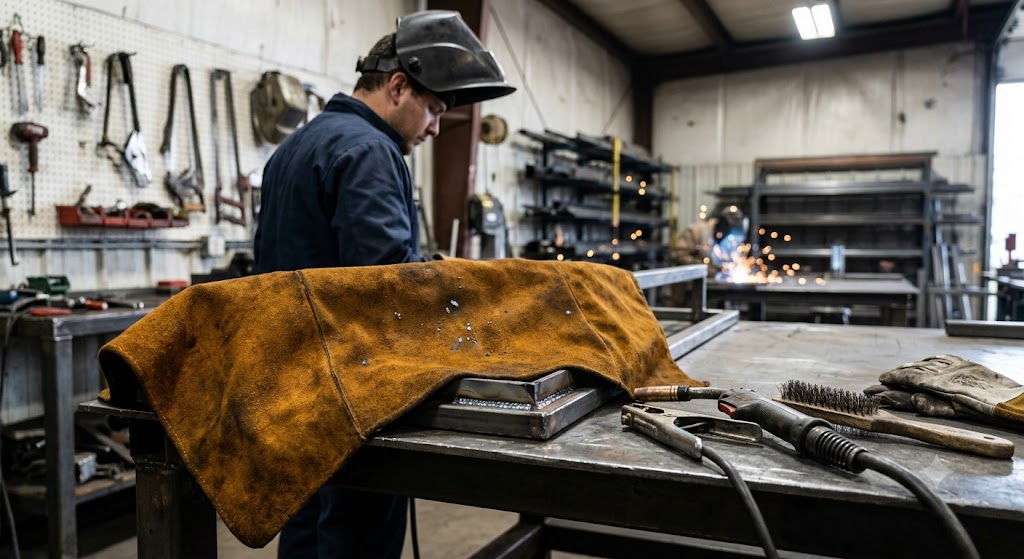
Walk into any serious fabrication shop and ask where the welding blankets are. There’s a good chance you’ll find Tillman. Not because someone made a marketing decision, but because the blankets showed up every day for years, got dragged across concrete floors, took slag hits, survived shop steam cleaning, and still hung straight. That’s not a story you build with a spec sheet. That’s a story you build with consistent material over time.
Tillman makes two welding blanket families that matter for most applications. The 590 is the company’s most popular model: 24 oz gold acrylic-coated fiberglass, FM approved, rated to a 1000°F melt temperature, available in 6x6 ft and 6x8 ft. The 596B steps up to 25 oz black vermiculite-impregnated fiberglass, FM approved, rated to 1200°F on flat surfaces and 1700°F in the vertical plane. Both are made in an established manufacturing pipeline, both carry FM certification, and both come from a company (John Tillman Co.) that has been making welding protection since 1935.
Fiberglass welding blankets block sparks, spatter, and radiant heat between a welding arc and whatever you don’t want burned. Coated fiberglass adds a surface treatment, usually acrylic or vermiculite, that increases abrasion resistance, reduces shedding, and in the 596B’s case, significantly raises the blanket’s ability to withstand direct contact with hot slag. The coating is the variable that separates Tillman’s two models from each other and from most budget brands.
Bottom line: If you weld professionally or run a shop where blankets work hard, the Tillman 590 is the minimum you should consider, and the 596B is what you want when molten metal contact is part of the job. For home-shop use, either Tillman outperforms budget alternatives in longevity, certification, and consistent spec integrity.
Model 590 vs. 596B: Picking the Right One
The Tillman 590 is built from acrylic-coated fiberglass. That coating makes the gold-colored blanket more abrasion-resistant than bare fiberglass, reduces loose fiber shedding, and provides the FM-approved performance certification that some shops and insurance policies require. The 1000°F melt temperature covers the overwhelming majority of MIG, TIG, and stick welding scenarios.
Where the 590 does not belong is under sustained slag impact or directly shielding surfaces from overhead heavy-spatter stick welding on structural steel. For that, you want the 596B.
The Tillman 596B (Check on Amazon) is the production-shop choice. The 25 oz vermiculite-impregnated fiberglass is both heavier per square yard and chemically treated so the vermiculite mineral fills the spaces in the weave. That treatment is what allows it to withstand 1200°F on a flat surface and 1700°F in the vertical plane, where heat convects up rather than dwelling in the fabric. At 0.06 inches thick, it’s thinner than the YESWELDER’s 0.31-inch construction, but thickness isn’t the primary performance driver in welding blankets. Material composition is.
FM Certification: Why It Matters
FM (Factory Mutual) certification is an independent engineering approval that confirms a product meets fire protection standards. Both the Tillman 590 and 596B carry FM certification. This matters in three situations: your shop’s insurance policy specifies FM-approved materials, a safety inspection requires it, or a contract job includes a clause about certified protective equipment.
For a home garage, FM certification is nice to have and worth nothing extra in daily practice. For any commercial or industrial environment, it’s the difference between a compliant shop and a liability problem.
VEVOR and YESWELDER do not carry FM certification on their welding blankets. That is not necessarily a disqualifier for home use, but it is a hard stop for commercial environments.
Tillman vs. YESWELDER and Steiner
Against YESWELDER: The YESWELDER 4x6 is 24.7 oz fiberglass rated to 1022°F. The Tillman 590 is 24 oz fiberglass rated to 1000°F. On raw numbers they’re within noise of each other. The gap opens in FM certification, brand track record in commercial shops, and the consistent quality control that comes with decades of industrial supply. For home shops, YESWELDER represents better value for the dollar. For anything professional, Tillman is the default.
Against Steiner: The Steiner 316 carbonized fiber blanket at 1800°F is in a different thermal tier than either Tillman model. If your application requires sustained contact with material over 1700°F, Steiner’s carbonized fiber is the correct answer. For standard MIG, TIG, and stick work, Tillman’s 596B covers the realistic upper end of the temperature range and does so with FM certification the Steiner 316 doesn’t carry.
The Named Flaw
Heat-related stiffening. The 596B’s vermiculite-impregnated fiberglass starts firm compared to a coated blanket and becomes stiffer over repeated high-heat exposure cycles. After heavy use, the blanket holds less drape and is harder to lay flat over curved surfaces like engine blocks or pipe runs. It works fine as a curtain or flat-surface cover, but for jobs where you need the blanket to conform to an irregular shape, the Tillman 590’s more flexible acrylic-coated construction is a better fit. The Steiner 316 carbonized fiber blanket, by comparison, is noticeably softer and more pliable even after heat exposure.
Comparison Table
| Model | Material | Temp Rating | FM Approved | Thickness | Best Use |
|---|---|---|---|---|---|
| Tillman 590 | Acrylic-coated Fiberglass, 24 oz | 1000°F | Yes | ~5mm | Light-to-medium duty, curtain use |
| Tillman 596B | Vermiculite Fiberglass, 25 oz | 1200/1700°F | Yes | 1.5mm | Heavy spatter, slag contact |
| YESWELDER | Fiberglass, 24.7 oz | 1022°F | No | 8mm | Home shop, budget coverage |
| Steiner 316 | Carbonized Fiber, 16 oz | 1800°F | No | 0.9mm | High-heat, skin-safe handling |
FAQ
Is Tillman a trusted welding blanket brand? Yes. John Tillman Co. has manufactured welding protection products since 1935. Their blankets are FM certified, widely specified in industrial safety programs, and sold through major welding supply distributors. They are one of the most recognized names in professional welding protection.
What thickness does Tillman offer? The 590 runs approximately 5mm thick at 24 oz/yd². The 596B is 0.06 inches (roughly 1.5mm) thick at 25 oz/yd². The 596B is thinner but denser and vermiculite-treated, which is what drives its higher temperature performance. Thickness alone does not predict protection level.
How does Tillman compare to Steiner? Tillman and Steiner are both professional-grade brands. Tillman’s 596B is FM approved; Steiner’s 316 carbonized fiber is not, but it carries a higher temperature rating (1800°F) and is softer and more flexible. Tillman is the standard for most fabrication shop curtain and flat-cover applications. Steiner’s carbonized fiber is preferred where flexibility and skin comfort matter, such as full-body pipe welding or wrapping curved surfaces.
How does Tillman compare to YESWELDER? For home shops, the gap is smaller than the price difference suggests. YESWELDER’s 1022°F fiberglass at 8mm thick performs comparably for everyday MIG and TIG protection. Tillman adds FM certification, commercial supply chain quality control, and a proven long-term durability record. For professional or commercial use, Tillman is the clear choice.
Is the Tillman 590 or 596B better for automotive work? The 590 is the better choice for most automotive welding, including MIG patch panel work, exhaust fabrication, and engine compartment repairs. Its flexibility makes it easier to conform around irregular surfaces. The 596B is better if you’re doing heavy stick welding near painted or upholstered surfaces where slag bounce is a real concern.
Where can I buy Tillman welding blankets? Tillman blankets are available on Amazon. The 596B 6x8 ft is at Check on Amazon and the 590B68 6x8 ft is at Check on Amazon.
Can Tillman blankets be used as welding curtains? Yes, and that is one of their primary applications. Both the 590 and 596B are FM approved as welding curtains. The grommets along the perimeter allow suspension from a curtain rod, overhead track, or chain. The 596B is the better choice for permanent curtain installations where heavy spatter exposure is expected.
References
- Tillman 596B 6x8 ft listing,: Check on Amazon
- Tillman 590B68 6x8 ft listing,: Check on Amazon
- John Tillman Co. official blanket page: https://jtillman.com/products/blankets/
- FM Approvals (Factory Mutual) welding protection standards: https://www.fmapprovals.com
- OSHA Hot Work (29 CFR 1910.252): https://www.osha.gov/laws-regs/regulations/standardnumber/1910/1910.252
- American Welding Society, Welding Safety: https://aws.org/publications/safety
URL slug: tillman-welding-blanket-review Excerpt: Tillman makes two welding blankets worth knowing: the 590 (24 oz acrylic-coated fiberglass, 1000F, FM approved) and the 596B (25 oz vermiculite fiberglass, 1700F vertical, FM approved). Here’s which one fits your shop and how they stack up against YESWELDER and Steiner.