VEVOR Welding Blanket Review: Big Coverage at a Low Bar to Entry
The VEVOR welding blanket ships in a red carry bag with a drawstring closure. It’s a small detail, but it tells you something about how VEVOR thinks about its buyers: people who want a complete, ready-to-use package without hunting for storage. Pull it out, hang it from the grommets, and you’re covered. That’s the VEVOR pitch, and for a lot of garage and light-commercial welders, it lands.
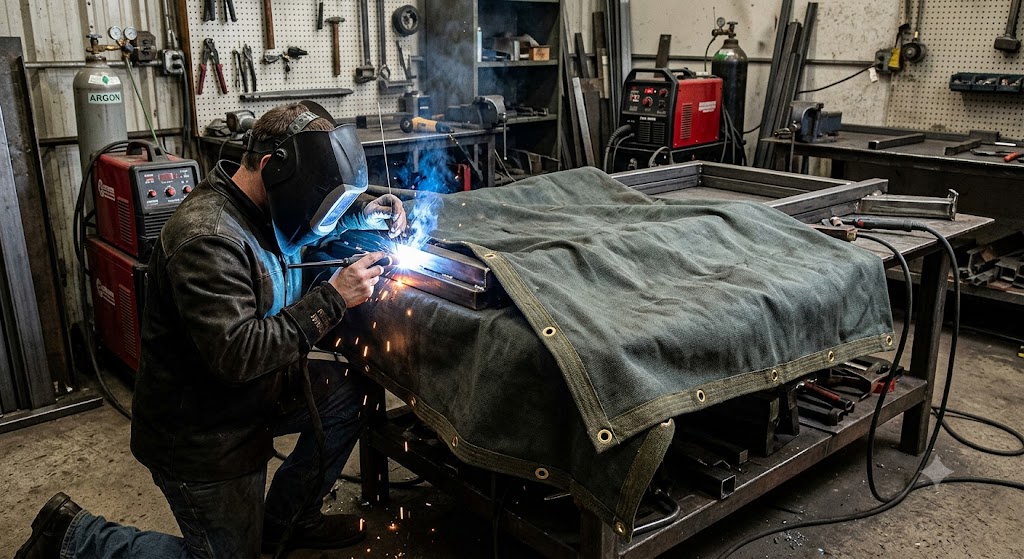
Fiberglass welding blankets serve one essential function: they intercept sparks, spatter, and radiant heat before those things reach something you care about. Whether that’s a car’s upholstery, wooden shop flooring, hydraulic lines, or a coworker’s legs, a blanket draped or hung between the arc and the hazard reduces the risk. VEVOR makes its welding blankets from fiberglass fabric, with silicone gel coating on some models to improve durability and heat distribution, with brass grommets for hanging. The stated working temperature on the fiberglass models is 1022°F (550°C).
Here’s the bottom line: VEVOR’s welding blankets are a competent choice for home shops, automotive hobbyists, and light industrial applications where FM certification isn’t required. They come in larger sizes than most budget blankets, the silicone coating on newer models adds a layer of durability the basic fiberglass lacks, and the included carry bag makes them more packable than competitors. The flaw you need to know about is grommet quality variation: some buyers have received units where grommet set points pull loose under tension, which is the one area where Steiner and Tillman have a clear engineering edge.
What VEVOR Actually Makes
VEVOR sells multiple welding blanket configurations. The core lineup for welding applications includes fiberglass blankets rated to 1022°F in sizes from 6x10 ft up through large roll formats, and a silicone-coated fiberglass roll (5x150 ft) rated to 1800°F on its product page.
For individual blanket use, the most relevant options are the 2-pack 6x10 ft fiberglass blankets (Check on Amazon), which give you two 6x10 panels for coverage of larger equipment or paired use across a work area. The fiberglass material on these blankets is described as coated with silica gel on the Home Depot listing, which VEVOR uses interchangeably with “silicone coating” to mean a surface treatment that reduces loose fiber shedding and improves abrasion resistance versus bare fiberglass.
The brass grommets are listed as stainless steel on some retailer pages and brass on others, which appears to be a spec inconsistency between SKUs and product generations. In either case, the spacing is sufficient for most hanging applications.
VEVOR vs. Steiner: Where the Line Falls
Steiner is the professional’s default when specs and longevity matter most. The Steiner 372 is 18 oz heat-cleaned tan fiberglass with a 1000°F rating and FM approval. The Steiner 316 is 16 oz carbonized fiber rated to 1800°F, soft to the touch, and doesn’t shed glass fibers.
VEVOR competes on coverage area and included accessories. A 2-pack of VEVOR 6x10 blankets gives you 120 square feet of coverage. A single Steiner 372-6X8 gives you 48 square feet. For protecting large areas, the VEVOR math works in its favor. For precision protection of a single work surface with verified spec integrity, Steiner wins.
If you’re blanketing the interior of a vehicle during chassis work and you need two large panels, VEVOR makes sense. If you’re a professional shop that sends invoices citing FM-approved materials, Steiner or Tillman is the answer.
Silicone Coating: What It Means in Practice
VEVOR markets silicone coating as a premium feature on its newer blanket models. The coating is a polymer applied to the surface of the woven fiberglass. It does two things: it binds surface fibers so they shed less on first handling, and it adds oil resistance, which makes the blanket easier to wipe down after contact with cutting fluid or shop grime.
It does not meaningfully raise the sustained temperature ceiling of the underlying fiberglass weave. The 1022°F rating applies to the fiberglass base material. The coating adds surface durability, not thermal performance. That distinction matters if you’re tempted to buy the silicone-coated VEVOR and assume it approaches the 1800°F silicone-coated fiberglass roll’s performance. The roll and the individual blanket are different products with different material weights.
The Flaw That Matters
Grommet pull-through is the named flaw in VEVOR blankets. Under sustained tension, particularly when the blanket is hung vertically and loaded with its own weight in a 6x10 configuration, some units show grommet reinforcement rings that don’t fully grip the fiberglass hem. The ring can pull through the material over time, leaving you with a blanket that hangs unevenly or drapes off its hang point.
This is not universal. Many buyers report grommets that hold without issue. But it’s common enough in the review base to warrant attention. The fix is simple: when hanging a large blanket vertically, use multiple hang points and avoid concentrating load at corner grommets alone. Spread the load, and the issue largely disappears.
Tillman and Steiner set their grommets with heavier reinforcement rings and hem stitching designed for sustained vertical loads. If you hang your blanket continuously at a fixed station, the Tillman 596B is worth the premium. If your blanket comes down after each session and lives in the bag, VEVOR’s grommet engineering is sufficient.
Size and Configuration Guide
For most home shop needs, the 2-pack 6x10 ft fiberglass option (Check on Amazon) is the practical starting point. Two large blankets covers a full vehicle side, a workbench plus floor zone, or a curtained-off welding corner.
If you need a single blanket for portability, look at the 6x10 ft single unit or the 8x10 ft for extra wide coverage.
Comparison Table
| Feature | VEVOR 6x10 (2-Pack) | Steiner 372-6X8 | Tillman 596B 6x8 |
|---|---|---|---|
| Material | Fiberglass | Fiberglass (heat cleaned) | Vermiculite Fiberglass |
| Temp Rating | 1022°F | 1000°F | 1200/1700°F |
| FM Approved | No | Yes | Yes |
| Pack Count | 2 | 1 | 1 |
| Carry Bag | Yes | No | No |
| Named Flaw | Grommet pull-through under sustained load | Stiffer, less drape | Heavier, less flexible |
FAQ
Is VEVOR a reliable welding blanket brand? VEVOR is a well-established budget-to-mid-range tool brand. Their welding blankets are adequate for home shop and light-commercial use. They are not the choice for certified industrial or high-production welding environments, where FM-approved blankets from Tillman or Steiner are the standard.
What sizes does VEVOR offer in welding blankets? VEVOR’s welding blanket lineup includes 6x10 ft and 8x10 ft individual and 2-pack options, plus a 5x150 ft silicone-coated roll for continuous coverage applications. The single- and double-pack blankets are rated to 1022°F; the silicone-coated roll is rated to 1800°F on the product page.
How does VEVOR compare to Steiner? Steiner blankets carry FM certification, have tighter grommet engineering, and come in both fiberglass and carbonized fiber options. The carbonized fiber Steiner 316 is softer, lighter, and doesn’t shed glass fibers. VEVOR covers more square footage per dollar and includes carry bags. For home use, VEVOR is competitive. For professional shops with documentation requirements, Steiner or Tillman is correct.
Does VEVOR use real fiberglass or a cheaper substitute? VEVOR’s listed blankets use fiberglass fabric, consistent with the appearance, weight, and burn behavior described in verified reviews. There is no evidence of a synthetic substitute. The silicone coating on some models is a surface treatment, not a replacement for the fiberglass base.
Can I use a VEVOR welding blanket as a fire emergency blanket? No. Welding blankets and fire emergency blankets are different products for different uses. A welding blanket deflects sparks and spatter during active welding. An emergency fire suppression blanket is designed to smother a small fire or protect a person. Do not substitute one for the other.
How long do VEVOR welding blankets last? With proper care (no machine washing, no sharp-edge contact, stored dry), a VEVOR fiberglass blanket used in a home shop should last multiple years of regular use. Commercial shops cycling blankets daily should expect shorter service life and should budget for more frequent replacement or upgrade to Tillman/Steiner.
Is the VEVOR blanket good for automotive welding? Yes. The 6x10 ft size is large enough to blanket an engine bay or door opening during patch panel work. The fiberglass handles MIG spatter well. Use the carry bag to keep it clean between sessions.
References
- VEVOR 2-Pack 6x10 ft welding blanket listing,: Check on Amazon
- VEVOR single 6x10 ft welding blanket,: Check on Amazon
- VEVOR official product page: https://www.vevor.com/s/welding-blankets
- Steiner Industries, 372 Tough Guard Fiberglass Blanket: https://www.steinerindustries.com/blankets-rolls
- OSHA, Hot Work Safety (1910.252): https://www.osha.gov/laws-regs/regulations/standardnumber/1910/1910.252
- American Welding Society, Welding Safety Resources: https://aws.org/publications/safety
URL slug: vevor-welding-blanket-review Excerpt: VEVOR’s fiberglass welding blankets offer large coverage and a carry bag at a budget price. Here’s what the specs actually mean, the one flaw worth knowing, and how VEVOR stacks up against Steiner in a direct comparison.