Welding Blanket Size Guide: 4x6 vs 6x8 vs Custom
Buy a welding blanket too small and sparks skate right past the edge onto whatever you were trying to protect. Buy one too big and you are wrestling stiff fiberglass into a space it does not fit. Getting the size right the first time is most of the battle, and this welding blanket size guide walks through the two standard sizes, 4x6 and 6x8, and when a custom blanket is the smarter call.
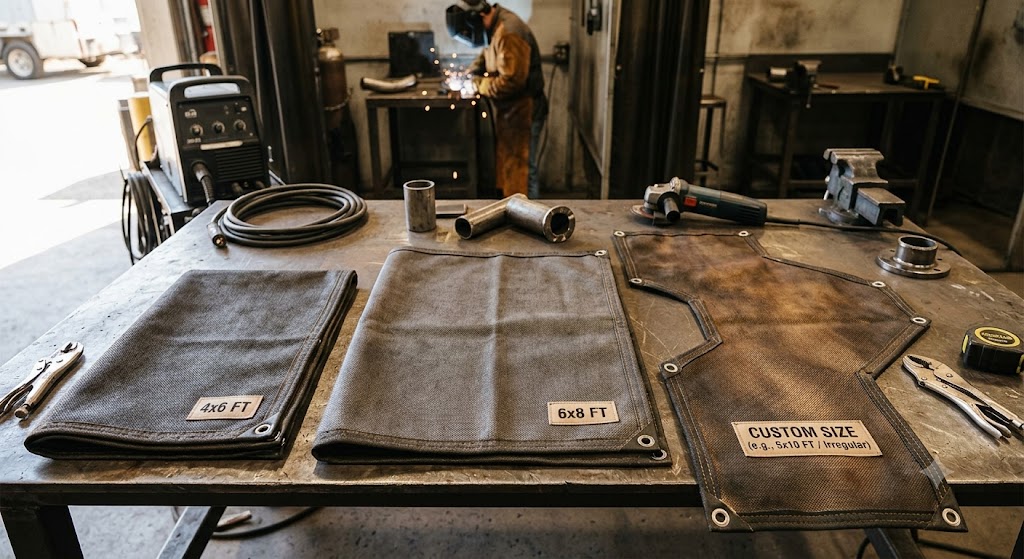
The short answer: a 4x6 foot blanket covers spot jobs and small equipment, a 6x8 foot blanket covers most real fabrication and floor protection, and custom sizes exist for when a standard rectangle simply will not fit the thing you need to shield.
First, size is only half the spec
Before the dimensions, know that a welding blanket is defined as much by its material and temperature rating as its size. Standard heat-cleaned fiberglass blankets are rated to roughly 1,000 degrees Fahrenheit (many listings cite 1,022 F, which is 550 C) and handle MIG, TIG, and stick spatter and radiant heat. For sustained higher heat you step up to silica fabric (rated near 1,800 F) or carbon felt. A perfectly sized blanket in the wrong material is still the wrong blanket, so match the rating to your heat first, then pick the size.
The 4x6 foot blanket: spot protection
A 4x6 foot blanket is the grab-and-go size. It is right for:
- Covering a single workpiece or a small area on the bench
- Draping over one machine, a fuel tank area, or a small stack of gear nearby
- Catching spatter from short, localized welds
- Tucking into a truck or toolbox because it folds down small
A common example is a 4x6 foot fiberglass welding blanket rated to about 1,022 F, which is plenty for standard arc work. The limit is obvious: 4x6 does not cover much floor, and for anything larger than a spot job the sparks find the edges.
The 6x8 foot blanket: the do-most size
Step up to 6x8 feet and you cover the situations most welders actually face:
- Protecting a wider floor area under and around your work
- Shielding furniture, walls, finished surfaces, or a vehicle during repair welding
- Hanging as a vertical spark curtain to keep a work zone contained
- Covering larger equipment or multiple items at once
A 6x8 foot fiberglass welding blanket is the size to buy if you can own only one, because it handles the wide jobs a 4x6 cannot and still folds down for a spot job when needed. The trade is bulk and a little more weight to move and store.
When custom makes sense
Standard rectangles are cheaper and in stock, so only go custom when the job truly demands it:
- You need to wrap or drape an odd-shaped object a rectangle cannot follow
- You are protecting a fixed, unusually large area (a full wall, a long run) where seams in a standard blanket would leave gaps
- You need a specific high-temperature material in a nonstandard dimension
- You want mounting features, grommet placement, or edge reinforcement a stock blanket does not offer
Custom blankets cost more and take time to make, so reach for one only after a standard 4x6 or 6x8 clearly cannot do the job.
How to choose your size
- Occasional hobby welding, small parts: a 4x6 foot blanket covers it and stores easily.
- General fabrication, repair welding, floor and property protection: buy the 6x8 foot blanket. It is the most useful single size.
- Big fixed areas or odd shapes: measure the area, add margin so sparks cannot reach the edge, and consider custom only if two standard blankets overlapping will not do.
- Always: buy a size that overhangs what you are protecting. Sparks travel, so a blanket that ends exactly at the edge is a blanket that is too small.
The verdict
Start with the material and temperature rating, then size up from there. A 4x6 foot blanket is the spot-protection size, a 6x8 foot blanket is the one to own if you own only one, and custom is for the odd shapes and oversized fixed areas that standard rectangles cannot cover. Whatever you pick, give yourself overhang, because the edge is exactly where a too-small blanket lets you down.
Frequently asked questions
What size welding blanket do I need? For small spot jobs, a 4x6 foot blanket. For general fabrication and floor or property protection, a 6x8 foot blanket. Always choose a size that overhangs what you are protecting.
Is a 4x6 or 6x8 welding blanket better? Neither is universally better. A 4x6 is easier to store and fine for spot work. A 6x8 covers wider jobs and is the better single blanket if you can own only one.
What temperature can a welding blanket handle? Standard heat-cleaned fiberglass is rated to roughly 1,000 F (often listed as 1,022 F or 550 C). Silica fabric runs near 1,800 F, and carbon felt higher still.
When should I buy a custom welding blanket? When a standard rectangle cannot cover an odd shape or a large fixed area, or when you need a specific material or mounting feature in a nonstandard size.
Can I hang a welding blanket as a curtain? Yes. Many blankets have reinforced hems and grommets so a 6x8 can hang as a vertical spark curtain to contain a work zone.
Should the blanket be bigger than the area I am protecting? Yes. Sparks travel and bounce, so buy a size that overhangs the workpiece or surface. A blanket that ends exactly at the edge will let sparks past.
References
- Steel Guard Safety, How to Choose the Right Welding Blanket (material and temperature ratings): https://www.steelguardsafety.com/welding-blanket/
- Steel Guard Safety, Fiberglass Welding Blankets (heat-cleaned fiberglass rated to 1,000 F): https://www.steelguardsafety.com/fiberglass-welding-blanket