Welding Blanket: The Complete Buying Guide With Ranked Picks
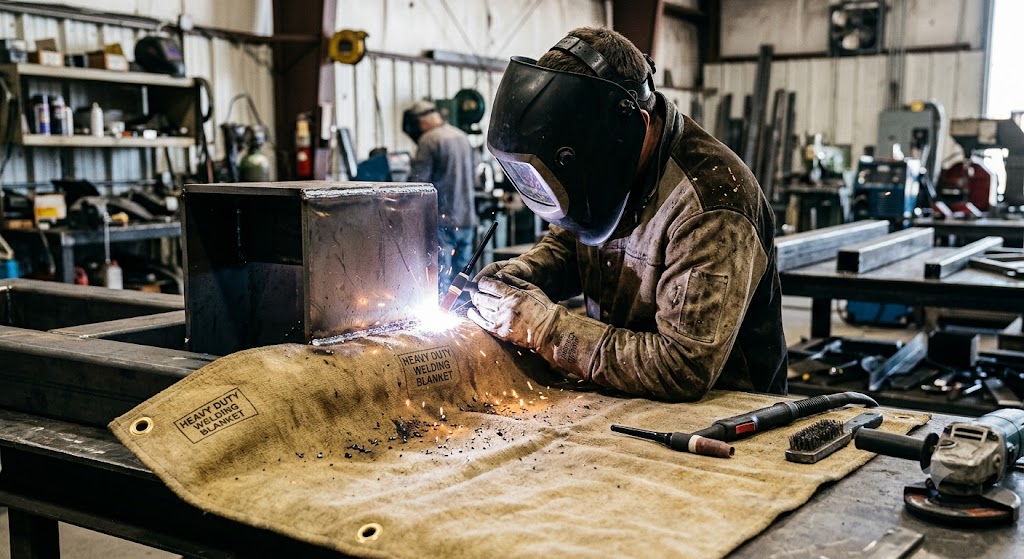
A spark lands on a hydraulic hose three feet from your arc and you don’t notice until you smell it. That’s the moment welders remember when they start taking blankets seriously. Not the spec sheet. Not the grommet count. The smell.
A welding blanket is a woven, heat-resistant fabric placed between an active welding arc and anything that shouldn’t be exposed to sparks, spatter, or radiant heat. The blanket intercepts these before they reach vehicle interiors, wooden flooring, finished surfaces, fuel lines, and bystanders. They come in fiberglass, coated fiberglass, vermiculite-impregnated fiberglass, and carbonized fiber. Each material has a different temperature ceiling, different texture, different weight, and different price. Getting the right one means matching the material to the actual hazard in your shop, not buying the cheapest option or the most expensive one.
Here is the direct answer: for most garage and small-shop welders doing MIG, TIG, or light stick work, a 24 oz coated fiberglass blanket rated to 1000 to 1022°F covers the realistic range of everyday spark and spatter exposure. For heavier production work with significant slag, you need vermiculite fiberglass or carbonized fiber with a higher temperature rating. For commercial or insured environments, FM certification is a non-negotiable filter.
Top Pick: Tillman 596B
The Tillman 596B (amazon.com/dp/?tag=mysuggestions01-20) is the top pick for anyone who welds regularly and wants a blanket they won’t have to replace annually. The 25 oz vermiculite-impregnated fiberglass carries a 1200°F flat surface and 1700°F vertical plane rating with FM approval. It handles heavy stick welding, sustained slag contact, and long curtain runs without degrading.
The named flaw: it stiffens with repeated high-heat exposure. After extended use, the blanket doesn’t drape as naturally over curved surfaces. If you need to wrap irregular shapes like pipe runs, the Steiner 316 is more pliable. But for flat protection and vertical curtain use, the 596B is the standard for good reason.
Best for: Production shops, heavy stick welding, commercial environments requiring FM certification.
Best Budget Pick: YESWELDER 4x6 ft
The YESWELDER 4x6 fiberglass blanket (amazon.com/dp/?tag=mysuggestions01-20) is the home-shop recommendation. At 24.7 oz/yd² with a 1022°F (550°C) rating and 8mm thickness, it competes credibly with the Tillman 590 on paper specs while undercutting it on price. Brass grommets every 11 inches, double-stitched edges, and a solid feel out of the box.
The named flaw: new YESWELDER blankets shed fine glass fibers on handling and folding. Wear gloves when setting it up. The shedding diminishes significantly after the first few heat cycles, but it’s real and it’s annoying. No FM certification, which rules it out for commercial compliance.
Best for: Home shops, garage welders, hobbyist automotive work, budget-first buyers.
Best for Flexibility and High Heat: Steiner 316 Carbonized Fiber
The Steiner 316 (amazon.com/dp/?tag=mysuggestions01-20) is the correct tool when you need a blanket to wrap around things. Pipe runs, curved equipment housings, overhead protection where the blanket is draped from a structure and needs to hang naturally. The 16 oz carbonized fiber is soft, doesn’t shed glass particles, and is rated to 1800°F.
The named flaw: no FM approval. For commercial shops that require FM-certified materials on the floor, the 316 does not qualify regardless of its performance. And at 16 oz per square yard, it’s lighter than fiberglass alternatives, which some welders interpret as lower quality. It isn’t; the thermal performance comes from the material type, not mass. But it may not feel as substantial to someone used to Tillman’s heavier fabric.
Best for: Pipe welding, overhead work, any application where the blanket needs to conform to shape.
Best Commercial Fiberglass: Steiner 372 or Tillman 590
For FM-approved fiberglass without the expense of the 596B, the Steiner 372 and Tillman 590 occupy the same tier. Both are FM approved, both cover standard welding applications at 1000°F, both are available through commercial welding supply chains.
Tillman 590 uses acrylic-coated gold fiberglass. Steiner 372 uses heat-cleaned tan fiberglass. The Tillman’s acrylic coating reduces shedding more than the Steiner’s heat-cleaning process. If loose fibers are a concern in a clean environment, the 590 has a slight edge. For general commercial shop use, either works.
Fiberglass vs. Carbon Felt: The Core Decision
This is the question that determines most purchasing decisions once you’ve narrowed to a professional product.
Fiberglass blankets (YESWELDER, VEVOR, Tillman 590, Steiner 372) are the standard. They’re available everywhere, competitively priced, and cover the temperature range of most welding work. The downsides are fiber shedding on handling, reduced flexibility after heat cycling, and varying surface feel depending on coating type.
Carbon felt (technically carbonized fiber) blankets (Steiner 316) are softer, more flexible, and rated higher at 1800°F. They don’t shed skin-irritating particles. They cost more and don’t carry FM certification in most configurations. They are the correct material for close-contact, skin-adjacent, or flexible-wrap applications.
For most welders, fiberglass is the right default. Carbon felt earns its price in specific situations.
What Size Welding Blanket Do You Need?
Think about coverage, not convenience. A 4x6 ft blanket covers a car door, a floor section under a grinder, or a drape over a fuel tank. A 6x8 ft covers a larger vehicle section, a full workbench area, or a vertical curtain between two work zones. The VEVOR 2-pack in 6x10 ft (amazon.com/dp/?tag=mysuggestions01-20) is the high-coverage option when you’re blanketing large equipment or setting up a semi-permanent curtain system.
Buying one blanket is almost always a mistake. Buy two: one for the work surface, one for the floor zone or a vertical hang. The second blanket is where the sparks you didn’t account for end up.
Garage vs. Production Shop: Different Standards Apply
A garage welder needs a blanket that works, stores easily, and doesn’t cost more than the project it’s protecting. YESWELDER or VEVOR fills that role.
A production shop needs blankets that meet insurance and safety audit requirements, last under daily abuse, and keep workers protected during sustained operations. Tillman or Steiner. FM certification. No exceptions.
The gap between these two use cases is why the blanket market looks confusing. A $25 fiberglass blanket and a $90 Tillman 596B look similar in a product photo. They’re not the same thing.
Full Comparison Table
| Blanket | Material | Temp Rating | FM Approved | Named Flaw | Best Use |
|---|---|---|---|---|---|
| Tillman 596B (Check on Amazon) | Vermiculite Fiberglass, 25 oz | 1200/1700°F | Yes | Stiffens with heavy use | Production shop, heavy stick |
| Steiner 316 (Check on Amazon) | Carbonized Fiber, 16 oz | 1800°F | No | No FM cert | Pipe wrap, overhead, skin-safe |
| Steiner 372 (Check on Amazon) | Heat-cleaned Fiberglass, 18 oz | 1000°F | Yes | Sheds glass fibers | Commercial FM-required use |
| Tillman 590 (Check on Amazon) | Acrylic-coated Fiberglass, 24 oz | 1000°F | Yes | Moderate stiffness | Medium-duty, curtain use |
| YESWELDER 4x6 (Check on Amazon) | Fiberglass, 24.7 oz | 1022°F | No | Glass fiber shedding | Home shop, garage |
| VEVOR 2-Pack 6x10 (Check on Amazon) | Fiberglass | 1022°F | No | Grommet pull-through risk | Large coverage, budget |
FAQ
What is the best welding blanket for a garage? For a home garage, the YESWELDER 4x6 ft (amazon.com/dp/?tag=mysuggestions01-20) is the practical pick. It’s 24.7 oz fiberglass rated to 1022°F, thick at 8mm, and solid enough for years of garage use. Handle it with gloves until the initial fiber shedding settles down after the first few heat cycles.
Should I get fiberglass or carbon felt? Fiberglass for most applications. Carbon felt (Steiner 316) when you need a blanket to conform to curves, when skin contact is likely, or when your temperature exposure regularly reaches the upper end of welding temperatures. Carbon felt is worth the premium in those specific scenarios; for flat protection and curtain use, fiberglass does the job.
What size welding blanket do I need? For single-panel automotive work or floor protection under bench tools: 4x6 ft. For engine bays, door frames, and larger surface coverage: 6x8 ft. For curtained work zones or large equipment: 6x10 ft or paired blankets. When in doubt, go larger. You can fold a blanket down; you can’t stretch it.
Do I need an FM-approved welding blanket? If you weld in a commercial shop, consult your safety officer or insurance policy. Many commercial environments require FM-certified materials. FM approval means the product has been independently tested and certified to meet fire protection standards. For home shop use, FM certification isn’t required but does indicate a higher manufacturing standard.
How long does a welding blanket last? Depends on how hard you use it. A Tillman 596B in a production shop might last two to four years of daily use. A YESWELDER blanket in a home garage might last five or more years with occasional use. Fiberglass blankets degrade from repeated folding, chemical contamination (oil, cutting fluid), and sustained slag contact beyond their rated temperature. Replace any blanket that shows brittle spots, through-holes from slag, or torn grommet seats.
Can I use a welding blanket for plasma cutting? Yes. Plasma cutting generates high-velocity sparks and hot dross that a welding blanket intercepts. Place the blanket around the work zone to protect flooring and surfaces below the cut. Do not drape a blanket under the cut path where falling dross will land directly on it; that generates more direct heat than a spark.
What’s the difference between a welding blanket and a welding curtain? A welding blanket is typically laid flat or draped over a surface. A welding curtain is suspended vertically, usually from an overhead rail, to create a visual and spark barrier between work zones. Many blankets, including both Tillman models, are FM approved for use as welding curtains when hung vertically using the perimeter grommets.
Is a thicker welding blanket always better? Not necessarily. The YESWELDER blanket at 8mm is thicker than the Tillman 596B at 1.5mm, yet the 596B offers significantly higher temperature protection. Thermal performance in welding blankets comes from material composition, not thickness. A thin vermiculite-treated fiberglass outperforms a thick untreated one at high temperatures.
Final Verdict
Buy the Tillman 596B if you weld regularly and want to buy once. Its FM certification and 1700°F vertical rating cover every realistic welding scenario short of active foundry work. The stiffening over time is a real limitation but not a dealbreaker for flat and curtain applications.
Buy the YESWELDER 4x6 if you’re setting up a home shop and want solid protection without paying the Tillman premium. It will serve you for years in a garage environment.
Buy the Steiner 316 if your work involves wrapping, overhead draping, or any close-contact application where glass fiber shedding is a legitimate problem. The 1800°F ceiling and soft texture justify the premium for that specific use case.
Get two blankets, whatever you choose. One is never enough.
References
- Tillman 596B listing, Check on Amazon (amazon.com)
- Tillman 590B68 listing, Check on Amazon (amazon.com)
- Steiner 316-6X8 listing, Check on Amazon (amazon.com)
- Steiner 372-6X8 listing, Check on Amazon (amazon.com)
- YESWELDER blanket listing, Check on Amazon (amazon.com)
- VEVOR 2-Pack blanket listing, Check on Amazon (amazon.com)
- John Tillman Co., Blankets and Roll Goods (jtillman.com)
- Steiner Industries, Blankets and Rolls (steinerindustries.com)
- YESWELDER official site (yeswelder.com)
- OSHA Hot Work Safety, 29 CFR 1910.252
- American Welding Society, Safety and Health Fact Sheets