Welding C-Clamps Guide
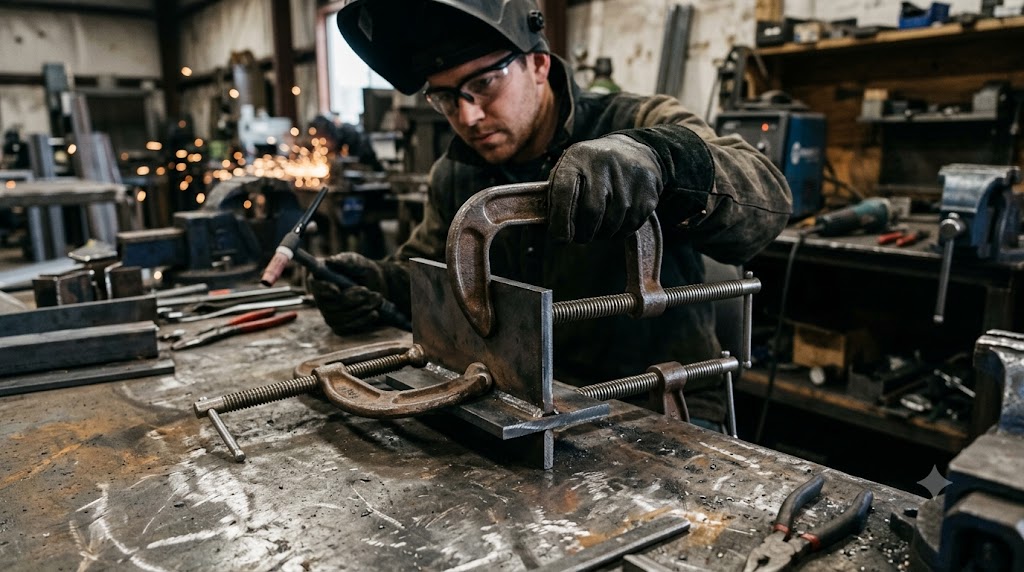
The C-clamp is the oldest trick in the fabrication book, and it is still one of the most useful tools on the bench. When you need to pull two pieces of steel together and hold them dead still while you tack, nothing beats the brute mechanical grip of a good C-clamp. But there is a real difference between the forged clamp built to take welding heat and abuse and the light hardware-store clamp that flexes and cracks. This guide covers what makes a C-clamp right for welding, how to size one, and which to buy.
Welding C-clamps are forged steel or ductile iron clamps that hold workpieces together with strong screw pressure for tacking and fabrication. The key features are forged construction, enough throat depth, and heat resistance. Here is how to choose and use them.
Why C-clamps still matter
Despite all the specialty clamps on the market, the humble C-clamp remains a fabrication staple for good reasons:
- Raw clamping force, since the screw generates far more pressure than most quick clamps or magnets.
- A locked, rigid hold that keeps parts from shifting while you tack.
- Simplicity and durability, with nothing to break on a well-made clamp.
- Versatility, working on everything from thin plate to heavy stock.
For pulling parts tight and holding them still, a good C-clamp is hard to beat, which is why every fabricator owns several.
Direct answer: what to look for
When choosing welding C-clamps, weigh these features:
- Forged steel or ductile iron construction, which resists cracking under high clamping force and near welding heat.
- Enough throat depth to reach past the edge of your work to where you need to clamp.
- A strong ACME-threaded spindle for smooth, powerful tightening.
- A swivel pad that adapts to angled surfaces and spreads pressure.
- A clamping-force rating matched to how heavy your work is.
Strong choices include the Bessey CDF drop-forged deep-throat clamp, the Wilton 540A ductile iron clamp, and the Strong Hand 4-in-1 utility clamp for faster setups.
Forged versus cast, and heat
The single biggest quality difference in C-clamps is how they are made. Drop-forged steel clamps are formed under massive pressure, which aligns the grain of the metal and makes them extremely strong and resistant to cracking, so a forged clamp can take heavy tightening and the heat of welding nearby without failing. Ductile (malleable) iron clamps, like the Wilton 540A series, are also tough and hold up well for general fabrication. What you want to avoid for welding is a brittle gray-iron clamp that can shatter under load or crack from heat. Because C-clamps sit right next to the arc, heat resistance matters: a forged or ductile clamp shrugs off the warmth, while a brittle one can fail at the worst moment.
Throat depth and sizing
Two measurements define a C-clamp: the jaw opening (how thick a stack it fits over) and the throat depth (how far in from the edge the clamp can reach). Throat depth is the one people underestimate. A shallow clamp only grabs right at the edge of your work, while a deep-throat clamp reaches farther in, letting you clamp where the joint actually is. For fabrication, a throat depth of around 3 to 4 inches covers a lot of work, and deep-throat clamps like the Bessey CDF series (with throat depths above 4 inches) give you real reach. Size the jaw opening to the thickness of the parts you clamp most, and keep a range of sizes on hand, since no single clamp fits every job.
Do hardware store C-clamps work for welding?
An honest answer: light hardware-store C-clamps can work for occasional, light tacking, but they are not ideal, and here is why. Many light clamps are made of brittle gray iron that can crack under heavy tightening or from welding heat, and their thin frames flex, letting parts shift as you clamp. For real fabrication you want forged steel or ductile iron clamps built for the pressure and heat. That said, you do not need to reach for the heaviest industrial clamp either; a mid-range forged or ductile clamp from a reputable brand hits the sweet spot of strength, heat resistance, and reach for most home and shop welding. Save the flimsy clamps for light woodworking.
Which C-clamps to buy
Here are three solid options.
- Bessey CDF404 drop-forged deep-throat C-clamp is a heavy-duty drop-forged, heat-treated clamp with a deep throat and a very high clamping-force rating, built for serious fabrication and welding heat. Its limitation is that it is heavier than a light utility clamp, which is the point.
- Wilton 540A ductile iron C-clamp (12 inch) is a classic ductile iron clamp with an oscillating swivel head and black-oxide corrosion resistance, a dependable all-rounder from a name trusted for over 50 years. The trade-off is that ductile iron, while tough, is not quite forged steel for the most extreme loads.
- Strong Hand Tools UD45 4-in-1 utility clamp sets up far faster than a traditional C-clamp with a sliding arm, 500 pounds of pressure, and a threaded jaw for accessories, great for quick repositioning. Its limitation is less raw force than a heavy forged C-clamp.
How to choose: for maximum force and reach, the Bessey deep-throat. For a trusted all-around clamp, the Wilton 540A. For fast, repeatable setups, the Strong Hand utility clamp.
Who should skip heavy C-clamps: welders doing only light sheet work, who may prefer locking pliers or specialty clamps that are gentler and quicker.
The bottom line
The C-clamp endures because nothing else generates the same locked, rigid clamping force, which is exactly what you want when tacking parts together. For welding, choose forged steel or ductile iron over brittle gray iron, get enough throat depth to reach your joint (3 to 4 inches covers a lot), and match the jaw opening to your work. The Bessey deep-throat clamp brings force and reach, the Wilton 540A is a trusted all-rounder, and the Strong Hand utility clamp speeds up setups. Keep a range of sizes on the wall, and you will reach for them on nearly every job.
FAQ
What size C-clamps do welders need? Most welders want a range, since no single size fits every job. For general fabrication, clamps with a throat depth around 3 to 4 inches and jaw openings matched to your typical material thickness cover a lot of work. Keep several sizes on hand and add deep-throat clamps for reaching in from an edge.
Do regular hardware store C-clamps work for welding? Light hardware-store clamps can work for occasional light tacking, but many are brittle gray iron that can crack under heavy tightening or welding heat, and thin frames flex. For real fabrication, choose forged steel or ductile iron clamps built for the pressure and heat.
How much throat depth is enough for fabrication? A throat depth of around 3 to 4 inches covers most fabrication, letting you reach past the edge of the work to the joint. Deep-throat clamps with throat depths above 4 inches give extra reach for wider workpieces or when the joint sits well in from the edge.
What is the difference between forged and cast C-clamps? Drop-forged clamps are formed under massive pressure, aligning the metal’s grain for high strength and crack resistance, ideal near welding heat. Ductile iron clamps are also tough for general work. Brittle gray-iron clamps are the ones to avoid for welding, since they can crack under load or heat.
Why do welding C-clamps have swivel pads? A swivel pad pivots to sit flat against angled or irregular surfaces, spreading the clamping pressure and gripping securely instead of contacting on one edge. It helps the clamp hold tapered or uneven work without slipping or marking a single point.
Can C-clamps handle welding heat? Forged steel and ductile iron C-clamps handle the heat of nearby welding well, which is why they are preferred for fabrication. Brittle gray-iron clamps can crack from heat, so choose forged or ductile clamps and avoid clamping directly on a spot that will get extremely hot.
References
- Bessey Tools drop-forged CDF and CM series C-clamp specifications, including throat depth and clamping force (manufacturer), besseytools.com.
- Wilton Tools 540A Series carriage C-clamp specifications, including ductile iron frame and oscillating head (manufacturer), wiltontools.com.
- Strong Hand Tools UD45 4-in-1 utility clamp specifications (manufacturer), stronghandtools.com.