Welding Cart with Tank Storage: What Actually Keeps Cylinders Safe
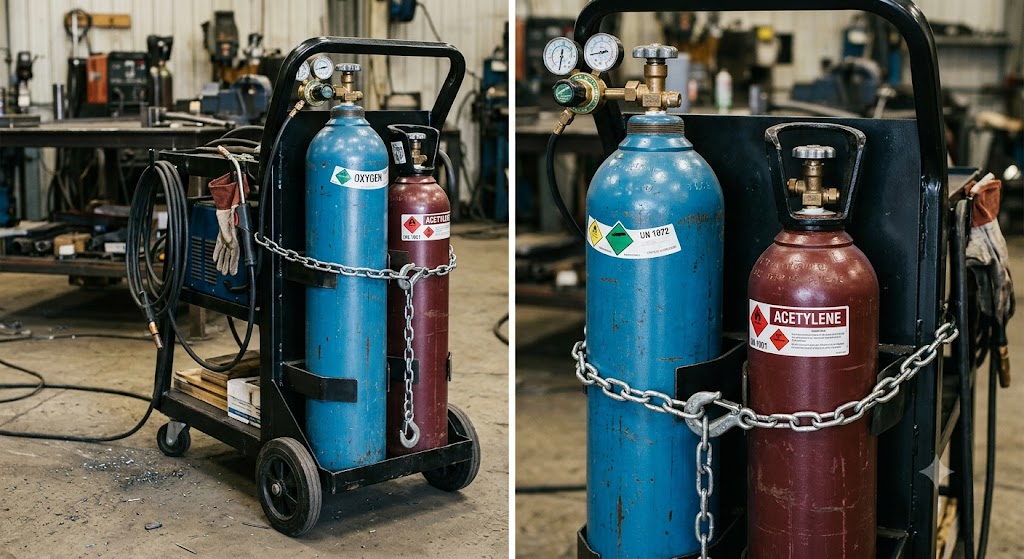
A gas cylinder sitting upright in the corner of a shop, leaning against the wall with nothing holding it, is one OSHA citation and one accidental bump away from becoming a serious hazard. A welding cart with a proper tank storage system is not just a convenience item. It is the mechanism that keeps a 150-lb compressed cylinder secured, upright, and attached to a restrained frame while you move it across your shop floor.
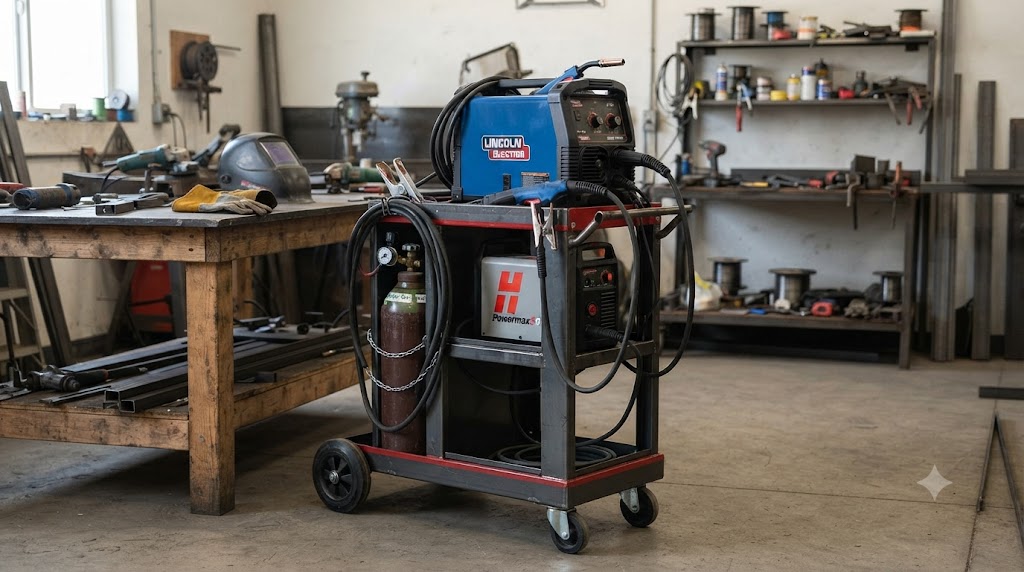
A welding cart with tank storage is a wheeled steel cart that integrates one or more dedicated cylinder holders, typically in the form of a tubular rack or ring, paired with a steel chain or strap restraint that keeps the cylinder from tipping or shifting. The better designs include dual-cylinder capacity, chain attachment points at two heights on the cylinder, and a foot-lock caster system that prevents cart movement when you open the regulator.
If your shop runs a single MIG or TIG setup with one shielding gas cylinder, the VEVOR 3-Tier cart is the best tank-storage-focused option in this price range. It holds one cylinder in a dedicated lower rack with a safety chain, carries 400 lbs static, and keeps the machine and cylinder in one stable rolling unit. For dual-cylinder work, the TOOLIOM lockable cabinet cart is the step up, with two reinforced cylinder holders and stainless steel chains.
Why Cylinder Restraint Is Non-Negotiable
OSHA 29 CFR 1926.350(a)(7) is direct: “A suitable cylinder truck, chain, or other steadying device shall be used to keep cylinders from being knocked over while in use.” That rule applies on active job sites, and the same logic applies in any garage or shop where a cylinder can be struck by a passing vehicle, falling stock, or simple inattention.
The Compressed Gas Association (CGA) guidelines extend this further by addressing storage separately from active use. OSHA’s interpretation guidance distinguishes “in use” cylinders (gas being drawn within a 24-hour window) from cylinders in storage. In-use cylinders must be restrained on the cart. Storage cylinders must also be secured vertically.
The practical takeaway: if your welding cart has only a bottom ring and no chain, the cylinder can pivot and fall even while the ring holds the base. A chain attached at a mid-body height (typically 18 to 24 inches from the ground) is what actually prevents a tip-over.
OSHA Separation Rules for Mixed-Gas Setups
If you run both oxygen and fuel gas (acetylene, propane), OSHA 29 CFR 1910.253(b)(4)(iii) requires that oxygen cylinders in storage be separated from fuel-gas cylinders by a minimum of 20 feet or by a noncombustible barrier at least 5 feet high with a 30-minute fire-resistance rating.
For a welding cart that parks between jobs, the compliant option is a firewall cart with an integral steel barrier between the oxygen and fuel-gas sides, which satisfies the noncombustible-barrier requirement. Standard budget carts do not have this barrier and are not compliant for storing mixed-gas setups under the same roof unless you maintain the 20-foot separation or add a barrier yourself.
For MIG and TIG setups running a single inert shielding gas (argon, CO2, or mixed), this separation rule does not apply. The concern is specifically oxygen and fuel gas in combination.
The Best Welding Carts for Tank Storage
VEVOR 3-Tier with Safety Chains
The VEVOR 3-Tier cart is built around heavy-load capacity. The cylinder rack sits at the rear lower section of the frame and includes steel safety chains. Three shelves above it give you room for the welder on top, wire spools and accessories mid-level, and the chain-secured cylinder at the base.
At 400-lb static capacity, this is the cart for shops running heavier TIG machines or keeping full industrial cylinders that push 150 to 170 lbs loaded. The 360-degree swivel casters handle the combined weight without excessive effort on smooth concrete.
Named flaw: the safety chain attachment points are at a single height. A very short cylinder (under 36 inches) may not be secured tightly at mid-body and can rock within the ring. For standard-height industrial cylinders this is not a problem, but worth checking before you mount an unusual tank size.
VEVOR 3-Tier Cart with Tank Storage
TOOLIOM Dual-Cylinder Lockable Cabinet Cart
The TOOLIOM lockable cabinet cart is the pick for dual-cylinder setups. Two reinforced cylinder holders sit at the rear of the frame, each with an independent stainless steel chain. The dual-holder design makes this the most tank-storage-focused cart in this guide.
The lockable cabinet up front gives you secured storage for consumables and gear. The 265-lb load capacity is adequate for a standard MIG machine plus two cylinders, but if you’re running an industrial-grade machine above 60 lbs, account for that in your weight math.
Named flaw: the cabinet door hinges are the weakest point of the build. In a high-use production shop, they will loosen before the rest of the frame shows any wear. A periodic tightening of the hinge hardware keeps it functional, but it is a recurring maintenance task that better-built carts don’t require.
Comparison Table
| Feature | VEVOR 3-Tier | TOOLIOM Cabinet |
|---|---|---|
| Cylinder capacity | 1 tank | 2 tanks |
| Chain restraint material | Steel | Stainless steel |
| Static load capacity | 400 lb | 265 lb |
| Cabinet/drawers | Open shelves | Lockable cabinet |
| Caster type | 360° swivel | 360° swivel |
What to Look for in Cylinder Rack Design
Cylinder ring diameter
Most standard DOT industrial cylinders are 7 to 9 inches in diameter. A rack ring too large lets the cylinder rattle and shift; one too small won’t accept the cylinder at all. The standard carts in this guide accommodate cylinders in the 7-to-9-inch range, which covers argon, CO2, mixed-gas, and most acetylene cylinders used in garage shops.
Chain versus strap restraints
Steel chain is the standard and the correct choice. Nylon straps and bungee cords degrade with heat exposure and UV. In an active welding environment where spatter and heat are present, chain outlasts anything else and doesn’t stretch under load. When you look at a cart listing, the description should specifically say “steel safety chain.” If it says “strap” or doesn’t mention the restraint material, contact the seller before buying.
Tip-over prevention and caster locks
A cart with lockable casters and a cylinder rack is only as safe as the lock. Before you accept delivery on any welding cart, test the caster locks under load. The rear wheels should hold without rolling when the full loaded cart is pushed lightly from the side. Locks that slip under partial lateral load are a sign of undersized or poorly manufactured caster hardware.
FAQ
How do I safely store gas cylinders on a welding cart? Secure the cylinder in the cart’s rack with the provided steel chain attached at mid-body height, approximately 18 to 24 inches from the base. Keep the valve protection cap in place whenever the regulator is not attached. Lock the casters when the cart is parked. Per OSHA 1926.350, cylinders must remain upright at all times except during active hoisting.
What is the standard cylinder size a welding cart holds? Most welding carts accommodate standard DOT cylinders in the 7-to-9-inch diameter range, which covers the most common industrial argon, CO2, argon/CO2 mix, and acetylene cylinders. Always confirm the rack ring dimensions with the manufacturer before buying if you run an unusual cylinder size or a small portable tank.
Do all welding carts include a tank rack? No. Some carts are designed primarily as welder platforms and tool storage with no cylinder accommodation at all. If cylinder transport and storage is a requirement, confirm the listing specifically calls out a cylinder rack and chain restraint before purchasing. The carts in this guide all include cylinder restraint systems.
Can I store both oxygen and acetylene cylinders on the same cart? Not unless the cart includes a noncombustible firewall barrier between the two cylinder positions, per OSHA 29 CFR 1910.253(b)(4)(iii). Standard budget carts do not include this. For dual-gas oxy-acetylene setups, either maintain 20 feet of separation between the cylinders during storage or use a purpose-built firewall cart.
What size cylinder do most cart racks fit? Most racks in this guide fit cylinders from approximately 40 cubic feet (small portable tanks) up to 330-cubic-foot industrial cylinders. The critical variable is diameter, not height. Verify the ring diameter before you purchase.
Are caster wheels rated for full cylinder weight? The casters on the carts in this guide are rated for the cart’s full stated load capacity. A 400-lb-capacity cart has casters rated for that total load including cylinders. The dynamic (rolling) capacity is lower than the static, typically 20 to 30 percent less, so account for that when loading your cart for transport.
References
- https://www.osha.gov/laws-regs/regulations/standardnumber/1926/1926.350
- https://www.osha.gov/laws-regs/regulations/standardnumber/1910/1910.253
- https://www.osha.gov/laws-regs/standardinterpretations/2006-05-08
- https://portal.cganet.com/publicationlist/
URL slug: welding-cart-with-tank-storage Excerpt: A welding cart with proper tank storage keeps gas cylinders upright and chained per OSHA requirements. This guide covers the cylinder restraint rules that matter, what to look for in rack and chain design, and the top-ranked carts for single and dual-cylinder setups.