Welding Corner and Angle Clamps Guide (Non-Magnetic)
Square is everything in fabrication. A frame, a box, a table base: if the corners are not true 90 degrees, the whole assembly is off, and you feel it in every part that follows. Magnetic squares are quick and popular for this, but they have real limits, weaker grip, no clamping pressure, and a tendency to lose their hold when things get hot or covered in spatter. Non-magnetic corner and angle clamps solve those problems by mechanically clamping your workpieces at a set angle, holding heavier steel dead square while you tack. This guide covers how they work and which to buy.
Welding corner and angle clamps mechanically hold two workpieces at a set angle, usually 90 degrees, for square joints. Unlike magnets, they apply real clamping pressure and hold heavier steel without losing grip near heat. Here is how to choose.
Why mechanical clamps over magnets
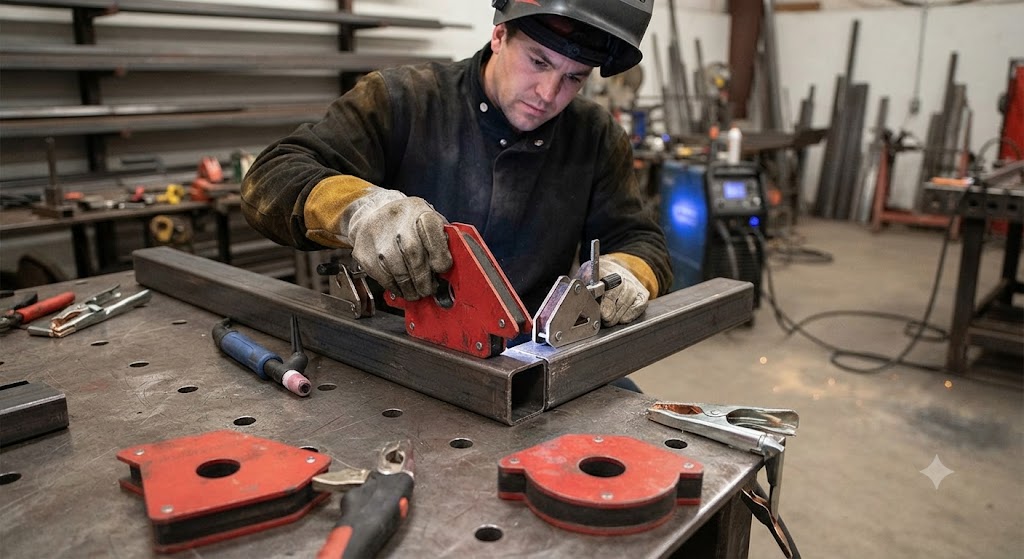
Magnetic squares have their place, but corner and angle clamps offer real advantages:
- Actual clamping pressure, pulling the workpieces tight against the fixture instead of just resting them there.
- A firm hold on heavier steel, where a magnet’s pull is not enough.
- No loss of grip from heat, since magnets weaken as steel warms, while a clamp does not care.
- Immunity to spatter buildup, which can lift a workpiece off a magnet’s face.
For a true, held 90 degree joint on anything but the lightest stock, a mechanical clamp is the more reliable tool.
Direct answer: what to look for
When choosing corner and angle clamps, weigh these features:
- A true 90 degree reference for square joints, and adjustable versions for other angles.
- Strong clamping pressure, applied by a screw or quick-acting handle.
- Sturdy cast iron or ductile construction that stays rigid and takes heat.
- Enough capacity for the thickness and size of stock you weld.
- Clearance to run your bead at the joint the clamp is holding.
Strong choices include the Strong Hand WAC35D right-angle corner clamp, the Strong Hand multi-axis angle clamp for varied angles, and the Cognative welder’s angle clamp.
Fixed 90 degree corner clamps
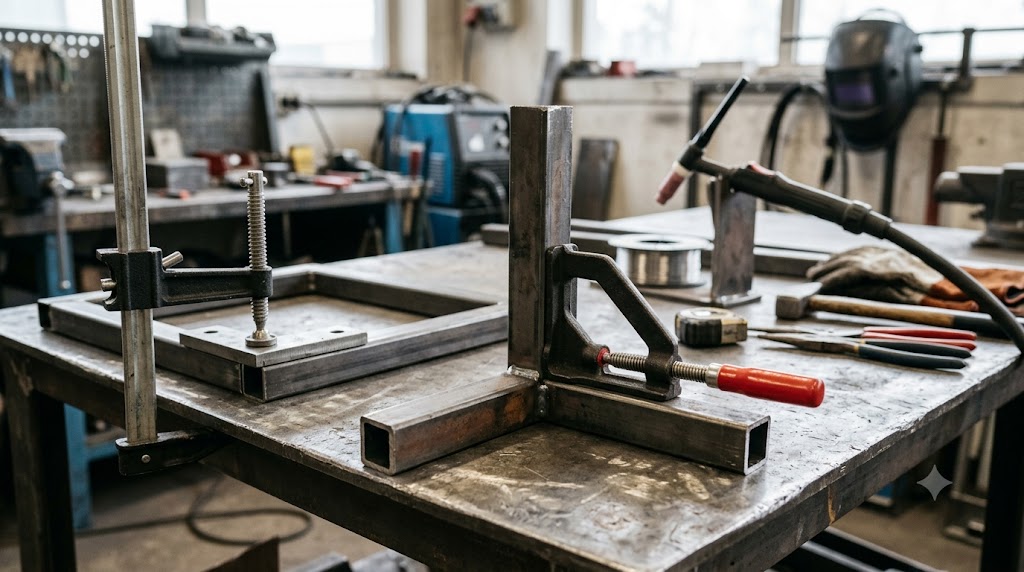
The most common corner clamp holds two pieces at a fixed, true 90 degrees, and it is the tool you reach for building frames and boxes. You set both workpieces into the clamp against its square reference faces, then tighten so they are pulled tight and held exactly perpendicular while you tack. Because a good corner clamp is cast iron or ductile and applies real screw pressure, it holds heavier angle iron, tube, and plate far more securely than a magnet, and it does not let go as the joint heats up. Look for a design with an adjustable swing jaw, which lets the clamp accommodate different material thicknesses, and enough open clearance to actually weld the inside or outside corner while the clamp holds it. For repeatable square corners, a fixed 90 degree clamp is the backbone of the set.
Adjustable angle clamps
Not every joint is 90 degrees, which is where adjustable angle clamps come in. These let you set and lock the jaws at a range of angles, so you can hold miters, off-square frames, and other layouts true while you tack. A multi-axis angle clamp goes further, holding pieces in more than one plane at once, useful for three-dimensional assemblies where two tubes meet at an angle and you need both held in position. The trade-off compared with a fixed 90 degree clamp is a little more setup to dial in and lock the angle, but the flexibility is worth it if your work goes beyond simple square corners. Many shops keep both: fixed 90 degree clamps for the bulk of frame work and an adjustable clamp for the odd angles.
Do you still need magnetic squares?
An honest take: magnets and clamps are not really rivals, they are teammates. Magnetic squares are fast and one-handed, perfect for quickly holding light pieces at a rough angle while you get a clamp on, or for tacking thin stock where a clamp is overkill. But when you need a joint held truly square under real pressure, on heavier steel, or where heat and spatter would defeat a magnet, a mechanical corner clamp is the tool that delivers. Think of magnets as quick helpers and non-magnetic clamps as the reliable holders for accuracy and heavier work. Most fabricators own both and reach for whichever fits the moment, which is the smart approach.
Which corner and angle clamps to buy
Here are three dependable options.
- Strong Hand Tools WAC35D right-angle corner clamp is a heavy cast-iron 90 degree clamp with an adjustable swing jaw and clearance to weld the corner it holds, built for square joints on real steel. Its limitation is that it is dedicated to right angles.
- Strong Hand Tools multi-axis welder’s angle clamp holds workpieces across angles and planes with a quick-acting action, ideal for three-dimensional assemblies and off-square joints. The trade-off is a bit more setup than a fixed clamp.
- Cognative welder’s angle clamp is a ductile/cast-iron angle clamp that holds stock square with a firm screw, a solid straightforward option for frame corners. Its limitation is a modest maximum jaw opening.
How to choose: for square frame corners, the WAC35D. For varied angles and 3D work, the multi-axis clamp. For a simple dependable corner clamp, the Cognative.
Who should skip mechanical corner clamps: welders tacking only thin, light stock quickly, who are well served by magnetic squares for that work.
The bottom line
Square joints are the foundation of good fabrication, and non-magnetic corner and angle clamps hold them true where magnets fall short. They apply real clamping pressure, grip heavier steel, and keep their hold through heat and spatter, giving you dead-square corners for frames and boxes. Fixed 90 degree clamps handle the bulk of that work; adjustable and multi-axis clamps cover miters, off-square joints, and 3D assemblies. Keep magnetic squares as quick helpers for light stock, but for accuracy under pressure, reach for a mechanical clamp. Build your corners true, and everything downstream fits.
FAQ
Why use a corner clamp instead of a magnet for welding? A corner clamp applies real clamping pressure to pull workpieces tight and hold them truly square, and it keeps that grip on heavier steel and through heat and spatter. Magnets only rest pieces at an angle with no clamping force and weaken as the steel warms, so clamps are more reliable for accurate, heavier joints.
Are welding corner clamps only for 90 degree joints? Fixed corner clamps hold a true 90 degrees for square frames and boxes, but adjustable angle clamps let you set and lock other angles for miters and off-square joints. Multi-axis clamps hold pieces across more than one plane for three-dimensional assemblies.
Do non-magnetic clamps work better than magnetic squares? For holding heavier steel truly square under pressure, and where heat and spatter would defeat a magnet, yes. Magnetic squares are faster and one-handed for light stock. Most fabricators use both: magnets as quick helpers and mechanical clamps for accuracy and heavier work.
What should I look for in a welding angle clamp? Look for a true angle reference, strong screw or quick-acting clamping pressure, sturdy cast iron or ductile construction that takes heat, enough capacity for your stock thickness, and clearance to run your bead at the joint. An adjustable swing jaw helps it fit different material thicknesses.
Can you weld the corner while the clamp holds it? Yes, if the clamp is designed with clearance at the joint. Good corner clamps leave the inside or outside corner open so you can tack it while the clamp holds the pieces square. Keep the clamp body out of the direct weld path and let it hold the alignment.
What are corner clamps made of? Quality welding corner and angle clamps are cast iron or ductile iron, which stays rigid under clamping pressure and handles the heat of nearby welding. That construction is why they hold heavier steel securely where a magnet would slip.
References
- Strong Hand Tools corner clamp and angle clamp specifications, including cast-iron construction and adjustable jaws (manufacturer), stronghandtools.com.
- Miller Electric and Lincoln Electric guidance on squaring and fit-up for frame and box fabrication (manufacturers), millerwelds.com, lincolnelectric.com.
- The Fabricator guidance on fixturing and holding square joints (industry publication), thefabricator.com.