Welding Ground Clamp Buying Guide
Here is a truth that surprises new welders: a bad ground clamp will ruin good welds. You can have the right machine, the right wire, and solid technique, but if your work clamp makes a poor connection, you get a sputtering arc, spatter, and inconsistent beads. The ground clamp (more correctly the work clamp) is the humble, overlooked end of your welding circuit, and upgrading a flimsy one is one of the easiest ways to make your whole setup weld better. This guide covers what makes a good one and how to choose.
A welding ground clamp (work clamp) completes the welding circuit by connecting your work lead to the workpiece or table. The best ones use copper alloy for low resistance, match your machine’s amp rating, and grip with a screw or strong spring. Here is how to buy the right one.
Why the ground clamp matters
Welding is a circuit: current flows from the machine, through the electrode, across the arc, into the work, and back through the work clamp. That means the clamp is not an afterthought, it is half of your connection to the metal. A poor clamp adds resistance to the circuit, and that resistance shows up as a weak or erratic arc, more spatter, heat building up in the clamp itself, and welds that just will not settle down. A good clamp, by contrast, makes a solid, low-resistance connection that lets your machine deliver clean, stable current. For such a small part, it has an outsized effect on weld quality.
Direct answer: what to look for
When buying a welding ground clamp, weigh these features:
- Copper alloy construction, which conducts far better than plain steel and lowers resistance in the circuit.
- An amp rating that meets or exceeds your machine’s maximum output.
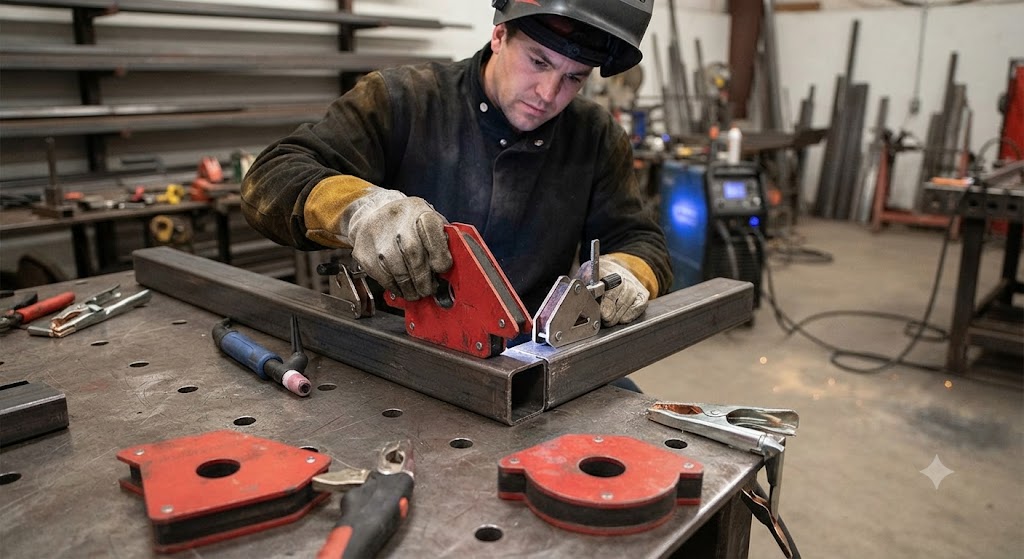
- A strong grip, either a screw-type clamp or a heavy spring, so the jaws bite the metal firmly.
- A solid cable connection, ideally a bolt or cap screw that clamps the cable tight rather than a weak crimp.
- A large contact area where the jaws meet the work.
Strong choices include the Tweco 300 amp copper clamp, the Forney 500 amp clamp for heavier machines, and the WeldingCity copper crocodile clamp.
Amp rating: match it to your machine
The most important number is the amp rating, and the rule is simple: your clamp should be rated for at least as many amps as your machine can put out. A clamp rated below your machine’s output becomes a bottleneck in the circuit, heating up and adding resistance under load. So if you run a machine that tops out around 200 amps, a 200 or 300 amp clamp is right; if you run a bigger machine, step up to a 400 or 500 amp clamp. A common question is whether a bigger clamp is always better. Not exactly: a much larger clamp than you need is heavier and more awkward, so the goal is to match or modestly exceed your machine’s rating, not to buy the biggest clamp on the shelf.
Copper alloy and grip
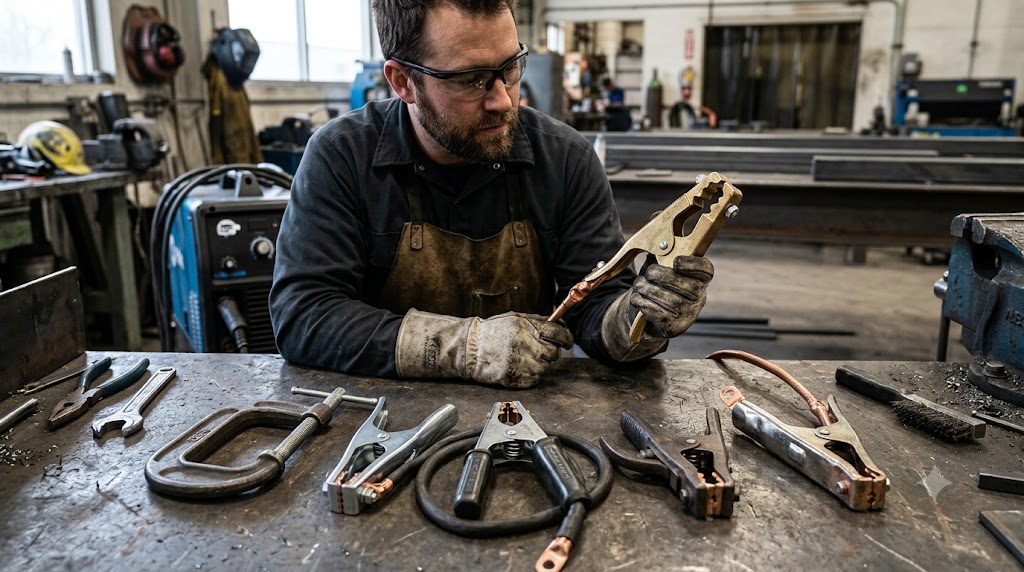
Two things separate a quality clamp from a poor one: what it is made of and how it holds on. Copper alloy is the material to look for, because copper conducts electricity far better than steel, which means lower resistance and a cleaner arc; many quality clamps are solid copper alloy castings for exactly this reason. Grip matters just as much. A screw-type (cap screw) clamp lets you tighten the jaws down hard onto the work for maximum contact, while a spring clamp is faster to move but relies on spring tension. For the best connection, especially at higher amps, a screw-type clamp with a large contact area and a bolted cable connection is hard to beat. A spring crocodile clamp is handier for quick, lower-amp work.
Why does my ground clamp keep loosening?
A frustration many welders hit: the clamp will not stay put or the connection fades. Usually the cause is one of a few things. The jaws may be gripping paint, rust, or mill scale rather than clean metal, so clamp to a ground spot you have wire-brushed to bare steel. The spring may be weak or the jaws worn, so they no longer bite; a screw-type clamp solves this by mechanically tightening. Or the cable connection at the back of the clamp may be loose, adding resistance and heat; check that the cable is bolted tight. Fix those three things and a loose, fading clamp usually comes right back to life.
Which ground clamps to buy
Here are three dependable work clamps.
- Tweco 300 amp copper ground clamp is a copper-alloy clamp from a long-trusted welding brand, rated 300 amps with a large contact area and a solid cable connection, ideal for most home and light professional machines. Its limitation is that very large machines want a higher-rated clamp.
- Forney 500 amp welding ground clamp steps up to a 500 amp rating with a brass body and a wide jaw opening, a strong pick for heavier machines and thicker cable. The trade-off is that it is more clamp than a small machine needs.
- WeldingCity 300 amp copper crocodile clamp is a copper-alloy spring (crocodile) clamp rated 300 amps, handy for quick moves around the shop. Its limitation is that a spring clamp does not bite as hard as a screw-type at the highest amps.
How to choose: for a solid all-around screw-type clamp, the Tweco 300 amp. For a heavier machine, the Forney 500 amp. For fast, lower-amp connections, the WeldingCity spring clamp.
Who should skip a heavy clamp: hobbyists running small machines, who are better served by a right-sized 200 to 300 amp clamp than the largest option.
The bottom line
A welding ground clamp is half of your connection to the metal, and a good one makes your whole setup weld better. Look for copper alloy construction for low resistance, an amp rating that meets or exceeds your machine, a firm grip (a screw-type clamp bites hardest), and a solid bolted cable connection. Clamp to clean bare steel to keep the connection strong. The Tweco 300 amp is a dependable all-around choice, the Forney 500 amp suits heavier machines, and the WeldingCity crocodile clamp is handy for quick work. Match the clamp to your machine and clean your ground spot, and your arc will thank you.
FAQ
What amp rating ground clamp do I need? Your ground clamp should be rated for at least as many amps as your machine can put out. If your machine tops out around 200 amps, a 200 or 300 amp clamp is right; for larger machines, step up to a 400 or 500 amp clamp so the clamp does not become a bottleneck in the circuit.
Why does my ground clamp keep loosening? Usually one of three things: the jaws are gripping paint, rust, or scale instead of bare metal; the spring or jaws are worn and no longer bite; or the cable connection at the back is loose. Clamp to wire-brushed bare steel, use a screw-type clamp for a firm bite, and check the cable is bolted tight.
Is a bigger ground clamp always better? No. The clamp should meet or modestly exceed your machine’s amp rating. A much larger clamp than you need is heavier and more awkward without improving the weld, so match the clamp to your machine rather than buying the biggest one available.
Why are copper ground clamps better? Copper conducts electricity far better than steel, so a copper alloy clamp adds less resistance to the welding circuit, giving a cleaner, more stable arc and less heat buildup in the clamp. That lower resistance is why quality clamps are made of copper alloy.
What is the difference between a screw-type and spring ground clamp? A screw-type (cap screw) clamp tightens the jaws down mechanically for maximum contact and grip, best at higher amps. A spring (crocodile) clamp is faster to move but relies on spring tension, making it handier for quick, lower-amp work but less firm under heavy load.
Does a ground clamp affect weld quality? Yes, significantly. The clamp is half of the welding circuit, so a poor connection adds resistance that causes a weak or erratic arc, more spatter, and inconsistent welds. A solid copper alloy clamp on clean metal helps your machine deliver clean, stable current.
References
- Tweco copper ground clamp specifications, including 300 amp copper casting, jaw opening, and cable connection (manufacturer), tweco.com.
- Forney Industries welding ground clamp specifications, including amp ratings and construction (manufacturer), forneyind.com.
- Lincoln Electric and Miller Electric guidance on the welding circuit, work clamps, and clean ground connections (manufacturers), lincolnelectric.com, millerwelds.com.