Welding Magnet Angle and Clamp Types Compared
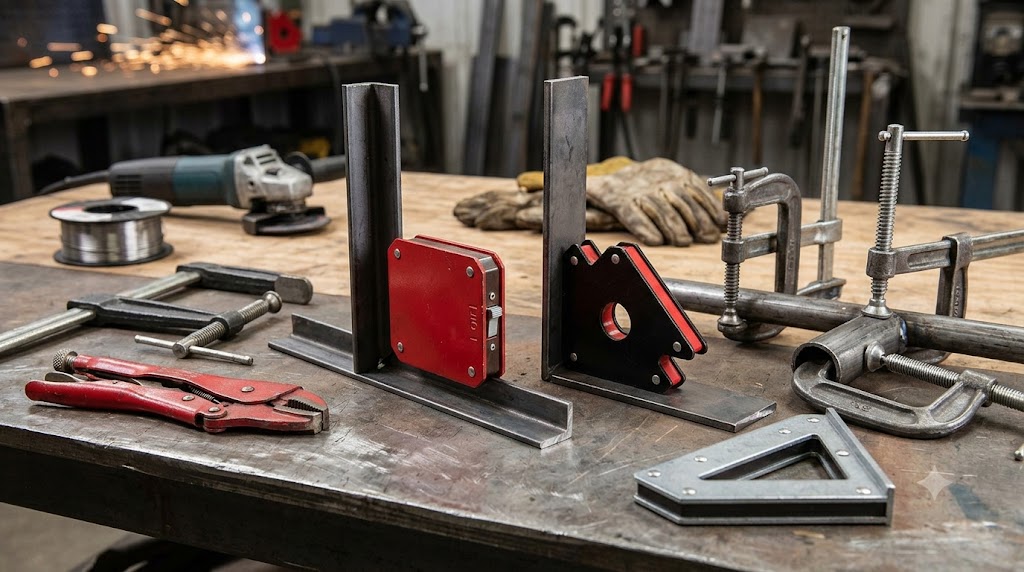
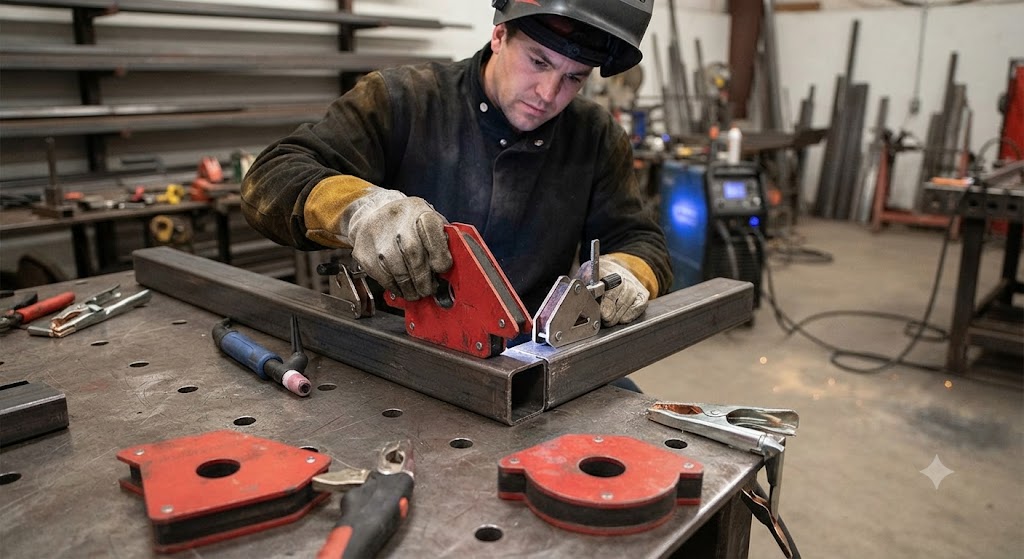
A welding magnet is the third hand you do not have to pay. It holds two pieces of steel at the angle you want while you tack, freeing both your hands for the torch and the filler. But magnets are not all the same, and buying the wrong type turns a helper into a hassle: a fixed-angle magnet cannot do the odd angle your project needs, and a magnet you cannot switch off fights you every time you try to reposition it. This guide compares welding magnet angle types and clamp styles so you buy the one your work actually calls for.
The short answer: fixed-angle magnets are cheap and strong for common 45, 90, and 135 degree setups, switchable on/off magnets let you place and release them cleanly, and adjustable-angle positioners handle any angle in between at a higher price.
The three magnet types, compared
Fixed-angle (arrow) magnets
These are the arrowhead-shaped magnets in every starter kit. Their sides are cut to standard angles, usually 45, 90, and 135 degrees, and the magnet is always on. They are inexpensive, strong for their size, and perfect for holding a simple square or miter tack.
The drawbacks are real, though. Always-on means they grab filings and skate to the workpiece before you are ready, and pulling them off a tacked joint takes muscle. And fixed means fixed: if your project needs 30 or 60 degrees, an arrow magnet cannot give it to you.
Switchable on/off magnets
These add a lever that turns the magnetism on and off. Switched off, they carry no external pull, so you position them precisely, then flip them on to clamp. When you are done, switch off and lift them away clean, no wrestling and no filings clinging to them. Many combine this with multiple fixed angles.
A good example is the Magswitch Mini Multi-Angle magnet, which offers 45/135, 75/105, and 90 degree faces with a true on/off switch. The trade is price and a bit more bulk, but for anyone repositioning often, the control is worth it.
Adjustable-angle positioners
When you need an angle that is not on the standard list, an adjustable positioner is the answer. These clamp at any angle across a wide range and often include a vernier scale and a bubble level for precise setup. The Strong Hand Tools MAV120, for instance, holds any angle from 30 to 275 degrees with dual on/off switches and a machined V-groove for round stock. For arbitrary angles and repeatable, measured setups, nothing else compares.
The catch is cost and complexity. An adjustable positioner is a bigger investment and overkill if all you ever weld is squares and miters.
Clamp and hold styles that matter
Beyond the angle, look at how the magnet grips your material:
- Flat faces hold flat plate and sheet, the everyday case.
- V-grooves cradle round and square tubing so pipe does not roll out of position. If you weld tube, insist on a V-groove.
- Dual switches let you engage one face at a time, which helps when you are setting an angle before committing the full clamp.
- On/off switching is the single feature that most improves day-to-day use, because it makes both placement and cleanup effortless.
An Amazon example of an adjustable, switchable unit is this dual-switch on/off welding magnet with an angle scale, which covers a wide angle range and releases cleanly.
The honest limits of any welding magnet
Two cautions. First, magnets do not work on non-ferrous metal, so aluminum and stainless (non-magnetic grades) get no help here. Second, heat weakens magnets: keep them off the immediate weld zone and away from prolonged high heat, or you will slowly degrade their pull. Use them to set and hold the tack, not to sit in the arc.
How to choose
- Occasional hobby squares and miters: a set of fixed arrow magnets is enough and cheap.
- Frequent repositioning, cleaner workflow: buy a switchable on/off magnet. The control pays for itself fast.
- Odd angles and precise, repeatable setups: invest in an adjustable positioner with a scale and level.
- Tube and pipe work: prioritize a V-groove face regardless of type.
The verdict
Match the magnet to the angles you actually weld and to how often you reposition. Fixed arrow magnets are the budget default for standard angles, on/off switchable magnets are the upgrade almost everyone appreciates, and adjustable positioners earn their price the moment your project needs an angle the others cannot reach. Whatever you choose, keep it out of the arc and remember it will not help on aluminum or non-magnetic stainless.
Frequently asked questions
What angles do welding magnets come in? Fixed arrow magnets usually offer 45, 90, and 135 degrees. Multi-angle magnets add options like 75/105 degrees, and adjustable positioners cover any angle across a wide range, such as 30 to 275 degrees.
What is an on/off welding magnet? It is a magnet with a switch that turns the magnetism on and off, so you can position it with no pull, clamp it on, then release and lift it away cleanly without wrestling or picking off filings.
Are adjustable welding magnets worth it? If you weld non-standard angles or need precise, repeatable setups, yes. For only squares and miters, a fixed or switchable magnet is more than enough.
Do welding magnets work on aluminum? No. Magnets only hold ferrous (magnetic) metals like steel. Aluminum and non-magnetic stainless grades will not respond to them.
Does heat affect welding magnets? Yes. Prolonged high heat weakens a magnet’s pull over time. Keep magnets away from the immediate weld zone and use them to hold the tack, not to sit in the arc.
Do I need a V-groove magnet? If you weld round or square tubing, yes. The V-groove cradles the tube so it will not roll out of position, which flat-faced magnets cannot do as well.
References
- Magswitch Technologies, Welding and Fabrication Magnetic Fixturing (manufacturer, angle tools and switching): https://magswitch.com/pages/welding-fabrication-magnetic-fixturing
- Strong Hand Tools, Adjustable Angle Magnet Positioner MAV120 (manufacturer spec, 30 to 275 degrees, dual on/off): https://www.stronghandtools.com/products/mav120
URL slug: welding-magnet-angle-and-clamp-types Excerpt: A welding magnet is the third hand you do not pay for, but the wrong type fights you. Compare fixed arrow, on/off switchable, and adjustable positioners, plus V-groove holds and the limits every magnet has.