Welding Screens and Curtains Guide
The first time I welded in a shared shop without a welding screen, my neighbor three booths down walked past at the wrong moment and spent a few seconds looking directly at the arc through a gap in some shelving. He was not hurt, but the look on his face when he described the after-image in his vision reminded me how fast arc flash exposure happens and how invisible the hazard is to people who are not paying attention. A welding screen curtain is the simple, cheap partition that keeps your arc from becoming someone else’s emergency. This guide covers what welding screens are, how they differ from welding blankets, and how to choose and set up the right screen for your space.
What Welding Screens and Curtains Actually Do
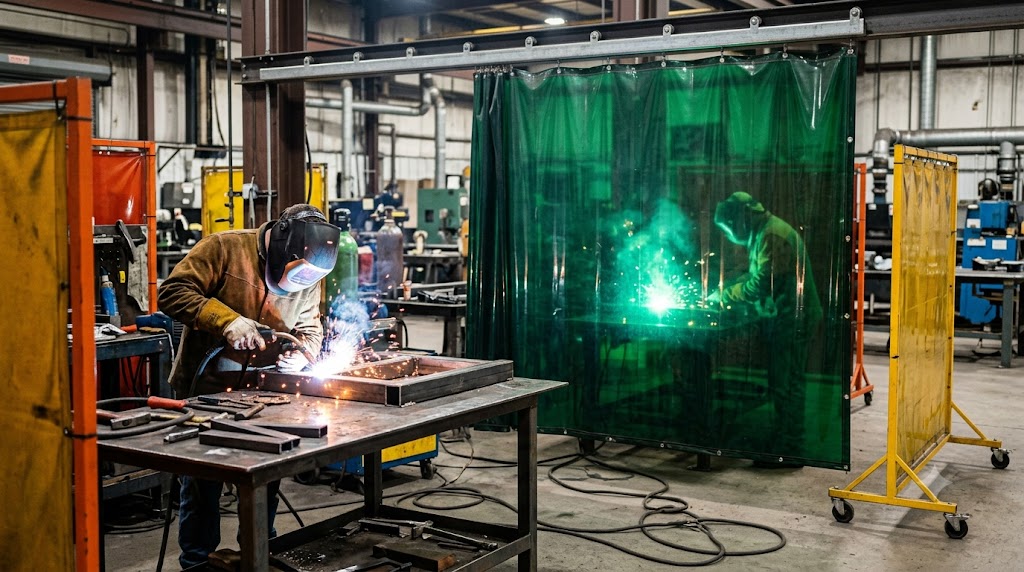
A welding screen or welding curtain is a translucent or semi-opaque partition designed to block arc flash UV and visible light radiation from reaching bystanders, co-workers, or anyone who might be walking through a shared workspace. It is a visual and UV barrier, not a spark or spatter barrier.
This distinction from a welding blanket matters. A welding blanket catches sparks and slag on surfaces. A welding curtain or screen stands between the arc and people who are not involved in the weld. Both are legitimate safety tools, but they solve different problems. In a professional shop or shared space, you often need both: the screen to protect bystanders from the arc, and the blanket to protect surfaces from the spatter.
Welding arc UV radiation causes photokeratoconjunctivitis, commonly called arc eye or welder’s flash, which is an extremely painful inflammation of the cornea caused by UV overexposure. Symptoms include severe pain, sensitivity to light, and the sensation of having sand in your eyes. It can occur from even brief indirect exposure to an arc. A proper welding curtain eliminates this hazard for anyone on the other side of it.
What Type of Welding Screen Should You Buy?
For most home garage and small shop applications, a vinyl welding curtain in a standard blue, orange, or green transparent shade is the right call. These curtains filter UV and visible arc light to safe levels while allowing enough ambient light through that the person on the other side can still see where they are walking. Blue and green shaded vinyl curtains are the most common. They are inexpensive, available in standard widths for hanging from hooks or ceiling rails, and easy to slide out of the way when you are not welding.
For a dedicated production welding booth, opaque curtain panels or solid welding screens with a small viewing window give maximum protection at the expense of visibility. These suit high-arc-frequency operations where bystanders will never need line of sight through the curtain during welding.
For outdoor and job-site work, portable freestanding welding screen frames with vinyl panels are the standard solution. They set up quickly, hold themselves stable on flat surfaces, and fold for transport.
Welding Screen Types Compared
| Screen Type | UV Protection | Visibility Through | Portability | Best For |
|---|---|---|---|---|
| Transparent vinyl curtain (blue/green shade) | Good | High, tinted view | Hang from hooks or rail | Home garages, small shops |
| Opaque vinyl panel | Excellent | None | Hang from hooks or rail | Dedicated welding booths |
| Mesh welding screen | Moderate | Moderate | Hang or frame mount | Ventilated areas |
| Portable freestanding frame system | Good to excellent | Depends on panel | Very portable | Job sites, open shop floors |
| Rigid welding shield panel | Excellent | Window only | Semi-portable | Industrial production booths |
Key Buying Factors
UV protection rating. Any welding curtain worth using must block UV radiation from the arc. Look for products specifically rated for welding arc exposure. Cheap plastic curtains without a specific UV rating may not provide adequate protection.
Size and coverage. A welding curtain that only covers half the arc exposure is worse than useless because it gives bystanders false confidence. Measure the area you need to cover and buy panels that overlap at the edges. Standard widths run from 4 to 6 feet and heights from 6 to 8 feet. For a full booth, you need coverage on all sides of the welding position.
Hanging system. Most welding curtains include grommets at the top for ceiling hooks, curtain rails, or frame kits. Check that the grommet spacing matches whatever hanging system you plan to use.
Mesh versus solid. Mesh screens allow air circulation, which matters in enclosed spaces with fume or heat buildup. They do not block UV as completely as solid vinyl panels. Use mesh only in well-ventilated areas where the primary hazard is arc flash from a distance rather than close proximity.
Freestanding frame versus hanging. Hanging systems from the ceiling or overhead structure are more permanent and out of the way. Freestanding frames are more flexible for temporary setups and job sites. For a permanent shop booth, overhead hanging wins. For a job site, freestanding frames are the practical choice.
Do You Need One in a Home Garage?
If you weld alone in a private garage and no one else is ever present, a dedicated welding curtain is not mandatory. The hazard of arc flash is to bystanders, and if there are none, the curtain solves a problem you do not have.
If your garage is shared with other household members, neighbors, or anyone who might walk through, a welding curtain is one of the most important safety investments you can make. Children, spouses, and visitors are particularly at risk because they are unaware of the hazard and do not know to look away. Set up a curtain partition around your welding area, close it before you strike an arc, and train everyone to never look toward the arc from any angle.
For any commercial or shared shop space, welding screens are a regulatory requirement under OSHA and a professional standard under AWS Z49.1 Safety in Welding standards.
The Bottom Line
Welding screens and curtains solve the problem of arc UV exposure to bystanders. Welding blankets solve the problem of spark and spatter damage to surfaces. You need both in any space where other people are present. For a home garage, a single vinyl welding curtain on a ceiling rail or freestanding frame is the simplest and cheapest way to keep your family safe from your arc. For a production shop, proper booth curtains on all sides are a baseline requirement, not a luxury.
Frequently Asked Questions
What is the difference between a welding screen and a welding curtain? The terms are often used interchangeably. A welding curtain usually refers to a hanging vinyl panel. A welding screen can refer to either a hanging curtain system or a rigid freestanding partition. Both do the same job: blocking arc flash UV and visible radiation from bystanders.
What color should a welding curtain be? Blue and green tinted transparent vinyl is the most common and the most functional for most shop environments. Orange tinted curtains are also common. The shade filters UV and arc visible light to safe levels while still allowing ambient light through.
Do welding curtains protect against sparks and spatter? No. Welding curtains are UV and light barriers, not spark barriers. For spark and spatter protection of surfaces, use a fiberglass welding blanket. Many shops use both together.
Can I make a welding screen out of regular plastic sheeting? No. Standard plastic or vinyl sheeting does not have the UV filtering properties required to protect against arc flash. Use only products specifically rated and designed for welding arc flash protection.
Does OSHA require welding curtains? OSHA requires employers to protect workers and bystanders from arc flash UV radiation under 1910.252. In any workplace where other personnel are in proximity to welding operations, protective screens or curtains are typically required.
How do I calculate how much curtain coverage I need? Map out the perimeter of your welding area and measure all sides that are accessible to bystanders. Buy enough panels to cover all open sides with at least a few inches of overlap at the edges.
What is a mesh welding screen good for? Mesh welding screens provide more airflow than solid vinyl panels, which matters in enclosed spaces with fume or heat buildup. They are a good choice for ventilated shop areas where the primary goal is blocking the arc from workers at a distance.
Can one person weld and another stand right next to them behind a welding curtain? Yes, if the curtain is properly rated and fully covering the gap between the two people. The person behind the curtain must not be able to see the arc directly through any gap in the coverage.
References
https://www.osha.gov/laws-regs/regulations/standardnumber/1910/1910.252 https://www.nfpa.org https://www.aws.org
SEO Title: Welding Screens and Curtains Guide