Welding Table and Workbench Guide
I built my first welding table out of 2x4 lumber with a sheet of plywood on top. I burned through that plywood on the first day and scorched the second sheet badly enough that I replaced it with a piece of expanded metal, which lasted longer but bent every time I laid something heavy on it. The lesson took about three attempts to learn: a welding table is not a regular workbench with a metal top. It is a purpose-built platform designed to handle sustained heat, heavy loads, and the specific demands of fitting up and welding steel. If you are buying or building your first welding table, this guide covers what separates a real welding table from a workbench, what types exist, and what specs actually matter.
What Makes a Welding Table Different from a Regular Workbench
A welding workbench must handle heat, weight, and abrasion that would destroy a wood or light-duty metal workbench in a single session. The top must be steel, not wood, because welding spatter ignites wood surfaces and wood cannot serve as a grounding path. The top must be thick enough to resist warping from sustained heat exposure, which for flat work means at least 3/8-inch steel for a production table and ideally 1/2-inch for heavy use.
The frame and legs must support the weight of the steel you are fitting and welding, including the load of clamping forces applied at the edge. A flimsy workbench that flexes under a clamp load produces inconsistent fit-up and frustrating squareness problems.
Finally, a welding table must be properly grounded. For MIG and stick welding, your ground clamp connects to the table or directly to the workpiece. If the table itself is the grounding point, the table must have a clean conductive path from the work surface through the frame to the ground cable connection. Paint and rust break that path and degrade arc quality.
What Welding Table Should You Buy?
For a home shop doing general fabrication with a MIG welder, a flat steel table in the 30x20 inch to 36x24 inch range with a 3/8-inch top and a welded steel frame handles most tasks. You do not need fixture holes unless you are doing precision jig work. A flat steel table is the most versatile and lowest-cost option and represents the baseline that every home shop should have.
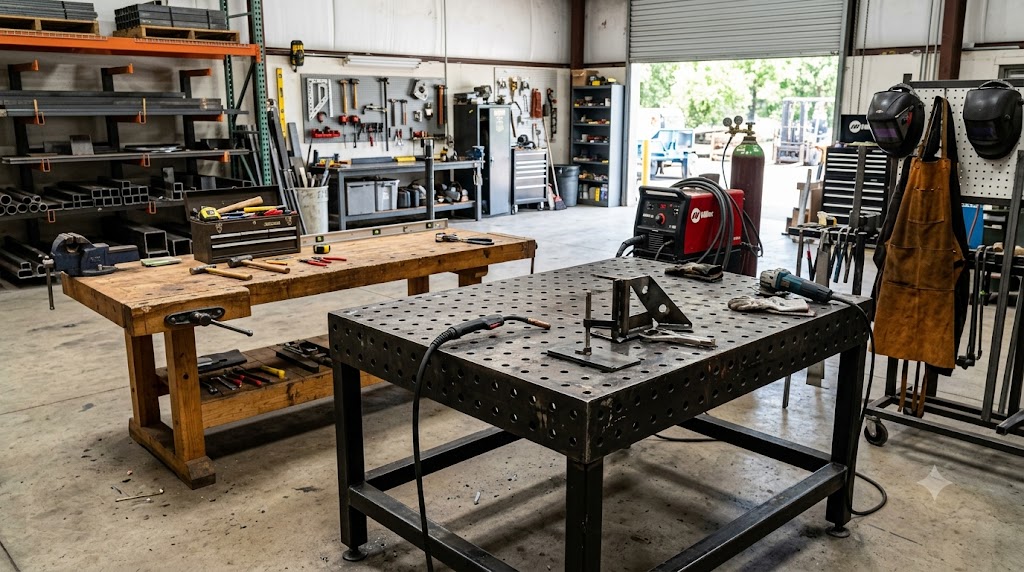
For precision fabrication, tube bending, and frame building where repeatability matters, a fixture table with a grid of standardized holes (14mm, 16mm, or 28mm are the common standards) lets you clamp and position workpieces using compatible fixtures, blocks, and pins. Fixture tables are significantly more expensive but save time when you need to produce multiple identical assemblies.
For a space-constrained shop or portable work, a folding or portable welding table gives you a steel work surface you can set up and put away. The tops are typically thinner than a fixed shop table, which limits heavy work, but for small weld repairs and light fabrication they are a practical space-saving solution.
Welding Table Types Compared
| Type | Top Thickness | Fixture Holes | Portability | Best For | Downside |
|---|---|---|---|---|---|
| Flat steel shop table | 3/8 to 1/2 inch | None | Fixed | General fabrication, home shop | No precision fixturing |
| Fixture table with grid holes | 1/2 to 1 inch+ | Yes, standardized | Fixed | Precision work, jig building | Expensive, requires compatible fixtures |
| Portable folding table | 1/8 to 3/16 inch | None | High | Small work, space constrained | Not for heavy loads or sustained heat |
| DIY angle iron table | Variable | Optional | Fixed | Budget builders | Requires welding to build |
Key Buying Factors
Top thickness. This is the single most important spec for a welding table. Thin tops warp from heat over time and bow under heavy clamping loads. For a fixed shop table, 3/8-inch minimum and 1/2-inch preferred. Fixture tables typically use 1/2-inch to 1-inch tops to maintain flatness under production use.
Overall dimensions. A table that is too small forces you to hang work over the edge, which is unstable and dangerous under clamping. A table that is too large for your space blocks movement. A 30x20 inch table handles most home shop work. Larger 4x4 or 4x8 foot tables suit production fabrication.
Load capacity. Steel structural components are heavy. A 6-foot section of 2x2 inch square tubing at 3/16 wall is around 20 pounds. Multiple pieces on a table for a frame assembly can easily reach 200 to 400 pounds. The table frame must handle that load without flexing.
Leg levelers. Concrete shop floors are rarely perfectly flat. Adjustable leg levelers let you level the table so your work surface is flat regardless of floor irregularity. This matters for squareness when fitting frame sections.
Grounding lug. A dedicated ground connection point on the table frame lets you connect your ground cable cleanly to the table when using the table as your grounding path. Tables without a ground lug require you to clamp directly to the work surface or the table leg, which works but is less convenient.
Fixture hole standards. If you plan to use a fixture table, make sure the hole pattern matches the fixtures you plan to buy. The 28mm European standard is common on professional fixture tables. The 16mm and 14mm standards are common on consumer and mid-range options. These are not interchangeable without adapters.
Grounding Your Welding Table
A welding table used as the grounding path for your MIG or stick welder must have a clean conductive connection from the work surface to the ground cable. Remove paint and rust from the area where the ground clamp contacts the table surface. Scale or paint on the contact area creates arc quality issues that look like a welder problem but are actually a ground problem. For a dedicated production table, grind a clean bare steel patch at the ground connection point and touch it up periodically.
The Bottom Line
Start with a flat 3/8-inch steel top table of appropriate dimensions for your shop and work scale. Add leg levelers and a ground lug if the base table does not include them. Only move to a fixture table when your work requires the precision that fixture holes and compatible tooling provide. Keep the top clean, keep the ground connection bare steel, and a good welding table will outlast most other tools in your shop by decades.
Frequently Asked Questions
What thickness should a welding table top be? For a fixed shop table, 3/8-inch is the practical minimum. Half-inch is preferred for heavy production use. Thinner tops warp from sustained heat and bend under heavy clamping loads.
Does a welding table need fixture holes? Not for general fabrication. Fixture holes are for precision jig work where repeatability across multiple assemblies justifies the investment in a fixture table and compatible tooling.
How do I ground a welding table? Connect your ground cable clamp to the table frame or a dedicated ground lug on the table. Make sure the contact point is bare steel with no paint, rust, or scale between the clamp and the metal.
Can I use wood in a welding table build? No. Wood ignites from welding spatter and cannot serve as a conductive grounding path. All surfaces of a welding table that will be in contact with hot metal or used as a work surface must be steel.
What are fixture holes in a welding table? Fixture holes are a standardized grid of holes in the table top that accept compatible fixtures, clamps, blocks, and pins for positioning workpieces precisely. Common standards are 28mm, 16mm, and 14mm hole diameters.
How heavy can a welding table hold? This varies by table construction. Check the manufacturer’s stated load capacity. A good fixed-leg steel table should handle at least 300 to 500 pounds on the work surface without flexing.
Should a welding table have a shelf underneath? A lower shelf is useful for storing angle grinders, wire brushes, clamps, and tools near the work surface. It is not structurally necessary but adds practical storage in a tight shop.
References
https://www.osha.gov/laws-regs/regulations/standardnumber/1910/1910.252 https://www.aws.org https://www.stronghandtools.com
SEO Title: Welding Table and Workbench Buying Guide