Welding Table Buying Guide
A welding table is one of the highest-value shop investments for anyone who welds regularly. A flat, grounded steel surface eliminates the need for constant fixture setup, enables precise angle work, and serves as a permanent ground clamp connection point. Here’s how to choose the right welding table.
Fixture Table vs. Flat Plate Table
Flat plate steel welding table: A simple steel surface with no holes. Provides a flat, grounded work surface. Inexpensive. The surface can be used as the welding ground by clamping the ground cable directly to the table.
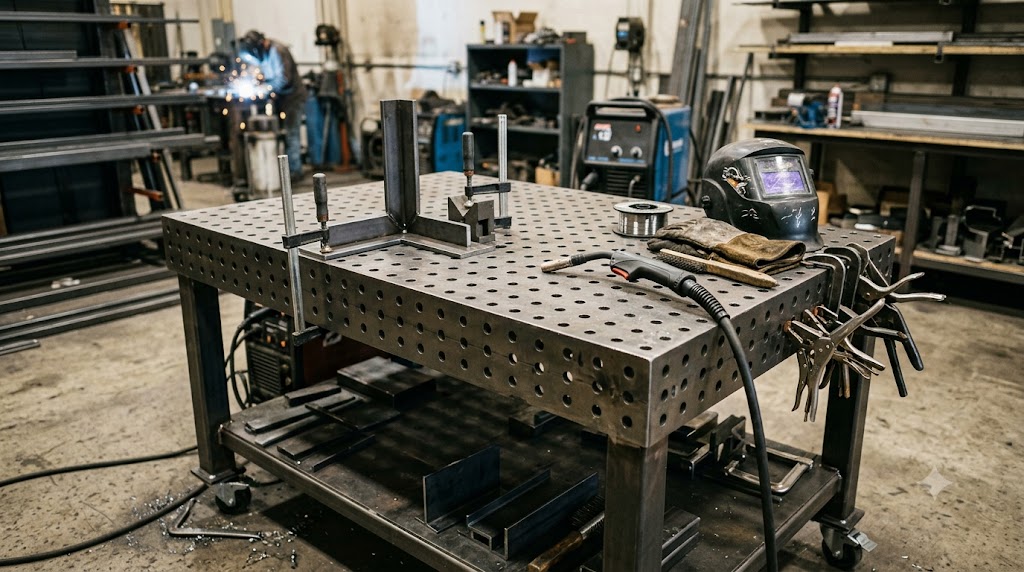
Fixture table (“hobby table” or “3D fixture table”): Has a grid of precision holes (typically 5/8” or 16mm spaced 2” or 50mm apart). Used with compatible clamps, stops, and fixtures to hold parts at precise angles and positions for repeatable production welding.
Which to buy:
- Occasional welding / fab work: Flat plate table (simpler, lower cost)
- Production welding / jig welding: Fixture table with compatible clamp system
- Professional fabrication: Fixture table (Siegmund, Certiflat, Strong Hand Tools, or BuildPro)
Recommended Welding Tables
Eastwood Welding Table
- Steel top work surface
- Folding frame for storage
- Integrated storage shelf
- Portable and lightweight
- Best for: Hobbyists and light fabrication; not a precision fixture table
Strong Hand Tools BuildPro Fixture Table
- 28” x 28” tabletop with 5/8” precision holes on 2” centers
- Compatible with Strong Hand Tools modular clamping system
- Available through welding supply retailers (~$400–800 depending on size)
- Best for: Production welding, jig fixtures, precise angle work
Certiflat Welding Table
- Modular design; ships flat and welds together as a build project
- 5/8” hole grid, 2” spacing
- ~$300–500 depending on size
- Available at CertiFlat.com and Amazon
- Best for: Welders who want a fixture table and enjoy a build project
DIY Steel Plate Table
- 3/8” or 1/2” hot rolled steel plate on a welded angle iron frame
- Material cost: ~$100–200 depending on size and steel prices
- No hole grid (flat surface only)
- Best for: Welders who can build their own and want maximum simplicity
What Thickness Steel Should a Welding Table Top Be?
| Thickness | Use Case |
|---|---|
| 3/16” | Light fabrication; warps under heavy localized heat |
| 1/4” | Good for general hobby/shop use |
| 3/8” | Preferred for professional shop use; excellent flatness retention |
| 1/2”+ | Heavy industrial use; fixture tables |
3/8” is the sweet spot for a shop-built welding table. Heavy enough to resist thermal warping from welding heat, light enough to move with help.
Grounding Through the Welding Table
One of the primary advantages of a steel welding table:
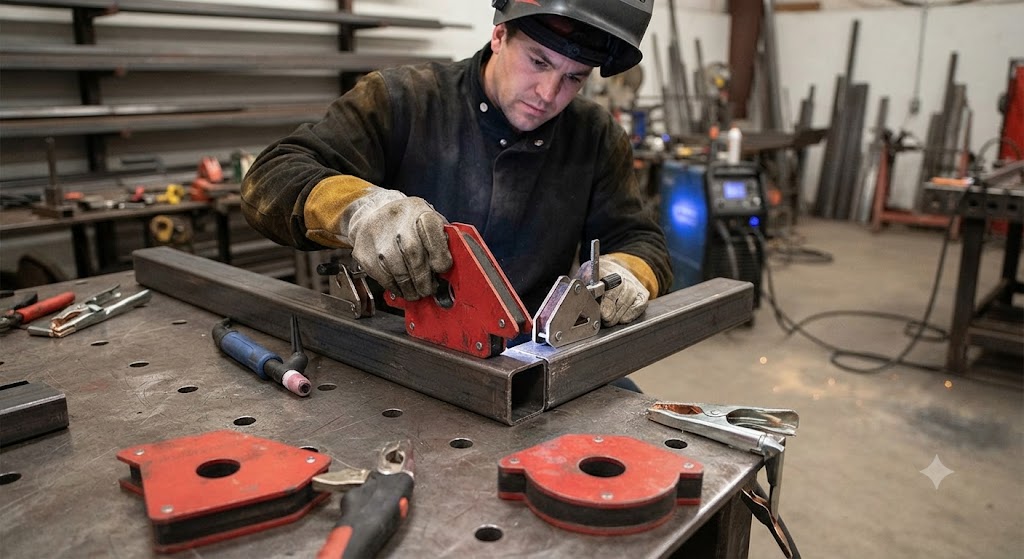
- Attach the ground (work) clamp directly to the table frame or surface
- Any steel workpiece placed on the table is automatically grounded
- Eliminates the need to reposition the ground clamp for each part
- Table must be steel - aluminum tables don’t work for this application with steel workpieces
Ground clamp placement: Clamp to the table frame near a leg, away from the primary work area. This prevents the ground cable from being a trip hazard across the work surface.
Welding Table Surface Flatness
For production and fixture work, surface flatness is critical. Factors affecting flatness:
- Material thickness: Thicker plate stays flatter under heat
- Stress relieving: Normalize the plate before use (heat and allow to cool slowly) or purchase pre-flattened plate
- Welding heat accumulation: Always allow the table to cool between long welding sessions to prevent cumulative thermal distortion
For hobbyist use: flatness to within 1/16” across the table surface is adequate. For precision fixture work: flatness to 0.005” across the surface is the standard for quality fixture tables.
FAQs
What is the difference between a fixture table and a flat welding table? A fixture table has precision holes in a grid pattern for use with compatible clamps and fixtures, enabling repeatable angle and position work. A flat table is a simple steel surface.
What thickness steel should a welding table top be? 3/8” is the recommended thickness for a shop-built welding table. Thinner plate warps; 3/8” provides good flatness retention under typical welding heat.
Can I use a welding table as a ground? Yes - attaching the ground clamp to a steel welding table grounds any steel workpiece placed on the surface, eliminating the need to reposition the clamp between parts.