Welding Table Top and T-Slot Fixturing Guide
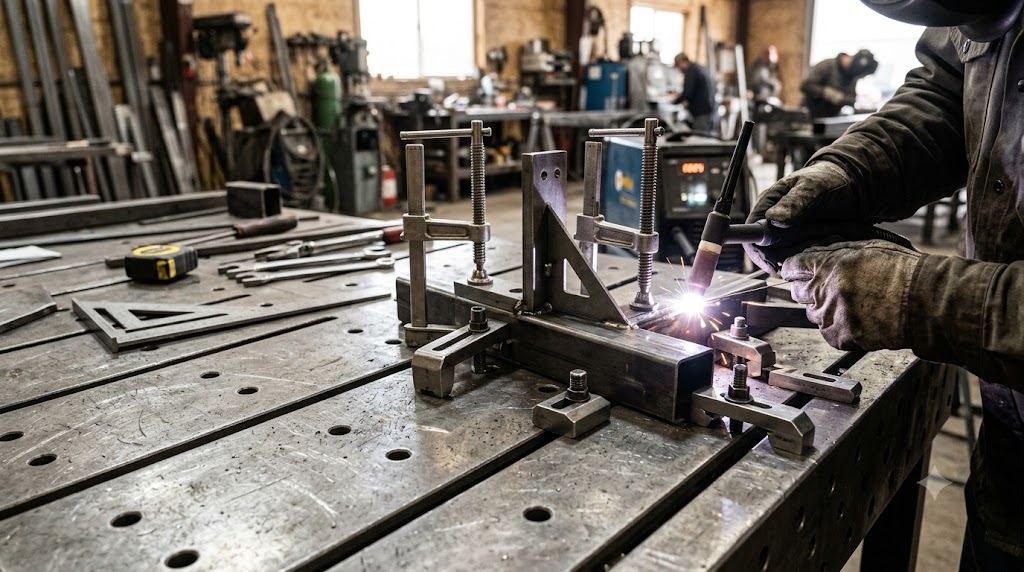
The moment you try to weld two parts together at a perfect right angle, you understand why fixturing exists. Holding metal square by hand while you tack is a recipe for parts that drift, warp, and end up close but not right. A fixturing tabletop, whether it uses a grid of holes or a set of T-slots, turns your table into an active tool that holds work exactly where you want it. But the choices (5/8 inch or 16mm or 28mm holes, hole grid or T-slot) can be confusing, so here is a clear guide to how tabletop fixturing works and which system fits your work.
Welding table fixturing means using a tabletop with holes or T-slots plus matching clamps and stops to hold, locate, and square workpieces precisely. The main systems are hole grids (5/8 inch, 16mm, 28mm) and T-slots, and choosing well depends on your work. Here is how they compare.
Why fixturing tabletops matter
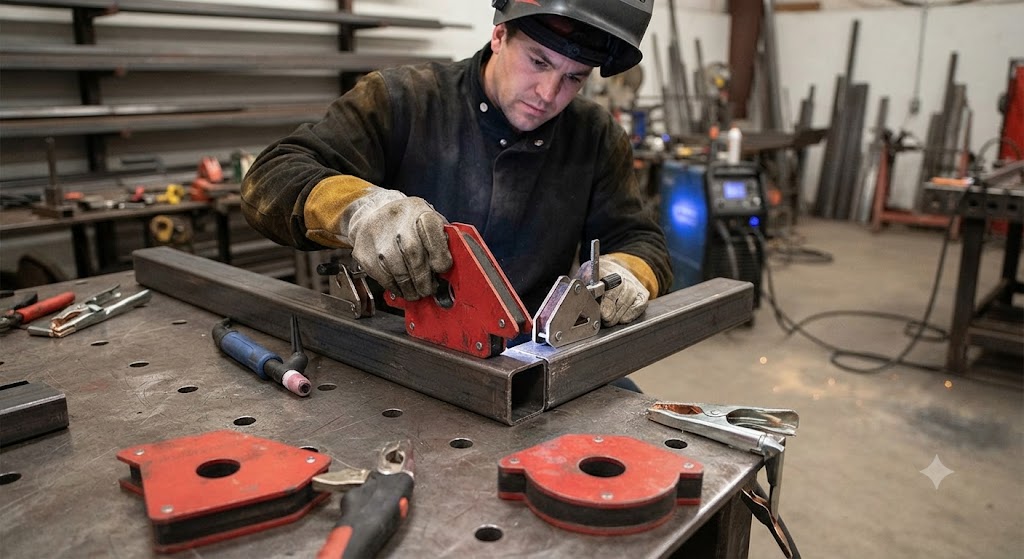
A plain steel table lets you clamp only at the edges, which limits where you can hold a part and how well you can keep an assembly square. A fixturing tabletop changes that: with holes or slots across the whole surface, you can drop in clamps, stops, and squares anywhere, so you can hold parts flat, locate them precisely, keep assemblies square as you tack, and reproduce the same setup for the next identical piece. For repeat work, weldments that must come out square, and any job where accuracy matters, that ability transforms the table from a passive surface into an active fixturing tool. It is the single biggest upgrade in work holding you can make.
Hole grid systems: 5/8 inch, 16mm, 28mm, 3/4 inch
Most fixture tables use a regular grid of round holes, and the diameter defines the system:
- 5/8 inch is the common imperial standard (BuildPro and many US tables), with wide tooling availability.
- 16mm is the metric standard (Certiflat and European-style tables). At 0.6299 inch it is only about 0.005 inch larger than 5/8 inch, so 16mm and 5/8 inch tooling generally interchange.
- 28mm is the heavy industrial standard (Siegmund-style and BuildPro Alpha 28), built for large, demanding fixturing with beefy tooling.
- 3/4 inch is Fireball Tool’s system, larger than 5/8 inch for stronger bolts and clamps while keeping a practical grid.
Holes usually sit on a 2 inch (imperial) or 50mm (metric) grid. The takeaway: 5/8 inch and 16mm cover most home and professional needs and share tooling, while 28mm and 3/4 inch target heavier or specialized fixturing.
Hole grid versus T-slot
The other big choice is holes versus T-slots, and they suit different workflows:
- A hole grid lets you place a clamp, stop, or square at any hole across the table, so you can build a fixture anywhere and reproduce it exactly. It is the most flexible system for squaring, locating, and repeatable setups, which is why modular fixture tables use it.
- T-slots are long grooves that accept clamps and stops which slide along the slot. They shine when you reposition clamps often or hold large, variable parts, since you can slide a clamp anywhere along the slot rather than jumping hole to hole. Some tables combine both, with slots between hole plates.
Neither is strictly better. Hole grids favor precise, repeatable fixturing; T-slots favor fast, sliding clamp positioning for large or frequently changing work. Match the system to how you actually clamp.
Can you add fixture holes to an existing table?
Yes, with realistic expectations. If you have a solid steel table and want fixturing, you can retrofit holes using a mag drill with an annular cutter (a rotabroach), which cuts clean, accurate holes in thick plate. The key is care: lay out the grid precisely (a 2 inch grid is standard), keep the holes square to the surface, and deburr the top and bottom so tooling seats properly. It will not match the precision of a purpose-machined fixture plate, but for a home shop it is a legitimate way to turn a plain table into a working fixture surface. If precision is critical, buying a machined fixture-hole table is the surer path.
Which fixturing tables to buy
Here are two accessible hole-grid tables to start fixturing.
- VEVOR welding table (36 by 18 inch, 5/8 inch fixture holes, on wheels) gives you a 5/8 inch hole grid, tool slots, and mobility in an accessible home-shop package, an easy entry into fixturing. Its limitation is a thinner top than a professional plate, better for lighter loads.
- BuildPro (Strong Hand Tools) modular welding table, 5/8 inch holes on a 2 inch grid is the professional step up, with precision-ground reversible plates and a deep 5/8 inch tooling ecosystem for accurate, repeatable fixturing. The trade-off is that it is a professional-grade table, more than a casual user needs.
How to choose: for an accessible entry into hole-grid fixturing, the VEVOR. For a professional, precise, repeatable system, the BuildPro. Both use the widely supported 5/8 inch standard.
Who should skip a fixture-hole table: welders who only do occasional tacking and never build square assemblies, who can get by clamping to a plain table.
The bottom line
A fixturing tabletop, with holes or T-slots and matching tooling, is the biggest upgrade you can make to your work holding, turning a passive surface into a tool that holds parts flat, square, and repeatable. For systems, 5/8 inch and 16mm cover most home and professional work and share tooling, while 28mm and 3/4 inch target heavier fixturing; hole grids favor precise repeatable setups, and T-slots favor fast sliding clamp positioning. You can retrofit holes into a solid table with a mag drill and care, or start with a 5/8 inch table like the VEVOR or step up to a BuildPro. Match the system to how you clamp, and your parts will come out square.
FAQ
What is the difference between 5/8 inch and 16mm fixture holes? Very little in practice. 16mm equals 0.6299 inch, only about 0.005 inch larger than 5/8 inch, so tooling made for either size generally works in both. 5/8 inch is the imperial standard (US tables) and 16mm is the metric standard (European and Certiflat tables).
What is a T-slot table used for? A T-slot table has long grooves that accept clamps and stops which slide along the slot, so you can reposition clamps anywhere along the length. It suits work where you reposition clamps often or hold large, variable parts, versus a hole grid’s fixed positions.
Which is better, a hole grid or T-slots? Neither is strictly better. A hole grid favors precise, repeatable fixturing since you place tooling at defined holes anywhere on the table. T-slots favor fast, sliding clamp positioning for large or frequently changing work. Some tables combine both. Match it to how you clamp.
Can I add fixture holes to my existing welding table? Yes, using a mag drill with an annular cutter (rotabroach) to cut a hole grid into thick steel plate. Lay out the grid precisely, keep holes square to the surface, and deburr both sides. It will not match a machined table’s precision but works well for a home shop.
What hole size should I choose for a fixture table? For most home and professional work, 5/8 inch or 16mm, since both have wide tooling availability and largely interchange. Choose 28mm only for heavy industrial fixturing, or 3/4 inch (Fireball) for its larger, stronger tooling within a practical grid.
What is a fixture-hole grid spacing? Most hole-grid tables use a 2 inch grid (imperial) or a 50mm grid (metric), meaning the holes are evenly spaced 2 inches or 50mm apart in both directions. The consistent spacing lets tooling locate anywhere on the table for square, repeatable setups.
References
- Strong Hand Tools BuildPro fixturing system documentation, detailing 5/8 inch, 16mm, and 28mm hole systems on 2 inch and 50mm grids (manufacturer), stronghandtools.com.
- Certiflat and Fireball Tool fixturing information on 16mm and 3/4 inch hole systems and tooling compatibility (manufacturers), weldtables.com, fireballtool.com.
- The Fabricator guidance on welding fixtures, tabletop fixturing, and work holding (industry publication), thefabricator.com.