YESWELDER Welding Blanket Review: Budget Fiberglass That Earns Its Place
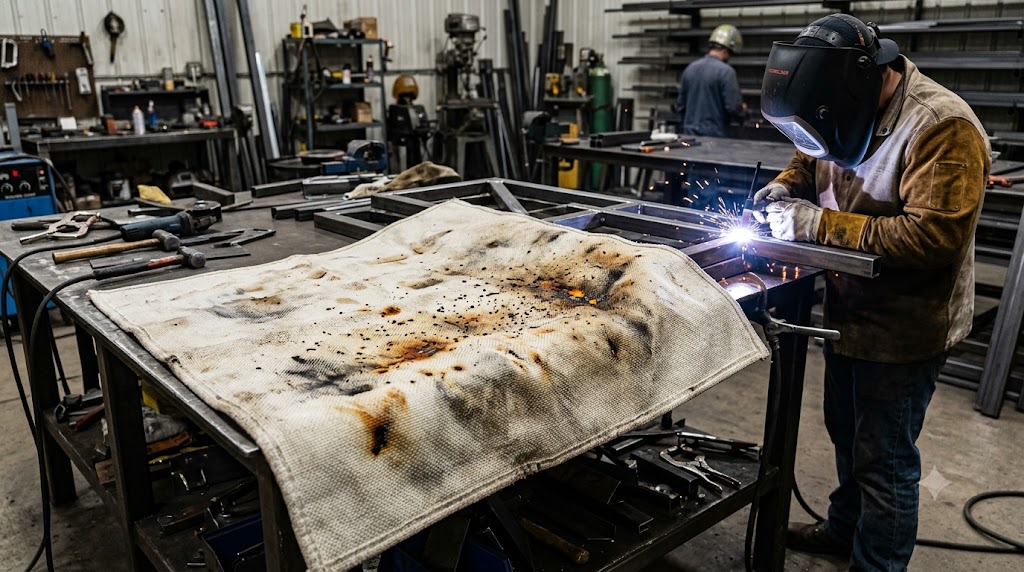
You pull a YESWELDER blanket out of the box and the first thing you notice is the weight. It feels denser than you expected for the price. The weave is tight, the grommets are solid brass, and the edges are double-stitched. For a moment you wonder if the spec sheet lied to you in a good direction. It didn’t. What you’re holding is a 24.7 oz/yd² fiberglass blanket rated to 1022°F (550°C), and it does exactly what that number says. The question is whether that’s enough for your shop.
Fiberglass welding blankets exist because sparks and spatter don’t take breaks. Drape one over a vehicle panel, a cable bundle, or a finished floor and you’ve created a barrier between a 2,700°F arc and everything you don’t want to resurface. The YESWELDER version is built from woven fiberglass yarn, coated to hold the fibers together under heat, with brass grommets punched every 11 inches along the perimeter so you can hang it vertically as a curtain, drape it flat as a floor mat, or clip it across equipment.
The short answer: for garage welders, hobbyists, and light-production shops doing MIG, TIG, or stick work, the YESWELDER welding blanket is a legitimate choice. It handles slag deflection and spark blocking at 1022°F, it won’t fall apart after a season of use, and it comes in two sizes at a price that lets you buy multiples without regret. Where it gives ground is against Tillman’s heavier vermiculite-coated models in high-slag, long-duration industrial runs. If you weld all day every day, you’ll want something thicker. If you weld a few hours a session in a home shop, this blanket will outlast you.
What You Actually Get: Specs That Matter
The YESWELDER blanket is available in 4x6 ft and 6x8 ft sizes. Both share the same material construction: 24.7 oz/yd² woven fiberglass, 8mm (roughly 1/3 inch) thick, with a stated working temperature ceiling of 1022°F (550°C). YESWELDER publishes this spec on the product listing and on yeswelder.com.
That 1022°F rating covers the vast majority of MIG, TIG, and stick welding applications. Where it falls short is sustained contact with molten slag or direct torch flame, which can push temperatures past 2000°F on the surface of the material being welded. For those scenarios, a carbon felt blanket or Tillman’s 596B with its vermiculite coating is the correct tool.
The grommets deserve a mention because they’re often the first thing to fail on cheaper blankets. YESWELDER uses brass grommets set every 11 inches. Brass won’t rust in a damp shop, and the spacing gives you enough hang points to pull the blanket taut without sagging in the middle.
The 8mm thickness is genuinely thicker than many entry-level fiberglass blankets, which tend to run 4 to 5mm. That extra material means more mass absorbing heat before it conducts through to whatever’s underneath.
YESWELDER vs. Tillman: The Honest Comparison
The Tillman 590 is the industry benchmark for medium-duty fiberglass blankets. It runs 24 oz gold acrylic-coated fiberglass with a 1000°F melt temperature, FM approved, and it’s been in welding shops for decades. The YESWELDER 4x6 comes in at similar weight per square yard (24.7 oz vs. 24 oz) and a slightly higher stated temperature ceiling.
So why does Tillman cost more? Two things. First, Tillman’s materials and tolerances have been audited at scale over years of commercial deployment. When a shop foreman orders Tillman, they know exactly what they’re getting batch after batch. YESWELDER is a newer brand without that track record in industrial environments. Second, Tillman’s 596B steps up to 25 oz vermiculite-impregnated fiberglass rated to 1200°F on flat surfaces and 1700°F vertical, which is a different class of protection the YESWELDER doesn’t approach.
For a home shop, the YESWELDER is the better value. For a production shop where blankets live on the floor ten hours a day, the Tillman’s proven longevity justifies the premium.
The One Flaw You Should Know
The fiberglass shedding is real. New YESWELDER blankets release fine glass fibers when you first handle them and whenever you fold or shake them. This is a property of uncoated and lightly coated fiberglass, not a defect specific to YESWELDER. Wear gloves when handling, don’t shake it out indoors, and the issue diminishes after the first few heat cycles as loose surface fibers burn off. But if you’re sensitive to skin irritation, this is the named flaw that matters. The Steiner 316 carbonized fiber blanket solves this completely because it uses soft carbon fiber instead of glass, though at a higher temperature rating and higher price.
Size Guide: 4x6 or 6x8?
The 4x6 ft version (Check on Amazon) covers a standard car door, a section of flooring under a bench grinder, or drapes across a fuel line you’re working near. It’s maneuverable enough to reposition quickly.
The 6x8 ft version (Check on Amazon) is what you want if you’re blanketing engine bays, larger equipment panels, or hanging a full curtain between work areas. The added coverage means fewer gaps for sparks to find.
For most garage welders, start with the 4x6. It’s easier to handle, easier to store, and covers the majority of situations. Get the 6x8 as a second blanket once you’ve mapped the spots in your shop that need more coverage.
Comparison Table
| Blanket | Material | Weight | Temp Rating | Thickness | FM Approved |
|---|---|---|---|---|---|
| YESWELDER 4x6 | Fiberglass | 24.7 oz/yd² | 1022°F | 8mm | No |
| YESWELDER 6x8 | Fiberglass | 24.7 oz/yd² | 1022°F | 8mm | No |
| Tillman 590 | Acrylic-coated Fiberglass | 24 oz/yd² | 1000°F | ~5mm | Yes |
| Tillman 596B | Vermiculite Fiberglass | 25 oz/yd² | 1200/1700°F | 1.5mm | Yes |
| Steiner 316 | Carbonized Fiber | 16 oz/yd² | 1800°F | 0.9mm | No |
Who Should Buy This and Who Should Skip It
Buy the YESWELDER if you’re setting up a home shop, doing occasional automotive work, or want inexpensive coverage to protect floors and equipment from light-to-medium spark fallout. It’s also a good secondary blanket to keep at a job site where blankets get dirty and beaten up.
Skip it if you weld in a production environment with sustained spatter loads, if your shop requires FM-approved materials, or if fiberglass shedding is a dealbreaker for you. The Tillman 596B handles the first two scenarios; the Steiner 316 handles the third.
FAQ
Is the YESWELDER welding blanket good quality? Yes, for its tier. The 24.7 oz/yd² fiberglass construction and 8mm thickness deliver solid protection against sparks, spatter, and slag at working temperatures up to 1022°F. It’s not a commercial-grade blanket, but it outperforms many blankets in its price bracket.
What size options are available? YESWELDER offers this blanket in 4x6 ft and 6x8 ft. The 4x6 suits most garage and single-panel automotive work; the 6x8 works better for larger coverage areas or hanging as a vertical curtain.
How does the YESWELDER compare to Tillman? On paper weight per square yard, they’re close: 24.7 oz vs. 24 oz. Tillman’s advantage is decades of proven performance in commercial shops and an FM certification. Tillman’s 596B model also offers significantly higher temperature ratings with vermiculite treatment. For home shop use, the YESWELDER holds its own; for demanding professional environments, Tillman earns its premium.
Is YESWELDER a reputable brand? YESWELDER has built a following in the hobbyist and entry-level professional welding segment. Their helmets, blankets, and accessories are sold through Amazon with thousands of verified reviews. They are not the brand a pipe welder reaches for on a major infrastructure project, but they’re a reliable choice for the intended audience.
Can the YESWELDER blanket be used as a fire emergency blanket? No. Welding blankets are designed for continuous spark and spatter exposure, not for smothering fires or wrapping people in emergency situations. Use a rated fire suppression blanket for emergency fire response.
Does the YESWELDER blanket work for TIG welding? Yes. TIG welding produces less spatter than MIG or stick, so the YESWELDER’s 1022°F rating provides ample protection for TIG work on most materials. Place it under the workpiece to protect tables and floors from any heat bleed-through.
How do I clean a YESWELDER welding blanket? Shake it out outdoors (wear gloves). For oil or grease contamination, a damp cloth wipe works for surface grime. Do not machine-wash fiberglass blankets as agitation accelerates fiber breakdown.
References
- YESWELDER product listing,: Check on Amazon
- YESWELDER product listing,: Check on Amazon
- YESWELDER official site: https://yeswelder.com
- Tillman product page, Model 590: https://jtillman.com/product/welding-blanket-roll-tillman-590/
- Tillman product page, Model 596B: https://jtillman.com/products/blankets/
- OSHA Fire Prevention (29 CFR 1926.152): https://www.osha.gov/laws-regs/regulations/standardnumber/1926/1926.152
- American Welding Society, Welding Safety: https://aws.org/publications/safety