Brazing Rod vs Welding Rod: What's the Difference?
They look similar enough sitting in a tube on the shelf: thin metal sticks you feed into a joint with heat. But a brazing rod and a welding rod work on completely different principles, and using one where the other belongs gets you a weak joint, a warped part, or a failure. The core difference comes down to one question: does the base metal melt or not? Everything else follows from the answer.
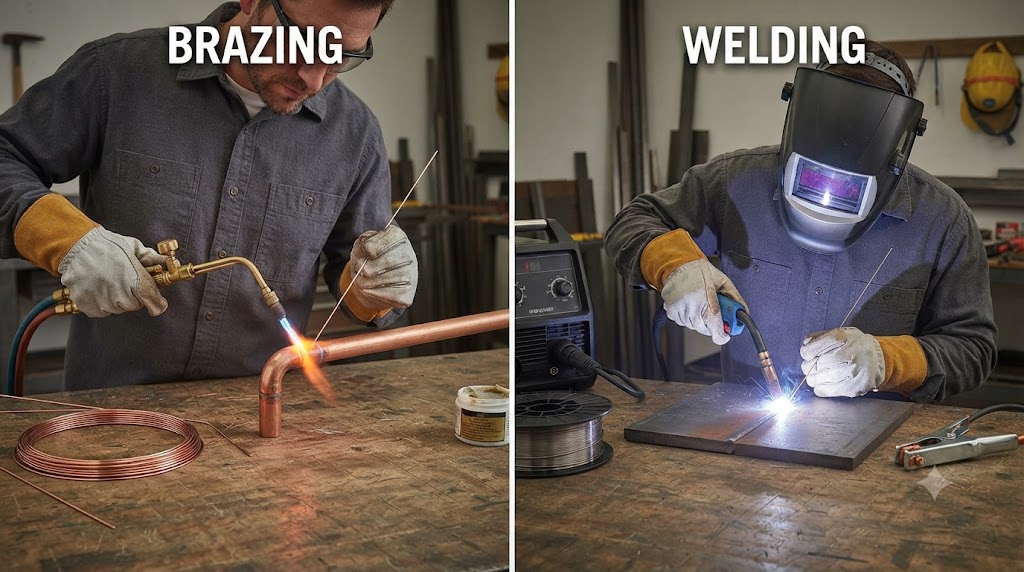
A welding rod melts and fuses into the base metal, which also melts, creating one continuous piece. A brazing rod melts at a lower temperature and flows into the joint by capillary action without melting the base metal, bonding to its surface instead. Welding is generally stronger; brazing runs cooler and joins dissimilar or thin metals. Here is how to tell them apart and choose.
The core difference: does the base metal melt?
Strip away the jargon and it comes down to this. In welding, intense heat melts the base metals and (usually) a filler rod together into a single molten pool that solidifies as one continuous piece of metal. The joint is essentially the same material as the parts.
In brazing, the base metal never melts. A filler rod with a lower melting point flows into the joint and bonds to the surfaces of the parts, held there by a metallurgical bond and drawn in by capillary action. The parts stay solid; only the filler melts. Brazing happens above 840 degrees Fahrenheit but below the base metal’s melting point (below 840 degrees it is soldering).
That single distinction drives every practical difference that follows.
Direct answer: which should you use?
Choose based on the job:
- Maximum strength on similar metals (structural steel, heavy fabrication): welding, because the fused joint is as strong as the base metal.
- Joining dissimilar metals (steel to copper, steel to brass): brazing, since it bonds without needing both metals to melt.
- Thin materials, tubing, or heat-sensitive parts: brazing, because the lower heat means less warping and burn-through.
- Cast iron repair: often brazing, which runs cooler and reduces the cracking that plagues fusion-welded cast iron.
- General repairs where appearance and low distortion matter: brazing, which leaves a cleaner, filable joint.
A quick rule: weld when you need maximum strength on the same metal, braze when you need lower heat, dissimilar metals, or thin materials.
How the two compare
The practical trade-offs line up predictably from the melt-or-not difference:
| Factor | Welding | Brazing |
|---|---|---|
| Base metal | Melts and fuses | Does not melt |
| Heat | Higher | Lower |
| Strength | Generally stronger | Strong, usually less than a weld |
| Dissimilar metals | Difficult | Good |
| Thin material | Risk of burn-through | Well suited |
| Distortion | More | Less |
| Skill and equipment | Often more involved | Often simpler (torch) |
Neither is better overall; they solve different problems. A structural steel frame wants welding, while a copper-to-brass fitting or a thin sheet repair wants brazing.
Strength: the honest comparison
Strength is where people oversimplify. A properly welded joint in matching metal is generally the stronger option, because the joint is fused base metal. But a well-made brazed joint is genuinely strong, often stronger than the filler metal alone thanks to the way a thin, well-fitted brazed joint behaves, and more than adequate for many real loads. The point is not that brazing is weak, it is that welding usually wins on ultimate strength for similar metals, while brazing wins on versatility, lower heat, and joining things welding struggles with. Match the method to what the joint actually needs.
Which rods to buy
Here is one of each so you can cover both processes.
- Harris Stay-Silv 15 phos-copper-silver brazing rod is a versatile brazing rod for copper and copper-to-brass joints, flowing into the joint by capillary action and self-fluxing on copper. Its limitation is that, as a phos-copper rod, it is not for steel or iron.
- SÜA low-fuming bronze flux-coated brazing rod is a general-purpose torch brazing rod for steel, cast iron, and copper, with flux built in for convenience. The trade-off is that it needs enough torch heat to flow properly.
- Forney E6013 welding rod (1/8 inch) is an easy-running stick welding electrode for mild steel, fusing into the base metal for a strong structural joint. Its limitation is that, being a fusion process, it puts more heat into the work and can warp thin material.
How to choose: for strong structural joints on steel, use a welding rod and fuse the metal. For dissimilar metals, thin materials, tubing, or cast iron repair, use a brazing rod and keep the base metal solid. Many shops keep both, because they solve different problems.
The bottom line
The difference between a brazing rod and a welding rod comes down to one thing: a welding rod melts the base metal and fuses into it, while a brazing rod flows into the joint by capillary action without melting the base metal. Welding usually wins on ultimate strength for similar metals, while brazing wins on lower heat, joining dissimilar or thin materials, and cast iron repair. Neither replaces the other. Decide by asking whether you need maximum fused strength or lower-heat versatility, and pick the rod to match.
FAQ
What is the difference between a brazing rod and a welding rod? A welding rod melts and fuses into the base metal, which also melts, making one continuous piece. A brazing rod melts at a lower temperature and flows into the joint by capillary action without melting the base metal, bonding to its surface instead.
Is brazing as strong as welding? A properly welded joint in matching metal is generally stronger, since it is fused base metal. But a well-made brazed joint is genuinely strong and more than adequate for many jobs. Welding wins on ultimate strength, brazing wins on versatility and lower heat.
When should you braze instead of weld? Braze when joining dissimilar metals, working with thin materials or tubing, repairing cast iron, or when low distortion and lower heat matter. Weld when you need maximum strength on similar metals, such as structural steel.
Can you use a welding rod for brazing? No. Welding rods are designed to fuse with melting base metal at high heat, while brazing rods are lower-melting fillers that flow into a joint without melting the base. They are different processes and the rods are not interchangeable.
Does brazing melt the base metal? No. In brazing the base metal stays solid, and only the filler rod melts and flows into the joint by capillary action. This is the key difference from welding, where the base metal melts and fuses.
What temperature separates brazing from soldering and welding? Brazing occurs above 840 degrees Fahrenheit but below the base metal’s melting point. Below 840 degrees it is soldering, and once the base metal melts and fuses it becomes welding.
References
- American Welding Society definitions and fundamentals of welding, brazing, and soldering, aws.org.
- Harris Products Group brazing versus welding process guidance (manufacturer), harrisproductsgroup.com.
- Lincoln Electric and Miller Electric process comparison resources on welding and brazing (manufacturers), lincolnelectric.com, millerwelds.com.