Welding Respirator vs Standard Dust Mask: Which One Actually Protects Your Lungs?
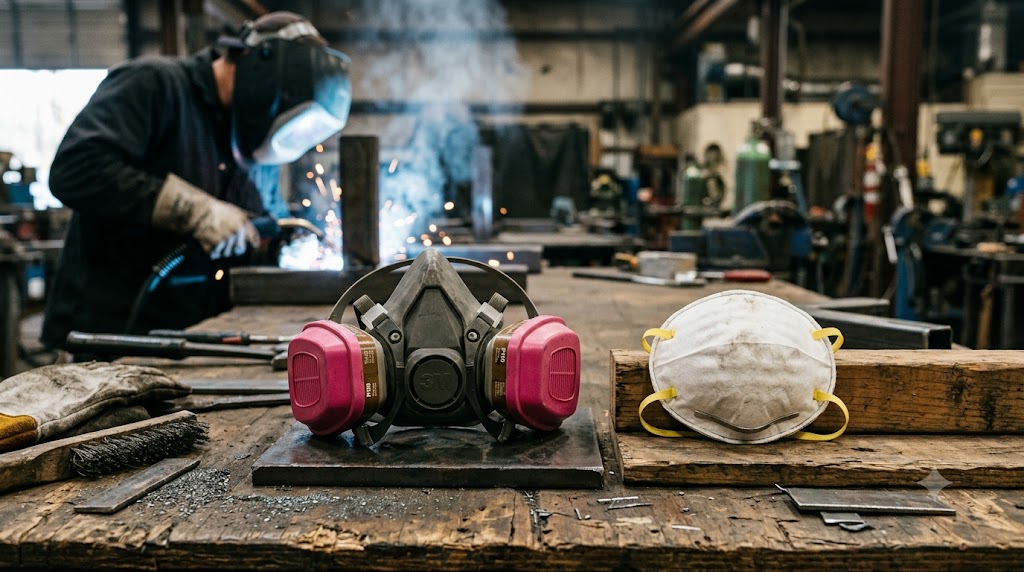
There is a comfortable lie a lot of welders tell themselves, and it goes like this: the paper dust mask from the hardware store is good enough for a little garage welding. The welding respirator vs standard dust mask question deserves a real answer, because the fumes coming off your arc are not sawdust. They are ultrafine metal oxides, and the mask you reach for decides whether your lungs filter them out or bank them for later. Let us settle it.
What You Are Breathing When You Weld
Weld fume is not one thing. Mild steel throws off mostly iron oxide, but mixed into that plume are additive metals: manganese, chromium, nickel, and more. When you burn stainless or anything with a coating, hexavalent chromium enters the picture, and manganese overexposure is linked to a Parkinson-like condition called manganism. The International Agency for Research on Cancer classifies welding fume as a known human carcinogen.[^https://www.cdc.gov/niosh/npg/npgd0666.html] This is the part the paper mask crowd skips.
The critical fact: welding fume particles are ultrafine, well below the 0.3 micron size that filter ratings are measured against. That single detail is what separates a respirator from a dust mask.
The Standard Dust Mask: What It Can and Cannot Do
A basic dust mask, or even an N95, is rated to capture 95 percent of particles at 0.3 microns, and the N grade means it is not resistant to oil based aerosols. For sweeping a floor or cutting drywall, that is fine. For welding, an N95 is the absolute floor, acceptable only for simple, brief mild steel work in a well ventilated space. It is a disposable stopgap, not a plan.[^https://pmc.ncbi.nlm.nih.gov/articles/PMC4529391/]
The honest weakness of any dust mask is the seal and the rating. Paper masks leak around the nose and cheeks, they sag when damp with sweat under a hood, and none of them touch the toxic metal load from stainless or galvanized work.
The Welding Respirator: What Changes
Step up to a reusable half mask respirator with P100 filters and two things improve at once. P100 filters capture 99.97 percent of particles at 0.3 microns and are strongly resistant to oil based aerosols, which is exactly the profile weld fume demands. Just as important, an elastomeric half mask seals to your face far better than folded paper, so you actually breathe filtered air instead of leaked room air.[^https://www.osha.gov/laws-regs/regulations/standardnumber/1910/1910.134]
A reusable P100 half mask like the 3M 6000 series assembly is the standard many welders settle on: it seats under most welding helmets, the filters swap out when they load up, and the mask body lasts for years. Check 3M 6000 Series on Amazon
The one thing to understand: P100 filters stop particulate only. They do nothing against gases and organic vapors. If you weld on coated, painted, or degreased metal that off-gases, you need a combination cartridge or supplied air, not a plain P100.
Head to Head
- Filtration: N95 dust mask captures 95 percent and fails against oil; P100 respirator captures 99.97 percent and resists oil. For toxic metals like chromium and manganese, P100 is the right tool.
- Seal: Paper masks leak and sag; an elastomeric half mask forms a repeatable, fit-testable seal.
- Cost over time: A dust mask is cheap and disposable; a respirator body is reusable for years and you only replace filters. Across a season the respirator is the better value as well as the safer choice.
- Comfort under a hood: Low profile half masks are built to clear a welding helmet; a bulky mask or a soggy paper one is miserable under a lens.
Who should skip the respirator upgrade: almost no one who welds regularly. The only defensible dust mask scenario is rare, brief, mild steel tacking in open air. Everyone running stainless, galvanized, coated metal, or long sessions in a shop needs the half mask, full stop.
The Bottom Line
The welding respirator vs standard dust mask debate is not really close once you accept what weld fume is made of. A dust mask manages nuisance particles; a P100 half mask manages the toxic metal load that welding actually produces, and it seals well enough to matter. Buy the respirator, fit it properly, and swap the filters on schedule. The quiet payoff is one you will never see: the lung capacity you still have in twenty years because you stopped treating a carcinogen like sawdust.
Frequently Asked Questions
Is an N95 dust mask ever acceptable for welding? Only for brief, simple mild steel welding in a well ventilated area. It is the bare minimum and not suitable for stainless, galvanized, coated metals, or long sessions.
What does the P100 rating mean? P100 filters capture at least 99.97 percent of airborne particles at 0.3 microns and are strongly resistant to oil based aerosols, which matches the demands of weld fume.
Do P100 filters protect against welding gases? No. P100 filters handle particulate only. For gases and organic vapors from coatings or solvents you need a combination cartridge or a supplied air respirator.
Why is welding fume so dangerous if it is mostly iron? Alongside iron oxide, the plume carries manganese, hexavalent chromium, and other metals. Welding fume is classified as a known carcinogen, and manganese exposure is linked to neurological harm.
Will a half mask respirator fit under my welding helmet? Low profile half masks are designed to seat under most welding helmets. Choose a compact model and check clearance with your specific hood.
How often do I replace respirator filters? Replace P100 filters when breathing resistance rises, when they get wet or damaged, or per your workplace schedule. A loaded filter makes breathing harder and signals it is time.
Do I need a fit test? For tight fitting respirators, a proper fit test confirms the seal. Even outside a formal program, a daily user seal check every time you put the mask on is essential.
References
- CDC NIOSH Pocket Guide, Welding fumes: https://www.cdc.gov/niosh/npg/npgd0666.html
- OSHA 29 CFR 1910.134 Respiratory Protection standard: https://www.osha.gov/laws-regs/regulations/standardnumber/1910/1910.134
- Comparison of protection factors, N95 vs P100 respirators (NIH): https://pmc.ncbi.nlm.nih.gov/articles/PMC4529391/